The Canadian economy navigated a familiar yet challenging landscape as consumer price pressures stabilized during the late summer months. According to fundamental economic analysis and preliminary financial reporting released on Monday, September 14, 2026, Canada’s annual inflation rate held steady at 3% in August. This crucial economic milestone provides monetary policymakers, financial institutions, and everyday consumers with a nuanced view of the nation’s post-pandemic economic recovery, persistent supply chain adjustments, and the ongoing trajectory of central bank interest rate decisions.
As market participants parse the implications of these latest figures, attention increasingly focuses on how the Bank of Canada will respond to a headline consumer price index (CPI) that refuses to decelerate rapidly toward the central bank’s elusive 2% target midpoint. With global commodity markets fluctuating and domestic wage growth remaining a point of intense discussion among economists, the August inflation report serves as a vital compass for Canada’s macroeconomic health heading into the final quarter of the year.
Main Facts and Current Economic Landscape
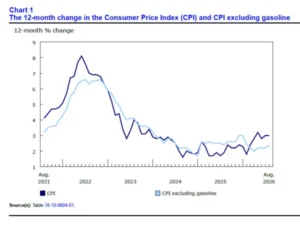
The headline inflation reading of 3% for August underscores a period of sustained price resilience within the Canadian marketplace. While the rate did not accelerate higher—a relief for households grappling with the cumulative cost-of-living increases accumulated over recent years—it also failed to show the meaningful cooling that many analysts had anticipated earlier in the quarter.
The consumer price index basket reveals a mixed picture across various sectors. Essential categories such as shelter, food, and energy continue to exert upward pressure on household budgets, even as discretionary spending shows signs of normalization. Shelter costs, driven by elevated mortgage interest rates and a structurally undersupplied housing market, remain one of the primary sticky components keeping overall inflation comfortably above the Bank of Canada’s optimal target range. Simultaneously, grocery price growth has shown tentative signs of moderation compared to the historic spikes of previous years, yet consumers continue to feel the pinch at checkout counters nationwide.
Energy prices have acted as a stabilizing counterweight in recent months, helping to offset some of the heavier domestic cost pressures. However, volatility in international crude oil markets and regional refining capacities mean that energy-related components of the CPI remain vulnerable to sudden shocks, complicating the broader monetary policy outlook.
Chronology and Background Context of the Event
To understand the significance of the August 2026 inflation reading, it is necessary to examine the historical trajectory of Canada’s economic metrics over the preceding years. The journey began with the extraordinary inflationary surge of 2021 and 2022, triggered by pandemic-era stimulus, unprecedented global supply chain bottlenecks, and a rapid resurgence in consumer demand. In response, the Bank of Canada embarked on one of the most aggressive tightening cycles in its history, raising its benchmark policy rate from near-zero levels to restrictive territory.
Throughout 2023 and 2024, these high interest rates gradually worked their way through the financial system, cooling the housing market and dampening consumer spending. Headline inflation steadily retreated from its multi-decade peaks near 8% down toward the 2% to 3% range by late 2024 and 2025.
However, the final leg of the journey back to the 2% target has proven to be the most difficult. Entering 2026, inflation oscillated within a stubborn band, influenced by persistent structural factors such as population growth outpacing housing construction, robust service-sector demand, and lingering wage adjustments aimed at catching up with historical cumulative inflation. The August 2026 reading of 3% directly reflects this plateau, demonstrating that while hyperinflation has been averted, the return to complete price stability requires prolonged economic restraint.
Supporting Data and Sector-Specific Breakdown
A deeper dive into the macroeconomic data underpinning the August report illustrates the complex crosscurrents within the Canadian economy. Core measures of inflation—which strip out volatile items like gasoline and certain food categories to provide a clearer picture of underlying price trends—also hovered near levels that give monetary policymakers pause.

Labor market data released concurrently with or adjacent to the CPI report shows a gradually softening employment landscape, with the unemployment rate ticking slightly higher over the summer months. Yet, wage growth has stubbornly maintained an annualized pace hovering above 3.5%, outpacing productivity gains and fueling ongoing debates regarding labor cost-push inflation.
Retail sales figures and housing market activity further illuminate the consumer mindset. Home resale activity across major metropolitan areas like Toronto and Vancouver remained subdued through the summer as prospective buyers adjusted to higher borrowing costs. Yet, rental markets remained exceptionally tight, keeping shelter inflation elevated and disproportionately impacting lower- and middle-income renters. Meanwhile, consumer credit data indicates that households are increasingly relying on savings or adjusting discretionary budgets to manage debt servicing, pointing to a cooling consumer engine even as headline prices hold firm.
Official Responses and Market Reactions
Financial markets and economic forecasting institutions were quick to analyze the ramifications of the 3% print. Analysts from major financial institutions, including TD Bank Financial Group, noted that the data aligns closely with expectations of a prolonged plateau rather than an imminent slide toward the 2% target.
While reports and economic commentary published by financial experts emphasize that the data has been drawn from reliable macroeconomic sources, they also underscore the inherent uncertainties moving forward. Economists generally view the 3% reading as confirmation that the Bank of Canada will maintain a cautious stance in upcoming policy meetings.
Bond yields experienced moderate fluctuations following the release, as fixed-income traders adjusted their pricing for upcoming central bank rate announcements. Equity markets showed a muted reaction, as investors had largely priced in a persistent, range-bound inflation environment for the late summer period. Business lobbying groups and retail associations voiced renewed calls for structural reforms aimed at boosting productivity and addressing supply-side bottlenecks, arguing that monetary policy alone cannot fully resolve the underlying cost pressures facing the economy.
Broader Impact and Policy Implications
The persistence of 3% inflation carries profound implications for monetary policy, fiscal planning, and consumer behavior. For the Bank of Canada, operating under its flexible inflation-targeting framework, a reading at the upper bound of its 1% to 3% control range complicates the timing and pace of future interest rate cuts.
While a weaker labor market and moderating GDP growth might ordinarily justify a more aggressive monetary easing cycle to support economic activity, a stubbornly sticky inflation rate warns against premature policy relaxation. Central bank officials have repeatedly stressed their commitment to anchoring long-term inflation expectations firmly at 2%. Cutting rates too quickly in the face of 3% inflation risks reigniting price pressures and damaging the credibility of the monetary framework.
For Canadian households, a 3% inflation rate means that the cost of living continues to compound, albeit at a slower pace than during peak inflationary periods. Real purchasing power remains under pressure, forcing consumers to prioritize essential expenditures over discretionary goods and services. This shifting consumption pattern directly impacts retail, hospitality, and entertainment sectors, which must adapt to a more cost-conscious consumer base.
On the fiscal front, provincial and federal governments face ongoing pressures regarding public sector wage negotiations, social program funding, and infrastructure investments. Higher baseline costs for construction and labor mean that public budgets are similarly stretched, requiring careful fiscal management to avoid exacerbating inflationary impulses through excessive deficit spending.
Looking ahead, economists will closely monitor incoming data releases—including retail sales, employment reports, and global commodity price trends—to determine whether the 3% plateau is a temporary resting phase before a renewed descent toward 2%, or if Canada is settling into a higher-inflation equilibrium for the medium term. As the autumn months approach, all eyes remain fixed on monetary authorities to see how they will balance the competing demands of economic growth and price stability.