HaasOnline Launches AI Agent Access on TradeServer Cloud to Revolutionize Automated Trading Workflows

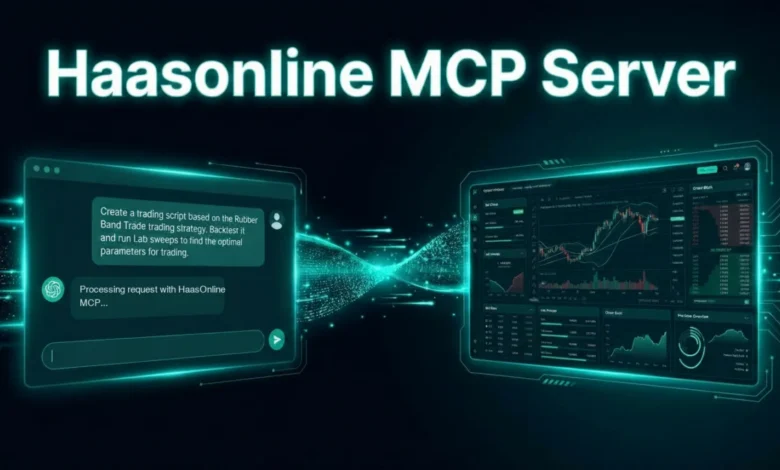
HaasOnline has officially expanded the capabilities of its TradeServer Cloud platform by integrating Model Context Protocol (MCP) support, allowing users to connect advanced AI assistants directly to their trading environments. This development marks a significant shift in how retail and professional traders interact with algorithmic trading infrastructure. By enabling AI agents—such as Claude, Cursor, and VS Code—to interface with live market data, scripts, and bot configurations, HaasOnline is removing the friction typically associated with local self-hosted configurations. This integration represents a major evolution in the automated trading space, where the complexity of managing multiple exchange accounts and scripts often requires significant manual oversight.
The implementation follows a strategic timeline for the company. In April of this year, HaasOnline first introduced MCP support for its self-hosted TradeServer product, providing power users with the ability to bridge their local instances with AI models. However, that version required users to maintain their own server infrastructure, a barrier for traders who prefer cloud-based, managed solutions. The new cloud-native rollout eliminates the need for downloads, manual API key management, and complex local hosting, effectively democratizing access to AI-augmented trading operations for the broader user base.
Moving Beyond API Key Vulnerabilities
Historically, integrating external tools with trading platforms has relied heavily on the manual generation and hard-coding of API keys. This practice, while functional, poses inherent security risks. When a user copies a long-lived API key into a configuration file on a local machine, the credential remains static and susceptible to potential exfiltration if that machine is compromised.
HaasOnline’s new cloud integration addresses this security bottleneck by moving to a standard OAuth 2.1 authorization-code flow, augmented with Proof Key for Code Exchange (PKCE). This is the same industry-standard security architecture utilized by major financial institutions and cloud service providers to ensure that applications can access user data without ever handling the user’s master credentials. When a trader connects an AI agent to their HaasOnline account, they are redirected to a secure browser interface where they explicitly grant permissions. This connection can be revoked at any time from the account dashboard, providing a granular layer of control that static API keys cannot offer. For the end user, this means no more pasting sensitive keys into plain-text configuration files; instead, the connection is managed through a secure, revocable handshake.
The Role of the Model Context Protocol (MCP)
The Model Context Protocol (MCP) acts as the connective tissue between the AI assistant and the trading platform. It serves as an open-source standard that allows developers to build universal connectors for AI assistants. In the context of HaasOnline, the MCP server acts as a bridge that allows the AI to "read" the state of a trader’s portfolio, backtests, and bot logs.
With 46 distinct tools now exposed to the AI, the agent is capable of performing deep analysis on specific trading strategies. Unlike generic AI models that can only provide theoretical advice based on historical market data, a HaasOnline-integrated agent can analyze the user’s actual, live-running grid bots. It can identify patterns in performance, suggest optimizations based on real-time fills, and assist in debugging complex scripts. This shift from generic advice to personalized, account-specific intelligence is a cornerstone of the current trend toward "agentic" trading workflows.
Operational Scope and Security Boundaries
While the integration is extensive, HaasOnline has implemented strict "guardrails" to ensure the safety of user funds. A critical component of the platform’s security policy is the absolute exclusion of trade execution capabilities from the MCP interface. No tool exposed through the MCP protocol has the authorization to place, modify, or cancel a trade on an exchange. Similarly, these agents cannot move funds between wallets or perform administrative actions like starting or stopping bots.
This design choice creates a clear separation of concerns: the AI agent is restricted to read-only access for sensitive financial operations, while it retains write-access for configuration tasks. The agent can suggest or draft changes to HaasScript, modify parameters for backtesting, or reorganize library files. By limiting the AI to these creative and analytical roles while keeping the execution layer isolated, the platform effectively mitigates the risks associated with "hallucinations" or errors in AI reasoning, which could be catastrophic if applied directly to market orders.
Practical Applications in Modern Trading
Industry analysis suggests that the adoption of AI agents in trading is primarily driven by the need to reduce the cognitive load of managing multi-exchange portfolios. Traders managing dozens of bots across platforms like Binance, OKX, or Kraken previously faced a fragmented workflow, often requiring a dedicated screen or spreadsheet to monitor performance.
With the new AI integration, the workflow is being transformed into a conversational one. Common use cases observed during the beta phase include:
- Portfolio Auditing: Instead of navigating through multiple exchange dashboards to reconcile performance, users can query their agent: "Which of my grid bots have shown the highest drawdown over the last 30 days, and what are their common settings?" The agent can cross-reference the user’s entire library of bots to provide an answer in seconds.
- Iterative Script Development: Traders can describe desired behaviors to the AI, which then drafts the necessary HaasScript code. The agent can then trigger a backtest, read the resulting logs, and present the findings. If the results are suboptimal, the trader can instruct the agent to iterate on the logic until the desired outcome is achieved—all within a single conversation window.
This evolution mirrors trends seen in software development, where tools like GitHub Copilot have changed the way engineers write code. In the trading sphere, this means that the "expert" is still the trader, but they are now equipped with an assistant that handles the data-crunching and syntactical heavy lifting.
Broader Market Implications
The launch of AI-integrated trading cloud services signals a maturing of the retail algorithmic trading sector. By simplifying the technical barrier to entry—specifically by removing the need for server maintenance and complex authentication—HaasOnline is likely to attract a wider demographic of traders who possess trading expertise but lack the software engineering background to manage self-hosted environments.
However, the industry remains cautious. While AI can improve the efficiency of strategy development, it does not replace the necessity of risk management. Market participants and analysts emphasize that even with sophisticated tools, the volatility of crypto and traditional assets remains a constant. The responsibility for the trading decision—and the capital at risk—remains firmly with the human operator. The AI serves as an analytical force multiplier, not a replacement for financial judgment.
Availability and Future Roadmap
The AI agent access is now available as a standard feature for users on the Standard, Pro, and TradeServer tiers. HaasOnline has opted to include this across all non-starter plans to encourage broad adoption. For those currently utilizing the self-hosted version of TradeServer, the existing workflow remains unchanged, ensuring that users who prioritize total hardware isolation can continue to operate as they always have.
As the financial technology sector continues to integrate large language models, the role of protocols like MCP is expected to grow. By standardizing how these agents interact with complex financial platforms, companies like HaasOnline are setting a precedent for how data, strategy, and execution can coexist in a secure, AI-ready ecosystem. For the average trader, the transition from manual, interface-heavy management to conversational, agent-driven optimization represents the next frontier in automated trading.
Disclaimer: Automated trading carries significant risk. Past performance of a strategy or algorithm is not indicative of future results. All traders should exercise caution and only deploy capital that they can afford to lose.