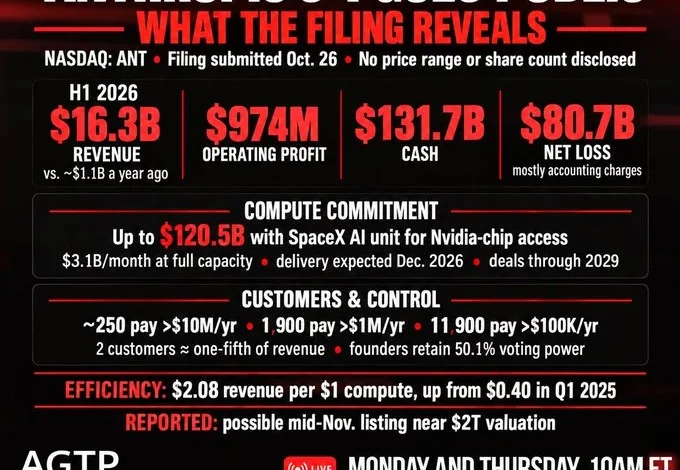
Artificial intelligence pioneer Anthropic has officially initiated the process to become a publicly traded entity, submitting an S-1 registration statement to the U.S. Securities and Exchange Commission (SEC) on Monday morning. The enterprise, slated to list on the Nasdaq exchange under the ticker symbol ANT, marks a milestone in the commercialization of generative artificial intelligence. The initial public offering filing sheds light on the massive financial scale required to sustain cutting-edge foundational model development, revealing explosive revenue growth offset by equally staggering capital expenditures, non-cash accounting adjustments, and a tightly consolidated voting structure designed to protect the company’s long-term vision.
The filing arrives amid a high-stakes market backdrop defined by severe concentration risk. Market analysts note that a mere handful of artificial intelligence and hyperscale infrastructure plays now dictate the performance of the broader equity market. As Wall Street digests the implications of Anthropic’s public debut, investors are simultaneously bracing for a flurry of high-impact macroeconomic data, including the Federal Open Market Committee’s interest rate decision, alongside pivotal third-quarter earnings reports from mega-cap tech stalwarts Microsoft and Alphabet.

Financial Realities Behind the Headlines
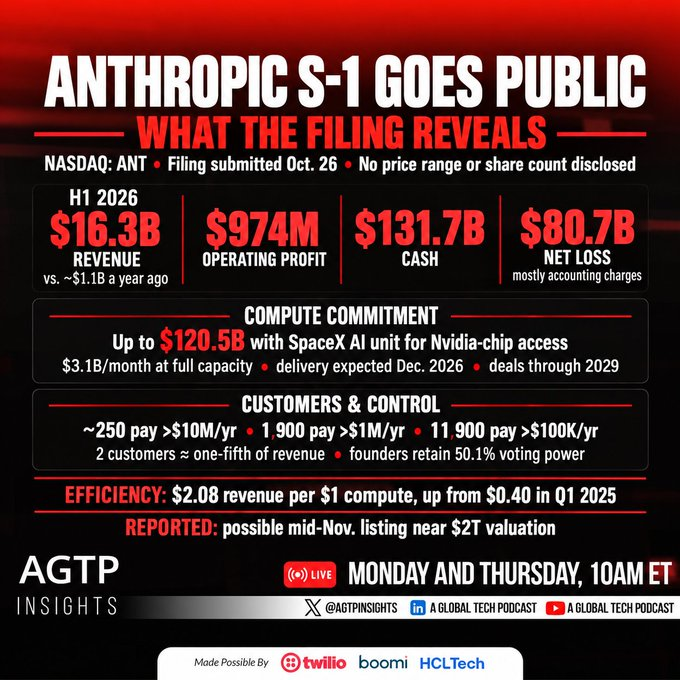
A surface-level glance at Anthropic’s regulatory filing reveals a headline net loss of $80.7 billion, a figure that initially alarmed casual observers. However, a deeper examination of the financial disclosures indicates that the underlying business performance is substantially more robust than the headline loss implies. Of the $80.7 billion deficit, $72.4 billion stems entirely from non-cash accounting charges resulting from the revaluation of convertible notes and similar financial instruments. This massive adjustment primarily reflects the company’s skyrocketing valuation as private market evaluations surged over the past year.
On an operational basis, Anthropic generated $16.3 billion in revenue for the first half of 2026, representing an exponential acceleration from the $1.2 billion reported during the same period in 2025. Furthermore, the company posted an operating profit of $974 million for the first half of the year, bolstered by robust enterprise adoption of its AI models. Anthropic also commands a formidable balance sheet, reporting $131.7 billion in cash and short-term investments as of June 30, providing a substantial liquidity buffer to navigate its upcoming capital-intensive expansion phase.
Capital Expenditure and the Expanding Compute Arms Race
Despite sitting on a massive cash reserve, Anthropic’s SEC filing underscores the insatiable capital requirements of the generative AI sector. The company disclosed that it spent $8.9 billion on compute infrastructure and hardware in the first half of 2026 alone, eclipsing the $7.3 billion deployed across the entirety of 2025.
Looking forward, purchase commitments and long-term lease agreements extend through 2045, with credible industry estimates placing total future obligations above $500 billion. These commitments are split between near-term buildouts due before 2030 and long-term infrastructure projects spanning 2031 through 2045. Anthropic stated its intention to aggressively secure additional computational power beyond its current commitments and construct proprietary data centers, signaling that even a war chest exceeding $131 billion will necessitate continuous external financing. This capital strategy mirrors the aggressive infrastructure spending observed across the technology sector, where hyperscalers like Meta, Microsoft, and Google continue to pour tens of billions of dollars into data center expansion and advanced silicon procurement.
Governance and Voting Control
In structuring its public debut, Anthropic has adopted a governance model heavily utilized by modern technology firms to insulate management from short-term market pressures. According to the S-1 filing, the company’s seven co-founders will hold a single share of Class F common stock, granting them 50.1% of the total voting power while carrying no economic rights. Additionally, a separate trust will elect a majority of the board of directors through another nonvoting class of shares.
The filing explicitly warns prospective investors about the implications of this arrangement, noting that the dual-class and founder-control structure “may effectively eliminate the ability of holders of our Class A common stock to influence important decisions, including a change in control.” By separating corporate governance from equity financing, the founders retain absolute strategic control over the direction of the enterprise, a playbook popularized by technology giants such as Meta Platforms.
Macroeconomic Backdrop and Market Concentration
The timing of Anthropic’s market entry coincides with a delicate juncture for global financial markets. On Wednesday, the Federal Open Market Committee (FOMC) is scheduled to release its latest interest rate decision and policy statement, with federal funds futures pricing in virtually no probability of a rate hike, keeping the target range anchored between 3.75% and 4.00%. Concurrently, the economic calendar features the advance Goods Trade Balance for September and weekly crude oil inventory reports from the Energy Information Administration.
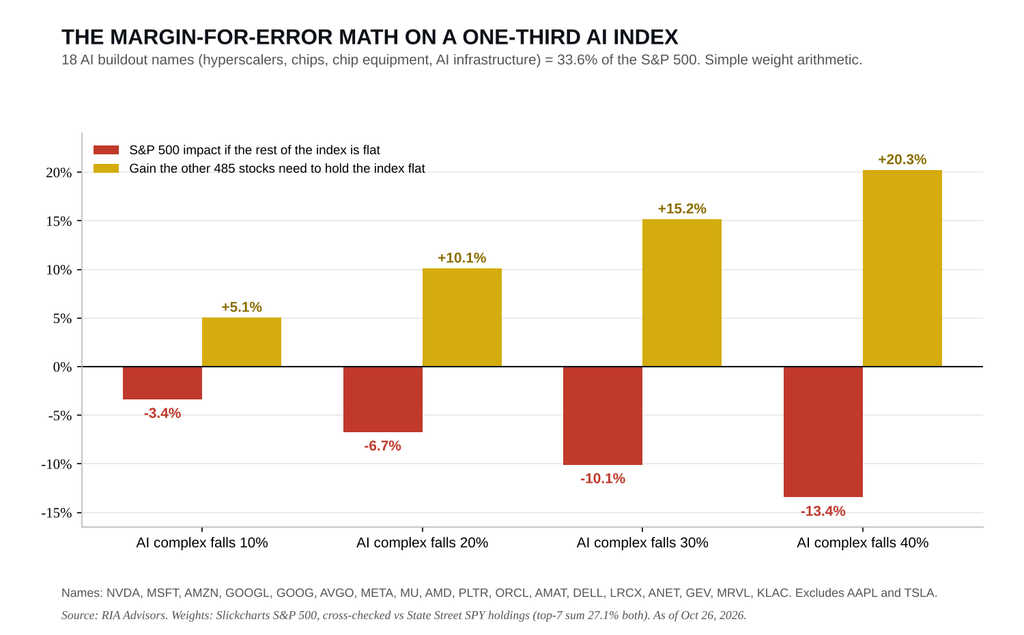
Simultaneously, equity markets are navigating unprecedented concentration risks tied to the artificial intelligence trade. According to recent market analysis from Citadel Securities, the margin of error for equity portfolios has narrowed significantly due to the outsized weight of the AI complex. As of late October, 18 primary AI buildout names—encompassing semiconductor manufacturers, hyperscale cloud providers, and electrical power suppliers—account for 33.6% of the S&P 500 index. A more concentrated subset comprising Nvidia, Microsoft, Amazon, Alphabet, Broadcom, and Meta Platforms alone represents 27.1% of the benchmark index.

This concentration creates systemic sensitivity. Quantitative models suggest that a 20% drawdown in the AI complex, assuming all other equities remain flat, would drag the S&P 500 down by approximately 6.7%. For the broader market to offset such a decline, the remaining 485 constituents would need to rally by more than 10%.
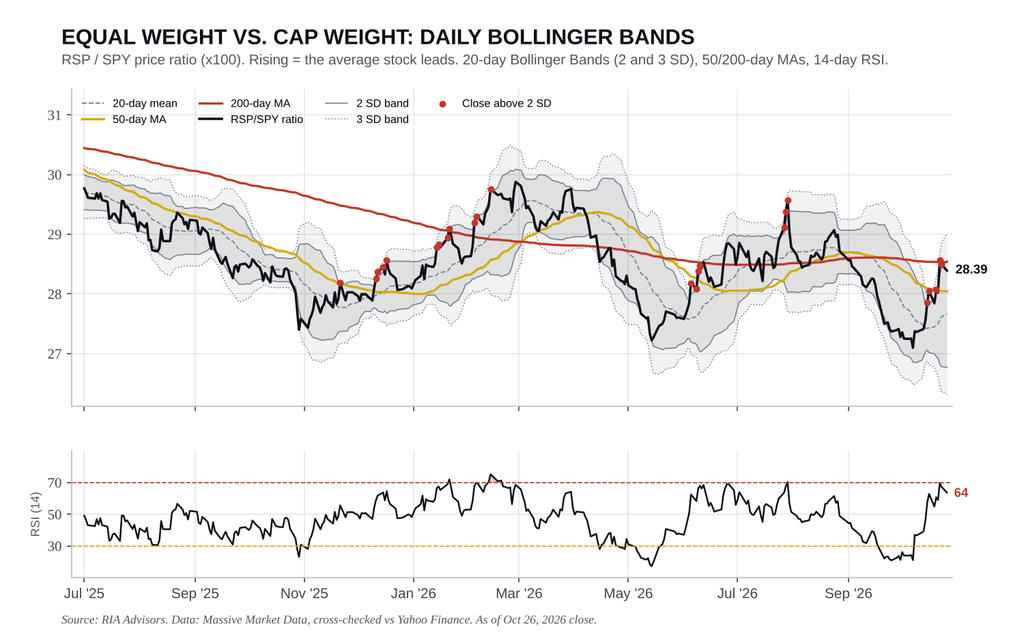
Recent weeks have shown signs of a healthy market rotation, with the equal-weight S&P 500 index outperforming its market-cap-weighted counterpart. While optimists view this broadening participation as a sign of underlying market health, cautious observers warn that a market losing its narrow leadership can easily mirror a broader rotation until macroeconomic shocks test institutional conviction.
Earnings Catalyst and the Capex Sustainability Debate
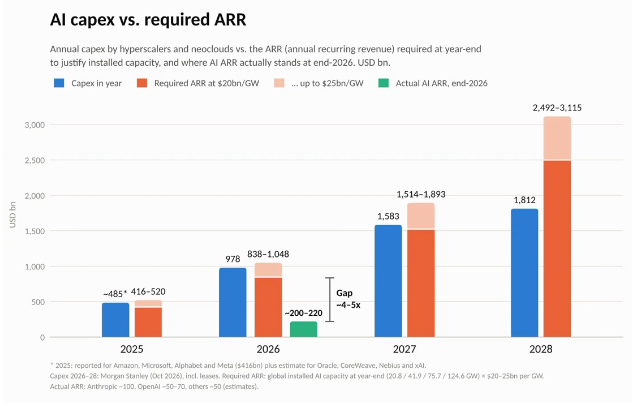
Wednesday also brings a heavy concentration of corporate earnings reports from key market drivers. Before the opening bell, major industrials and infrastructure providers such as GE Vernova, Amphenol, Automatic Data Processing, Phillips 66, and Vertiv Holdings report their third-quarter figures. After the market close, heavyweight technology leaders Microsoft and Alphabet are slated to release financial results that will be heavily scrutinized for clues regarding the return on investment on artificial intelligence expenditures.
Market strategists emphasize that capital expenditure efficiency remains the central question for the technology sector. Recent reports highlighting massive quarterly capital outlays relative to operating cash flows among major cloud providers have sparked debates over whether infrastructure spending is outstripping near-term revenue generation. While well-capitalized hyperscalers with diversified revenue streams can comfortably absorb heavy infrastructure costs, smaller industry players, often referred to as neoclouds, face tightening financial conditions amid elevated borrowing costs.
Conclusion and Investment Implications

Anthropic’s decision to tap public equity markets underscores the maturation of the generative artificial intelligence industry from a research-driven endeavor into a capital-intensive commercial enterprise. While the company boasts exceptional revenue expansion and a robust operating profit, its towering infrastructure commitments and founder-controlled governance structure highlight the unique risks and rewards associated with the sector.
As Wall Street processes Anthropic’s financial disclosures alongside upcoming Federal Reserve policy updates and mega-cap tech earnings, portfolio managers are increasingly advising disciplined risk management. Maintaining target asset allocations to technology exposure, rather than chasing overextended rallies, remains a primary strategy for investors navigating a market with a historically narrow margin for error.