Navigating the Data Deluge: How Pfizer Medical Director Nabil Khan Sees Practical AI Adoption Transforming Pharma Evidence Workflows

The global pharmaceutical industry finds itself at a historical crossroads, producing more clinical evidence and scientific literature than at any point in medical history, yet struggling to translate this vast influx of data into timely, strategic corporate decisions. According to baseline statistics published by the National Library of Medicine, PubMed alone incorporated well over 1.5 million new citations during the 2023 fiscal year, equating to an overwhelming rate of roughly 4,300 additions per calendar day. Beyond traditional academic literature, contemporary medical affairs and clinical development teams must constantly absorb, process, and reconcile complex real-world evidence, dense medical congress data, and continuous qualitative field insights gathered directly from healthcare professionals worldwide.
This unprecedented data volume has fundamentally strained the operational capacity of pharmaceutical organizations. While the raw quantity of scientific knowledge expands exponentially, the human cognitive bandwidth and legacy analytical frameworks required to evaluate, synthesize, and act upon this information have failed to scale at a matching pace. Consequently, vital clinical insights frequently experience substantial operational bottlenecks before they can influence drug development pipelines, commercial strategies, or patient care pathways.
The Rise of Generative AI and the Danger of Compounding Errors
To alleviate these severe operational bottlenecks, pharmaceutical researchers and medical affairs professionals are increasingly turning to artificial intelligence, specifically large language models, to drastically shorten the time required for evidence synthesis. By automating the preliminary aggregation and summarization of massive academic corpuses, AI systems promise to liberate high-level experts from tedious administrative data collection, allowing them to focus instead on critical interpretation and strategic execution.
However, this technological transition is not without significant operational hazards. A prominent 2023 study published in npj Digital Medicine evaluated the performance of various large language models when tasked with medical evidence summarization and revealed a troubling systemic flaw: the models frequently generated outputs that were both factually inconsistent and deceptively persuasive. Crucially, the researchers observed a direct correlation between text length and error frequency, demonstrating that models committed more factual errors and hallucinations when processing longer, more complex medical documents.
Recognizing these inherent vulnerabilities, regulatory bodies have begun establishing stringent oversight mechanisms. The United States Food and Drug Administration subsequently proposed a comprehensive risk-based credibility framework explicitly designed for artificial intelligence and machine learning models intended to support regulatory decision-making for drugs and biological products. This regulatory posture highlights a growing consensus among industry regulators and corporate executives alike: the primary challenge is no longer merely whether AI can process text, but rather how organizations can verify its accuracy, prevent the propagation of synthesized misinformation, and ensure total compliance with federal mandates.
Decision-Anchored AI Measurement in Medical Affairs
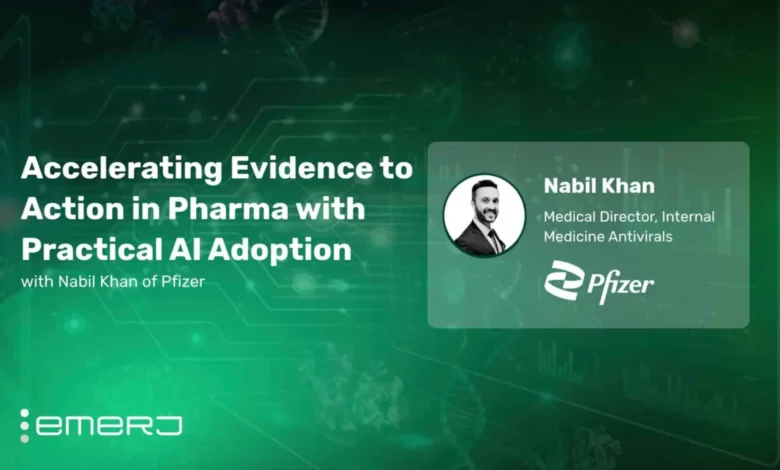
Addressing these complex industry dynamics on a recent episode of the AI in Business podcast, Emerj Senior Editor Yolandi de Weerdt sat down with Dr. Nabil Khan, Medical Director for Internal Medicine Antivirals at Pfizer. Their in-depth conversation explored the practical realities of artificial intelligence adoption within evidence-heavy, heavily regulated pharmaceutical workflows, shifting the executive focus away from abstract technological capabilities and toward targeted operational utility.
Dr. Khan brings a wealth of clinical and operational expertise to the discussion. Before stepping into his current role at Pfizer, where he bridges the gap between field insights from healthcare professionals and clinical development teams, Khan spent over a decade in senior clinical research roles monitoring trial sites and supporting studies across diverse therapeutic areas including vaccines, cardiometabolic disease, ophthalmology, and neurology at major clinical research organizations such as PPD, ICON, and IQVIA. He also served as Director of Clinical Operations at Impact Physician Group and holds a medical degree from Xavier University School of Medicine.
During the podcast discussion, Khan identified the delay in turning evidence into actionable strategy as one of the single most consequential bottlenecks facing modern pharmaceutical companies. While access to publications, real-world data, and congress abstracts is rarely restricted, the ability of internal teams to synthesize and act upon this information has not kept pace with generation rates. Khan noted that the nature of this bottleneck varies depending on an individual’s role within the organization: field medical teams must constantly evaluate which healthcare professional interactions yield genuine, clinically relevant insights, while internal medical affairs and clinical development personnel receive these insights secondhand and must translate them into overarching corporate strategies.
According to Khan, artificial intelligence fundamentally alters this workflow in three distinct ways. First, it accelerates synthesis, allowing teams to process vast corpuses of publications, congress abstracts, and real-world data in a fraction of the traditional time, thereby freeing experts to concentrate on high-level interpretation and decision-making. Second, AI assists in detecting subtle emerging patterns and data signals that might otherwise escape human notice during manual reviews. Third, it establishes a more consistent foundational evidence base, fostering better operational alignment across medical affairs, clinical development, and commercial divisions.
Avoiding the Toolbox Fallacy: Establishing Strategic Anchors
When evaluating executive enthusiasm for AI-driven operational acceleration, Khan cautions against adopting technology for its own sake, comparing unanchored AI implementation to owning a comprehensive toolbox without understanding which tool is suited for a specific repair job. Effective adoption, he emphasizes, must invariably originate from a precisely defined business problem rather than the software application itself.
Executives evaluating proposed AI evidence workflows must systematically press their teams on fundamental operational questions: What specific decision are we attempting to improve? What operational bottleneck are we trying to accelerate? And how will we measure and scale this improvement across the enterprise?
The practical downstream implications of this disciplined approach are evident in complex operational workflows such as clinical trial site selection. While artificial intelligence tools can efficiently assist teams in identifying potentially relevant healthcare professionals within a specific geographic region, the true test of the upstream data occurs much later in the pipeline. Only after field medical teams rigorously vet investigators, and clinical development successfully guides the selected sites through comprehensive protocol training, regulatory reviews, compliance checks, and formal site activation, can an organization determine whether those sites actually produce clean, reliable data. Only at this terminal stage can leadership definitively assess whether the upstream AI-enabled selection process succeeded.
Mitigating the Risks of Source-Verified AI Synthesis
While the speed and consistency of artificial intelligence make it an exceptionally attractive proposition for large-scale evidence synthesis, those exact characteristics simultaneously render its operational errors uniquely costly. Khan highlights a profound paradox regarding system consistency, noting that corporate leaders traditionally view consistency as an unmitigated positive attribute, yet consistency directed toward an inaccurate conclusion can severely amplify organizational risk.
This vulnerability is acutely pronounced during major medical congresses, where Pfizer teams utilize AI tools both to optimize limited physical time on-site and to synthesize the immense volume of scientific material presented. Khan cautions that specialized AI outputs frequently require rigorous, manual double-checking because separate presentations with similar titles, overlapping topics, or even identical keynote speakers can easily become erroneously amalgamated by the algorithm. Once disparate clinical studies are incorrectly merged within an AI summary, any subsequent strategic planning or document expansion builds directly upon fundamentally flawed foundational information.
To counteract these hazards, Khan champions a strict operating principle: artificial intelligence must consistently be treated strictly as a tool rather than an authoritative primary source. If an AI system is fed poor, ambiguous, or inaccurate initial data, it will inevitably amplify that misinformation. In the highly regulated healthcare sector, once amplified misinformation infiltrates internal repositories or external communications, it becomes exceptionally difficult to contain and rectify. Consequently, pharmaceutical organizations must institute mandatory multi-step verification checks before any AI-generated summary or synthesis is approved for cross-functional dissemination.
Navigating the Regulatory Landscape and Funded Learning Curves
Within the highly regulated pharmaceutical industry, possessing access to an advanced artificial intelligence platform and maintaining institutional readiness to deploy that technology on regulated workflows are two entirely separate matters. When asked which critical step corporate organizations most frequently overlook during digital transformation initiatives, Khan points directly to comprehensive, context-specific employee training.
In the pharmaceutical sector, personnel must thoroughly understand precisely where artificial intelligence utilization intersects with strict regulatory mandates, legal compliance obligations, intellectual property law, and external communication standards, in addition to mastering the mechanics of the software itself. Because commercial generative tools like ChatGPT, Microsoft Copilot, and Anthropic Claude were engineered as general-purpose consumer technologies rather than dedicated healthcare platforms, they lack innate awareness of pharmaceutical compliance boundaries. Untrained employees relying on these general models for regulatory work expose both themselves and their corporate entities to severe compliance breaches and regulatory penalties. Furthermore, the operational context matters deeply; utilizing a generative AI application on a personal mobile device presents vastly different compliance exposures than deploying enterprise-grade AI tools on secure corporate workstations for regulated clinical tasks.
Acknowledging that major pharmaceutical organizations remain firmly entrenched in an iterative trial-and-error phase as they determine optimal AI integration pathways, Khan outlines a structured three-stage learning curve for corporate adoption. The temporal progression of this curve depends heavily on the specific use case: routine administrative tasks such as drafting standard correspondence require minimal organizational readiness, whereas complex analytical assignments—such as synthesizing extensive clinical journal articles or building comprehensive strategic presentations from disparate medical evidence—demand rigorous preparation. For these evidence-heavy workflows, Khan estimates a minimum timeline of five to six months for initial proficiency, with true, enterprise-wide meaningful adoption requiring significantly more time in practice.
As the pharmaceutical industry continues to grapple with exponential data growth, the insights articulated by leaders like Dr. Nabil Khan establish a vital roadmap for sustainable innovation. By anchoring artificial intelligence deployment to clearly defined strategic decisions, maintaining rigorous source verification protocols to prevent error amplification, and heavily investing in comprehensive regulatory training, pharmaceutical executives can successfully bridge the widening gap between clinical evidence generation and rapid, defensible strategic action.