The Strategic Shift from Planning to Design as the New Frontier for Artificial Intelligence in Global Supply Chain Management

The global enterprise landscape has entered a volatile era where traditional supply chain planning models, once the bedrock of operational efficiency, are no longer sufficient to protect business interests against compounding disruptions. As artificial intelligence becomes a ubiquitous feature in enterprise software, industry experts and academic researchers are warning that the competitive advantage derived from standard AI optimization is rapidly diminishing. A recent study by the MIT Sloan Management Review posits that the edge provided by AI is structurally temporary, driven by the increasing commoditization of algorithms, hardware, and specialized talent. Consequently, the focus of forward-thinking organizations is shifting away from the automation of existing plans and toward the fundamental design of the supply chain itself.
This transition comes at a critical juncture for global trade. Data from the World Economic Forum reveals a startling disconnect in the digital transformation of logistics: despite four years of unprecedented global disruption, more than 40% of organizations still report limited or no visibility into the performance of their Tier 1 suppliers. This suggests that while many enterprises have invested heavily in automation, they have failed to gain the structural insight required to navigate a world characterized by constant volatility. The emerging consensus among leaders is that design—the architecture of the decision-making environment—is the true competitive battleground for the next decade.
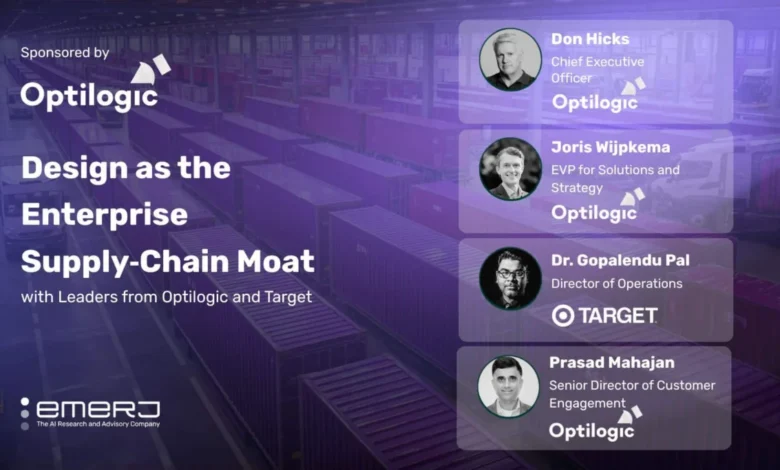
In a comprehensive series hosted on the AI in Business Podcast by Emerj, a panel of four distinguished industry leaders examined the imperative for enterprises to rebuild their supply-chain decision-making frameworks. The participants included Don Hicks, Chief Executive Officer at Optilogic and founder of LLamasoft; Joris Wijpkema, Executive Vice President for Solutions and Strategy at Optilogic; Prasad Mahajan, Senior Director of Customer Engagement at Optilogic; and Dr. Gopalendu Pal, Director of Operations at Target. Their collective insights underscore a growing movement toward scenario-driven modeling as the primary mechanism for maintaining strategic flexibility in an unstable global economy.
The Evolution of Supply Chain Strategy: A Chronology of Disruption
To understand the current shift toward supply chain design, it is necessary to examine the evolution of logistics strategy over the last decade. Throughout the 2010s, the primary objective for most global enterprises was the refinement of "Lean" principles. Supply chains were optimized for cost and speed, often resulting in highly efficient but brittle networks that relied on just-in-time delivery and minimal inventory buffers.
The year 2020 served as a definitive turning point. The COVID-19 pandemic exposed the structural vulnerabilities of these lean networks, as border closures and manufacturing halts caused systemic failures. Between 2021 and 2023, the industry entered a phase of reactive crisis management, characterized by "war rooms" and manual spreadsheet-based troubleshooting. During this period, organizations realized that their planning software, designed for stable environments, could not account for the rapid-fire succession of events, including the Suez Canal blockage, geopolitical tensions in Eastern Europe and the Middle East, and fluctuating tariff structures.
As of 2025, the industry is moving into a "Design-First" era. This phase is characterized by the realization that planning operates within the boundaries of a current network, whereas design allows a company to question and reconfigure those boundaries. The focus has moved from predicting a single "most likely" future to architecting a network capable of surviving multiple potential futures.
Distinguishing Design from Planning in an AI-Driven World
The distinction between supply chain planning and supply chain design is central to the modern enterprise strategy. Don Hicks, who previously grew LLamasoft into a $1.5 billion supply chain software leader, argues that most organizations are currently "trapped" within their existing structures. Planning involves making the best possible decisions within fixed constraints, such as existing supplier mixes, static lead times, and established business rules.
In contrast, design involves taking a systemic step back to ask what the supply chain could look like if those constraints were removed or altered. By using AI to model alternative network configurations, companies can identify structures that are inherently easier to plan and more resilient to environmental shifts. Hicks suggests that while AI-automated planning is becoming a "table stakes" commodity, the ability to architect the decision environment itself remains a rare and potent competitive advantage.
This sentiment is echoed by recent research from MIT Sloan and Tata Consultancy Services, which concludes that the future of competitive advantage depends not on the decisions AI generates within a system, but on how well humans and machines work together to design the parameters of that system. Most enterprises remain unequipped for this shift, continuing to rely on planning tools that are ill-suited for strategic reconfiguration.
AI-Accelerated Scenario Analysis and Risk Visibility
One of the most significant contributions of AI to modern supply chain management is its ability to provide visibility into risk long before a disruption occurs. Traditional tools are designed to optimize for the present, but they often fail to reveal "failure modes"—the specific points where a network will break under pressure.
Prasad Mahajan, whose experience includes leadership roles at Uber Freight and Transplace, notes that risk is rarely the result of a single, isolated shock. Instead, it emerges from complex interactions between supplier dependencies, inventory policies, and regulatory changes. AI-accelerated scenario analysis allows teams to generate thousands of variations of these interactions, exposing vulnerabilities that a human analyst might never consider.
Joris Wijpkema, an executive with over two decades of experience at McKinsey & Company, highlights that the goal is no longer to run "more scenarios," but to run the "right scenarios." This includes testing for "edge-case" conditions such as sudden supplier insolvency, tariff spikes, or demand cliffs. By building digital models—often referred to as "digital twins"—organizations can move away from reactive crisis management and toward a state of constant preparedness. Wijpkema observes that while most organizations still rely on manual war rooms during a crisis, those with advanced modeling capabilities can evaluate hundreds of response options in a fraction of the time, allowing them to act while competitors are still gathering data.
Bridging the Gap: Cross-Functional Alignment through Unified Design
A recurring theme among the experts is the "decision gap" created by organizational silos. In many large enterprises, planning, finance, operations, and commercial teams operate using different datasets and conflicting objectives. Planning teams focus on execution, finance focuses on cost reduction, and commercial teams prioritize customer service levels.
This fragmentation acts as a "speed tax" on decision-making. Dr. Gopalendu Pal, who oversees large-scale fulfillment operations at Target, emphasizes that flexibility is only valuable if the organization is structurally capable of acting on it. He argues that complexity in standard operating procedures (SOPs) and fragmented Key Performance Indicators (KPIs) often prevent companies from executing the insights provided by AI. For example, a transportation team measured solely on cost may reject a routing change that, while more expensive, would significantly reduce risk or improve long-term resilience.
To overcome this, the panel advocates for "Unified Design Environments." This involves creating a single data foundation and a shared model of the future that all departments can access. When finance, operations, and planning teams look at the same "design sandbox," the conversation shifts from debating whose data is correct to deciding which future the company should pursue. This alignment ensures that when a pivot is required, the entire organization can move in unison.
Supporting Data and Economic Implications
The economic stakes of this transition are substantial. According to industry analysis, supply chain disruptions cost the average large organization approximately 45% of one year’s profits over the course of a decade. Furthermore, the move toward "reshoring" and "near-shoring"—bringing production closer to the point of consumption—requires a total rethink of network design that cannot be achieved through simple planning adjustments.
Data from recent logistics surveys indicates that companies utilizing advanced design and scenario modeling have seen:
- A 15% to 20% reduction in overall supply chain costs through network reconfiguration.
- A 30% improvement in response times to major market disruptions.
- Significantly higher "service-level resilience," maintaining customer delivery standards even during periods of high volatility.
Conversely, organizations that fail to adopt these design-centric approaches face increasing "technical debt" in their supply chains, as they continue to layer AI automation over fundamentally flawed or outdated network architectures.
Broader Impact: The Future of the Decision Environment
The insights provided by the Optilogic and Target leadership team suggest a new mandate for corporate boards and C-suite executives. The "third twin" concept—a dedicated design sandbox separate from the live operational environment—is becoming an essential tool for strategic foresight. This environment allows leaders to test the "what-ifs" of global trade without risking the stability of current operations.
As AI continues to commoditize the "how" of planning, the "where" and "why" of design will define the winners of the next industrial era. The transition requires not just new software, but a cultural shift toward simplicity, unified data, and a willingness to challenge long-standing business rules.
In conclusion, the path to resilience in the modern age is not paved with better predictions, but with better architecture. By prioritizing design over planning and using AI to illuminate risk rather than just automate tasks, enterprises can transform their supply chains from a source of vulnerability into a durable competitive advantage. The move from reactive "war rooms" to proactive "design studios" marks the beginning of a more agile, informed, and resilient era of global commerce.