Quantifying the Impact of Corporate Insider Purchases: An Empirical Analysis of SEC Form 4 Filings from 2022 to 2026


The scrutiny of corporate insider activity has long been a cornerstone of quantitative finance, serving as a primary indicator for market participants attempting to gauge the conviction of C-suite executives. A rigorous examination of SEC Form 4 filings submitted between January 1, 2022, and June 30, 2026, reveals that while insider purchases are frequently associated with short-term positive abnormal returns, the long-term predictive power of these signals remains statistically ambiguous when subjected to stringent controls.
The research, which synthesized over 1.3 million raw transaction rows into a curated set of 7,406 distinct issuer-day signals, highlights the immense complexity involved in transforming raw regulatory data into actionable investment insights. By focusing on "Code P" transactions—which denote open-market or private purchases of non-derivative securities—the study provides a window into the behavior of officers, directors, and beneficial owners who are legally mandated to report transactions within two business days.
The Anatomy of a Regulatory Filing
Section 16 of the Securities Exchange Act of 1934 requires insiders to report changes in beneficial ownership. However, the SEC’s Form 4 is rarely as straightforward as a single insider making a single trade. Filings often contain multiple transaction rows, diverse security classes, and joint reporting by multiple owners. Furthermore, the inclusion of Rule 10b5-1 plan disclosures, which became mandatory for filings on or after April 1, 2023, has introduced a critical layer of granularity. By filtering out transactions affirmatively marked as 10b5-1 plan trades, researchers can better isolate discretionary, information-driven purchases from routine, pre-planned acquisitions.
The methodology employed in this study utilized a multi-stage "filing funnel" to ensure data integrity. After excluding Form 4/A amendments to avoid double-counting, and discarding transactions involving derivatives, gifts, or equity swaps, the sample was narrowed to 11,957 component events. The final aggregation to the "issuer-day" level—collapsing all valid components for a specific company on a single filing date—prevents the overrepresentation of coordinated insider activity, ensuring that each statistical signal represents a unique market event.
Chronology and Data Filtering
The significance of the filing date cannot be overstated. Unlike studies that utilize the transaction date—which inherently suffer from "lookahead bias" by including returns that occurred before the public disclosure—this analysis anchors its timeline to the filing date. Because federal regulations require filing by the end of the second business day following a transaction, the lag between the trade and public visibility is typically minimal, yet crucial.
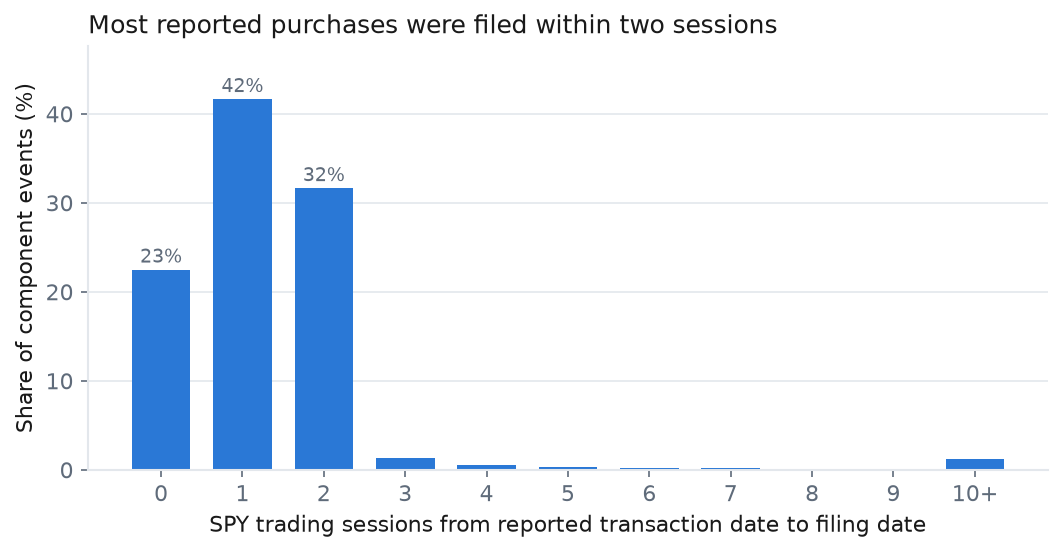
Analysis of the 11,957 component events shows that the median lag between the transaction date and the filing date is one trading session. Approximately 95.8% of these events are reported within two sessions, consistent with SEC mandates. By using the SPY exchange-traded fund as a benchmark, the study measures Cumulative Abnormal Returns (CAR) and Buy-and-Hold Abnormal Returns (BHAR), providing a conservative proxy for how the broader market reacts once the insider’s purchase is made public.
Statistical Findings and Market Sensitivity
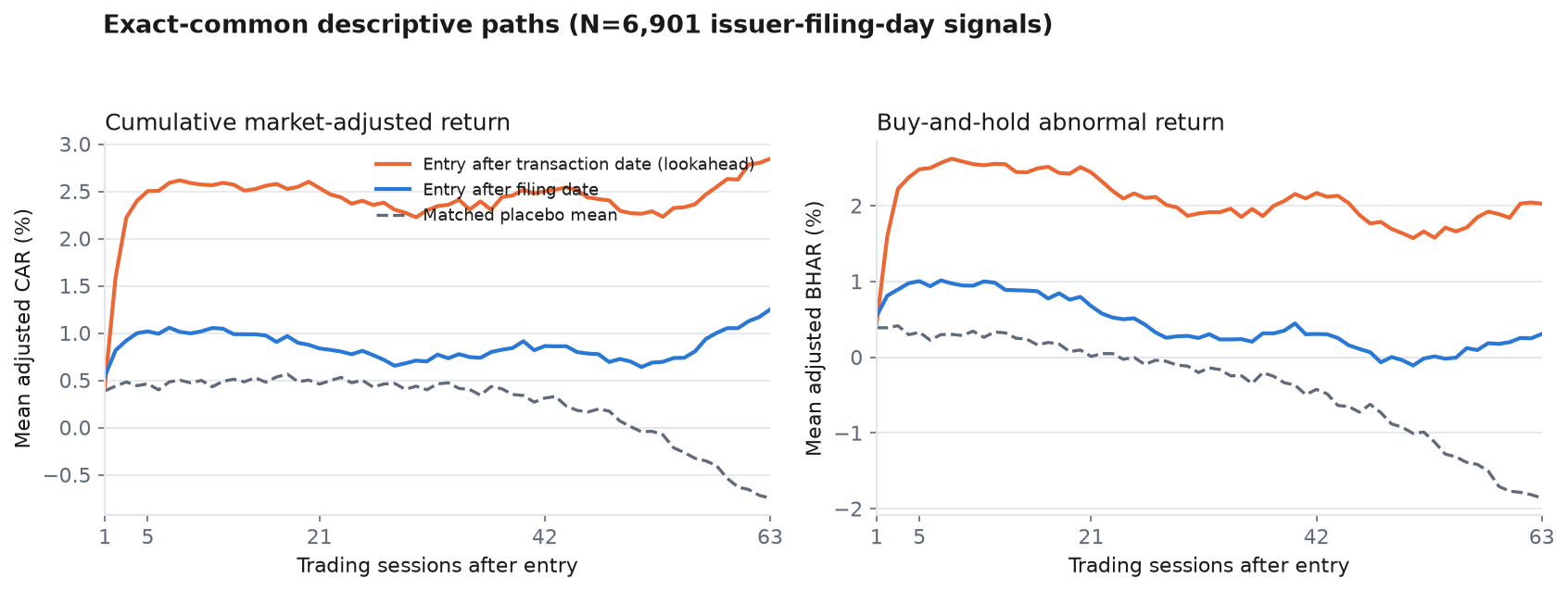
The primary findings demonstrate a clear, albeit short-lived, market reaction. The SPY-adjusted mean CAR for the next session stands at +0.534%, growing to +1.009% over a five-session window. These results, supported by two-way clustered t-statistics of 6.460 and 5.053 respectively, indicate that the market tends to digest insider purchase information quickly, leading to an immediate price premium.
However, the efficacy of this signal diminishes significantly as the time horizon extends. At 21 and 63 trading sessions, the confidence intervals for both CAR and BHAR include zero, suggesting that any initial "alpha" or outperformance dissipates as the market incorporates the news or as the initial momentum fades. The study further tested a market-model sensitivity approach, which yielded higher estimates—up to +6.560% at 63 sessions—but noted that these results are heavily influenced by the negative pre-event alpha of the underlying stocks. Consequently, the research concludes that these market-model results should be viewed as a sensitivity check rather than a definitive measure of long-term predictive value.
Methodological Rigor and Limitations
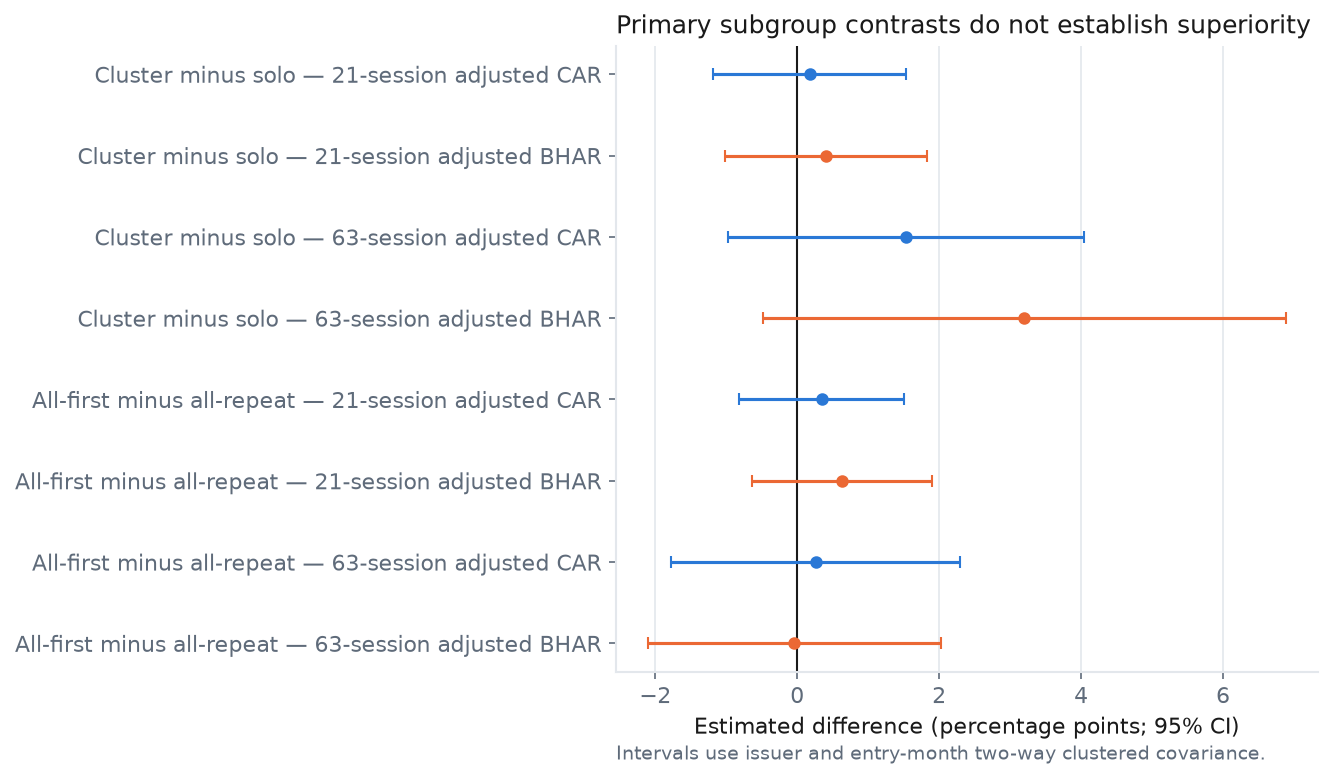
A critical component of this study is its commitment to reproducibility and its candid assessment of limitations. By using two-way clustering—accounting for both the issuer and the entry month—the research corrects for the fact that insider trading activity is often clustered in specific market environments or by specific firms.
The study also employs a "matched-placebo" analysis, where thousands of candidate dates were matched on volatility and momentum to see if the real filing dates truly outperformed. The resulting contrasts remained statistically imprecise, reinforcing the conclusion that while insider purchases are an important signal, they are not a "silver bullet" for portfolio performance. Furthermore, the analysis acknowledges liquidity constraints, noting that in nearly 10% of cases, the disclosed purchase value exceeded 100% of the median daily dollar volume, suggesting that institutional capacity would be a significant hurdle for any real-world strategy attempting to replicate these signals.
Broader Implications for Market Efficiency
The findings underscore a fundamental tenet of market efficiency: public information is rapidly priced in. While the "insider effect" is real, it is largely concentrated in the immediate aftermath of the filing. For investors, this implies that attempting to trade on the basis of public insider filings requires extreme efficiency and low execution costs.
The study also provides a cautionary tale regarding data processing. By demonstrating that raw SEC filings are often messy and require significant cleaning—such as reconstructing price histories around corporate actions or handling ambiguous ticker symbols—the researchers highlight the importance of "data hygiene" in quantitative finance. Without careful aggregation, researchers might inadvertently include errors that distort the findings, such as misinterpreting private purchases as open-market trades.
Concluding Perspectives
The evidence presented suggests that corporate insider purchases are a valuable, if limited, signal. The positive average returns observed over the first five sessions are robust, yet the failure of these gains to persist over three months suggests that the "insider signal" is better characterized as a short-term market reaction than a long-term value discovery mechanism.
The primary lesson for the financial community is methodological. The rigor applied to the 2022–2026 data—carefully defining the funnel, accounting for joint filings, and using conservative, two-way clustered inference—serves as a template for future research. In an era where alternative data and automated trading systems dominate, the value of traditional regulatory filings remains high, provided they are treated with the necessary skepticism and analytical discipline.

As market participants continue to look for ways to gain an edge, the temptation to over-interpret insider activity will persist. However, the data confirms that there is no substitute for a nuanced understanding of the regulatory landscape and the inherent limitations of event-study methodologies. Whether for institutional quantitative firms or individual researchers, the path to understanding insider influence lies not in the headline returns, but in the careful, reproducible reconstruction of the filing funnel itself. Future research will likely need to incorporate even higher-frequency data and more granular corporate sentiment analysis to determine if the "drift" that remains invisible in this study can be better captured or if it truly is, as the data suggests, a product of statistical noise.