Mastering Asset Allocation Through Risk Parity: A Quantitative Approach to Portfolio Stability

Most investors focus their energy on the art of stock picking, yet academic research and institutional data consistently confirm that asset allocation—the strategic distribution of capital across various financial instruments—is the primary driver of long-term investment performance. While the novice investor often builds a portfolio based on subjective preferences or available liquidity, leading to accidental and often dangerous concentrations of risk, professional quantitative managers employ systematic frameworks to ensure that no single asset dominates the volatility profile of a portfolio. Among these frameworks, Risk Parity has emerged as a robust strategy designed to balance risk contributions rather than capital weights, offering a sophisticated alternative to traditional methods.
The fundamental flaw in many retail portfolios is an over-reliance on capital-weighted allocation. For instance, consider an investor holding five major technology stocks—Apple, Microsoft, Amazon, Alphabet, and Nvidia. If this investor distributes their $30,000 capital by simply buying shares based on initial sentiment or price, they may inadvertently assign 39% of their total capital to a single volatile asset like Nvidia while allocating only 6% to Apple. In this scenario, the portfolio becomes highly sensitive to the idiosyncratic movements of a single company. If that company underperforms, the entire portfolio suffers a disproportionate drawdown. Conversely, if a smaller holding significantly outperforms, the investor fails to capture the full benefit of that growth due to their low exposure. This lack of balance is precisely what institutional asset managers seek to eliminate.

Historically, the evolution of portfolio construction has moved through several distinct phases. Following the development of Modern Portfolio Theory in the mid-20th century, the industry moved toward Mean-Variance Optimisation (MVO). MVO aims to maximize expected returns for a given level of risk. While theoretically sound, MVO often suffers from "estimation error," where small changes in input assumptions regarding expected returns lead to wildly different and often unstable portfolio weights. To counter this, many investors turned to Equal-Weighting, a simpler, non-parametric approach that distributes capital evenly across all assets. While Equal-Weighting provides basic diversification, it ignores the reality that not all assets possess the same volatility profile. A portfolio of five stocks, each with 20% capital weight, may still have 80% of its risk concentrated in the two most volatile assets.
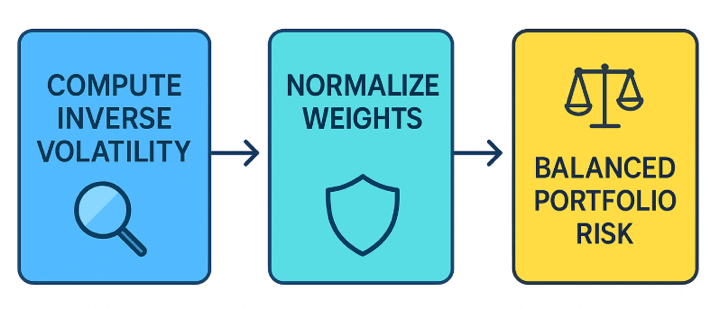
Risk Parity addresses this disparity by shifting the focus from capital to risk. The core objective is to ensure that each asset contributes an equal amount to the total portfolio volatility. The mathematical foundation for this involves calculating the volatility (standard deviation) of each asset and then allocating capital in inverse proportion to that volatility. By assigning higher weights to lower-volatility assets and lower weights to higher-volatility assets, the portfolio reaches a state of "risk equilibrium."
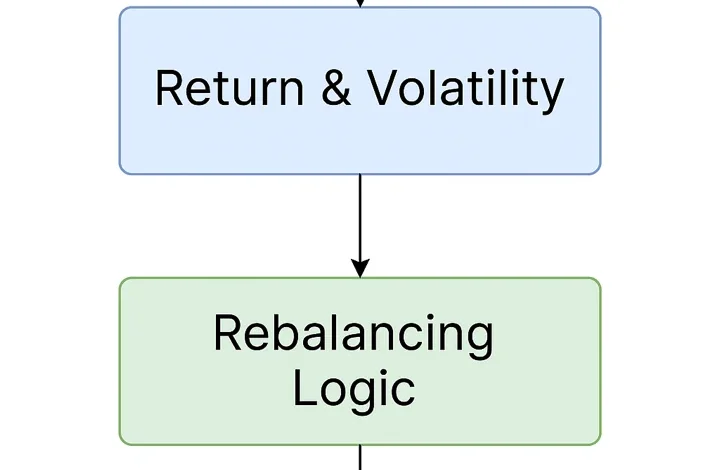
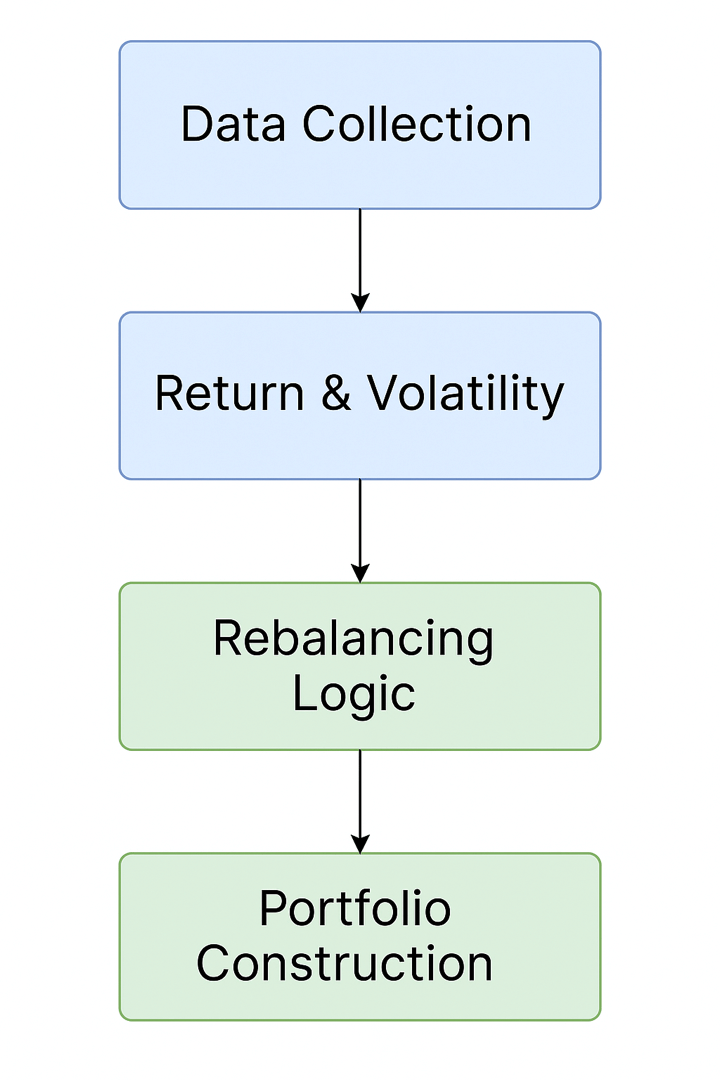
To implement this in a modern trading environment, data scientists utilize Python to automate the rebalancing process. The methodology typically involves fetching historical price data via APIs, such as those provided by Yahoo Finance, and calculating the rolling volatility of each asset. A function is then created to compute the Net Asset Value (NAV) of the portfolio, which is periodically rebalanced to maintain the desired risk-parity weights. This process effectively removes human bias from the equation, replacing it with a data-driven, systematic rule set that adapts as market conditions evolve.
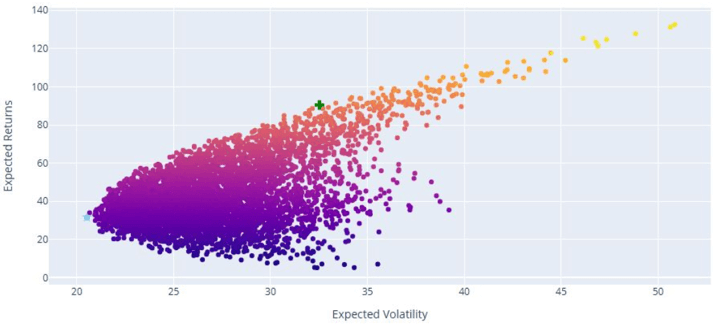
The performance implications of this approach are significant. During periods of market turbulence, traditional portfolios often see their risk profile expand rapidly as volatile assets correlate and move in tandem. A Risk Parity portfolio, by virtue of its inverse-volatility weighting, naturally de-risks by scaling back exposure to assets that exhibit rising volatility. While this strategy may occasionally lag behind a concentrated, high-growth portfolio during a euphoric bull market, its true value is demonstrated in its superior risk-adjusted returns and its ability to withstand market regime shifts.
Beyond basic Risk Parity, the financial industry has developed even more advanced methodologies, such as Hierarchical Risk Parity (HRP). HRP utilizes machine learning clustering techniques to detect the relationships between assets—identifying which assets tend to move together—and allocates risk based on these underlying structures. This mitigates the instability often found in classical models, as it does not rely on a simple covariance matrix, which can become noisy or unreliable during periods of extreme market stress. Other strategies, such as the Black-Litterman model, further refine these concepts by allowing investors to combine market equilibrium with their own subjective views, creating a hybrid approach that balances professional rigor with practical investment intuition.
The broader implications for the investment community are clear: the democratization of quantitative tools has made it possible for individual investors to move beyond "gut-feeling" investing. By leveraging Python, pandas, and financial data libraries, an investor can now simulate thousands of scenarios to test how their allocation would behave under historical stress events, such as the 2008 financial crisis or the 2020 pandemic-induced volatility. This shift toward systematic, data-backed portfolio management is not merely a trend but a necessary evolution in an increasingly complex global market.
However, it is essential to acknowledge the limitations of these models. Risk Parity is inherently backward-looking, as it relies on historical volatility to predict future behavior. If a market regime shifts fundamentally—for example, if a low-volatility asset suddenly becomes highly volatile due to a structural economic change—the model may require time to adjust. Furthermore, frequent rebalancing, while necessary to maintain the risk-parity target, can lead to higher transaction costs and tax implications. Therefore, the frequency of rebalancing must be carefully calibrated to balance the goal of risk mitigation against the realities of execution costs.
Looking ahead, the integration of factor-based allocation—where portfolios are constructed not just by asset class but by underlying economic drivers like value, momentum, or quality—is becoming the new standard for institutional portfolios. The synergy between Risk Parity and factor investing represents a frontier where risk is not just balanced, but actively managed across multiple dimensions.
For the serious investor, the path forward involves continuous learning. Understanding the nuances of covariance matrices, the impact of asset correlations on portfolio variance, and the effectiveness of Monte Carlo simulations in stress-testing is critical. These competencies are no longer reserved for hedge fund managers; they are accessible skills that can be acquired through structured quantitative finance education. Whether through exploring dedicated learning tracks in portfolio management or enrolling in comprehensive algorithmic trading programs, the objective remains the same: to move away from the fragility of subjective, concentrated bets and toward the resilience of a scientifically constructed portfolio.
In conclusion, while the allure of picking the "next big stock" remains a constant in financial media, the data consistently favors the disciplined, systematic allocator. Risk Parity serves as a powerful testament to the idea that how you hold your assets is as important as which assets you hold. By shifting the focus from equalizing capital to equalizing risk, investors can construct portfolios that are not only more resilient to the inevitable cycles of the market but are also better aligned with the long-term goal of wealth preservation and steady, sustainable growth. As market complexity grows, those who embrace these quantitative foundations will find themselves better equipped to navigate the uncertainty of the modern financial landscape.
Related posts: