Fine-Tuning vs. Frozen Embeddings: When to Adapt the LLM vs. the Sklearn Head

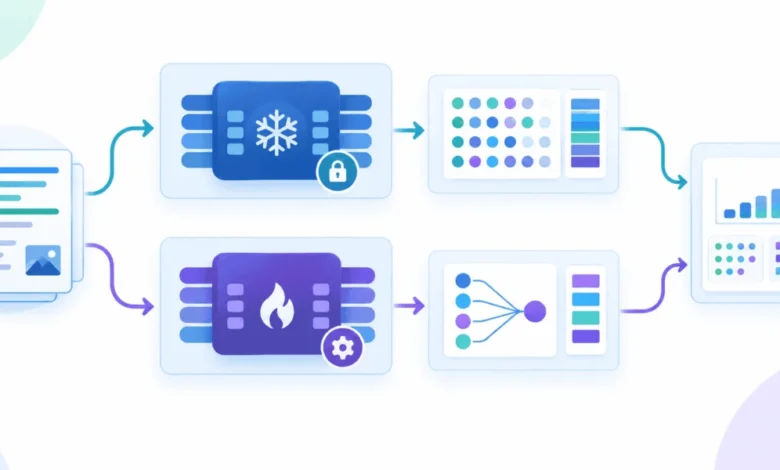
The rapid proliferation of Large Language Models (LLMs) has fundamentally altered the landscape of natural language processing (NLP), shifting the paradigm from training specialized models from scratch to adapting general-purpose architectures for niche domains. As developers and data scientists grapple with the computational costs and technical complexities of deploying these models, two distinct strategies have emerged as the primary contenders for domain adaptation: full or parameter-efficient fine-tuning (PEFT), such as Low-Rank Adaptation (LoRA), and the utilization of frozen embeddings paired with lightweight downstream classifiers. While the former modifies the internal architecture of the LLM to align with specific datasets, the latter treats the model as a static feature extractor, delegating the decision-making process to traditional machine learning algorithms like those found in scikit-learn.
The Evolution of Model Adaptation
Historically, the machine learning community relied heavily on training task-specific models from the ground up, often requiring massive, labeled datasets and significant computational infrastructure. The advent of Transformers and pre-trained LLMs changed this by providing models that already possess a sophisticated understanding of language syntax and semantics. However, "out-of-the-box" models often struggle with domain-specific nuances, such as medical terminology, legal jargon, or industry-specific classification tasks.
Fine-tuning emerged as the gold standard for bridging this gap. By adjusting the model’s weights on a domain-specific corpus, developers could theoretically achieve superior performance. Yet, as models scaled into the billions of parameters, the resource requirements for full fine-tuning became prohibitive for most organizations. This necessity birthed Parameter-Efficient Fine-Tuning (PEFT) methods like LoRA, which freezes the pre-trained weights and injects trainable low-rank matrices into the transformer layers. Simultaneously, the "frozen embedding" approach—popularized by earlier BERT-based pipelines—retained its relevance as a cost-effective, high-speed alternative, particularly for applications where latency and compute budgets are strictly constrained.
Comparative Analysis: Frozen Embeddings vs. LoRA
The fundamental difference between these two strategies lies in where the "learning" occurs. In the frozen embedding approach, the LLM functions as a high-dimensional encoder. Input text is transformed into a fixed-length vector representation—the last hidden state—which is then fed into a classifier, such as a Random Forest or Support Vector Machine (SVM). This method is computationally lightweight because it avoids the expensive backpropagation process through the entire LLM.
Conversely, LoRA fine-tuning directly updates the model’s internal parameters through the injection of adapter matrices. This allows the model to shift its internal representation of language to better suit the specific domain. While this approach generally yields higher accuracy, it requires significantly more GPU time, memory, and specialized hardware to execute successfully.
Practical Implementation and Performance Metrics
In a controlled experiment using the AG News dataset, which categorizes news articles into four distinct classes, the performance gap between these two strategies becomes quantifiable. When employing a frozen Qwen2.5-1.5B model, the feature extraction process—converting text into embeddings—takes approximately 96.5 seconds. The subsequent training of a scikit-learn Random Forest classifier is near-instantaneous, completing in under three seconds. This pipeline achieves a classification accuracy of 82.0%.
When switching to QLoRA (Quantized LoRA) fine-tuning, the results shift. The training process, which involves updating the adapter layers over three epochs, requires approximately 300 seconds of GPU time. The payoff, however, is an increase in accuracy to 87.0%. For many enterprise applications, this 5% gain in accuracy represents a substantial improvement in performance, but it comes at a 300% increase in training time and a corresponding increase in electricity and cloud compute costs.
Technical Considerations for Deployment
The choice between these two methodologies is not merely a matter of accuracy; it is a strategic decision dictated by the project’s specific constraints. The frozen embedding approach is highly attractive for "cold-start" problems or scenarios where labeled data is scarce. Because the underlying LLM remains unchanged, there is little risk of "catastrophic forgetting," a phenomenon where a model loses its general language capabilities while trying to learn new, domain-specific tasks.
Furthermore, the scikit-learn approach offers unparalleled modularity. If the classification requirements change, one can simply re-train the downstream classifier without ever touching the heavy, frozen LLM. This provides a level of agility that is difficult to replicate in fine-tuned environments, where a change in data distribution often necessitates a complete re-run of the fine-tuning process.
On the other hand, QLoRA is indispensable when the "meaning" of the language is highly specialized. In domains such as legal or medical document analysis, where the semantic relationship between words is highly specific to the industry, the structural adjustments made during fine-tuning are often necessary to capture the subtle nuances that a frozen model might treat as noise.
Broader Industry Implications
As the AI industry moves toward more sustainable and cost-efficient development practices, the trend is shifting toward "right-sizing" the solution. The belief that every application requires a fully fine-tuned model is being replaced by a more nuanced understanding of model architecture.
For developers building applications on free-tier cloud environments or edge devices, the frozen embedding strategy is often the only viable path. The ability to use a powerful, pre-trained backbone while keeping the training overhead to a minimum allows small teams to compete with larger organizations that have the budget to sustain intensive fine-tuning operations.
Conversely, the rise of specialized model "hubs" and pre-trained adapters suggests a future where fine-tuning is increasingly automated. As tools like Hugging Face’s transformers and peft continue to evolve, the barrier to entry for fine-tuning will lower, potentially closing the gap between these two strategies. However, the fundamental trade-off between "fast-and-cheap" (frozen embeddings) and "optimized-and-accurate" (fine-tuning) is likely to persist.
Conclusion and Strategic Recommendations
The decision to prioritize either frozen embeddings or LoRA fine-tuning should be based on three primary factors: accuracy requirements, available compute budget, and the nature of the data.
- When to use Frozen Embeddings: This strategy is recommended when the objective is to build a high-speed, cost-effective classifier where a baseline level of accuracy is sufficient. It is also ideal for rapid prototyping and iterative development where the training data may change frequently.
- When to use QLoRA: This approach is the superior choice for high-stakes applications where every percentage point of accuracy is critical. It is also the necessary route when the domain language is so distinct from general web-scraped data that the model’s internal representations must be fundamentally reconfigured.
Ultimately, both approaches represent a sophisticated use of modern LLMs. By understanding the mechanical differences and the resulting performance trade-offs, developers can avoid the "over-engineering trap" and ensure that their resource allocation matches the business requirements of their specific project. As the AI field matures, the ability to discern when to modify the model’s weights versus when to simply "listen" to its output will remain a hallmark of effective machine learning engineering.