AI-Driven Risk Management: Redefining Algorithmic Trading with LLM-Assisted Decision Architectures

The integration of Large Language Models (LLMs) into algorithmic trading has historically been hampered by a fundamental misapplication of technology: the attempt to utilize these models as predictive engines for market direction. Industry experts, including quantitative researcher Ernie Chan, have consistently noted that predicting next-day returns for highly liquid assets like Apple Inc. (AAPL) remains a task that no current statistical, machine-learning, or language-based model can perform with a reliable, repeatable edge. However, a shift in methodology is emerging. By pivoting from direction-forecasting to risk-assessment, developers are now utilizing models like DeepSeek to act as sophisticated risk managers, creating a new paradigm in automated portfolio management.
This evolving strategy replaces the traditional "buy/sell" logic with a regime-aware, state-based approach. Rather than querying an LLM on whether a stock will rise or fall, the system provides the model with historical statistical context—such as mean returns, standard deviations, and Sharpe-like performance metrics—for specific market states. The LLM then determines the appropriate level of exposure, effectively functioning as an automated risk manager that navigates market volatility through nuanced, state-dependent decision-making.
The Shift from Predictive Modeling to Risk Management
The failure of early LLM trading attempts was largely rooted in the "next-day prediction" fallacy. Markets, particularly large-cap equities, are characterized by high levels of noise and stochastic behavior that defy deterministic prediction. By re-framing the objective, developers have identified that LLMs excel at distinguishing between market regimes—such as periods of high volatility versus calm, or trending versus sideways movement—that a standard rule-based threshold would treat with rigid, binary logic.
In this updated framework, the LLM processes compact numeric summaries of historical market performance. It outputs a policy table that dictates position sizing, typically ranging from 50% to 100% long exposure. By opting for a 50% floor rather than a full exit, the strategy ensures continued participation in long-term market drift, mitigating the "opportunity cost" associated with premature exit signals during temporary market pullbacks. This approach acknowledges that while the LLM may lack the ability to time the market, it possesses the qualitative capacity to understand whether a current environment warrants a conservative or aggressive stance.
Implementation: The Walk-Forward Architecture
To ensure robustness, the strategy employs a monthly walk-forward loop. This methodology is critical for maintaining "honesty" in backtesting. At the start of each month, the model utilizes the preceding three years of data to build a fresh policy table. This temporal separation ensures that no future data leaks into the decision-making process of the current month.
The architecture is supported by a three-layer system:
- Feature Engineering: Raw OHLCV (Open, High, Low, Close, Volume) data is transformed into a set of seven distinct signals, which are then discretized into 12 recognizable market states.
- LLM Policy Layer: The model consumes these states and historical metrics to assign an exposure level, effectively balancing risk based on historical outcomes.
- Hard Guardrails: Independent of the LLM, a layer of automated safety triggers—including volatility stops and drawdown limits—acts as a failsafe to prevent catastrophic losses during unprecedented market events.
Addressing the Guardrail Deadlock
A persistent issue in automated trading systems is the "guardrail deadlock." Historically, if a drawdown-based stop loss triggers a total exit from the market, the strategy’s equity remains frozen at the point of exit. Because the equity is static, it cannot recover to the peak levels required to reset the stop-loss condition, potentially keeping the system sidelined indefinitely.
Recent implementations have addressed this through a forced re-entry mechanism. By setting a "cooldown" period (e.g., 10 days), the strategy mandates that even if the market remains in a volatile state, the system will re-engage a portion of its capital. This ensures the portfolio remains dynamic and capable of recovering from the specific event that triggered the initial risk-off signal.
Empirical Performance and Data Verification
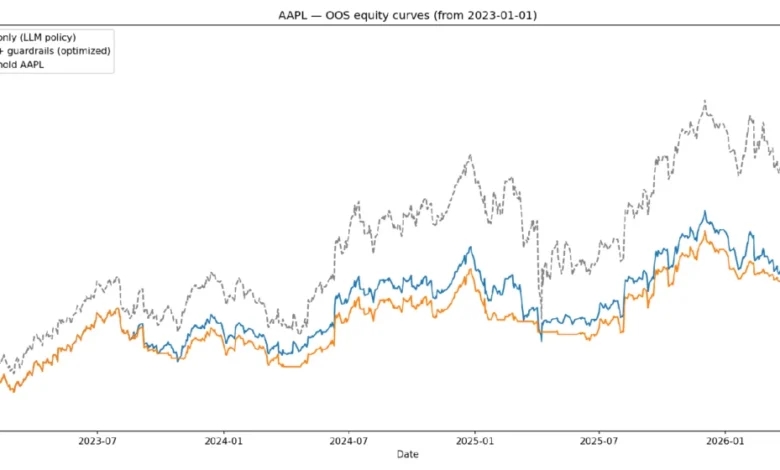
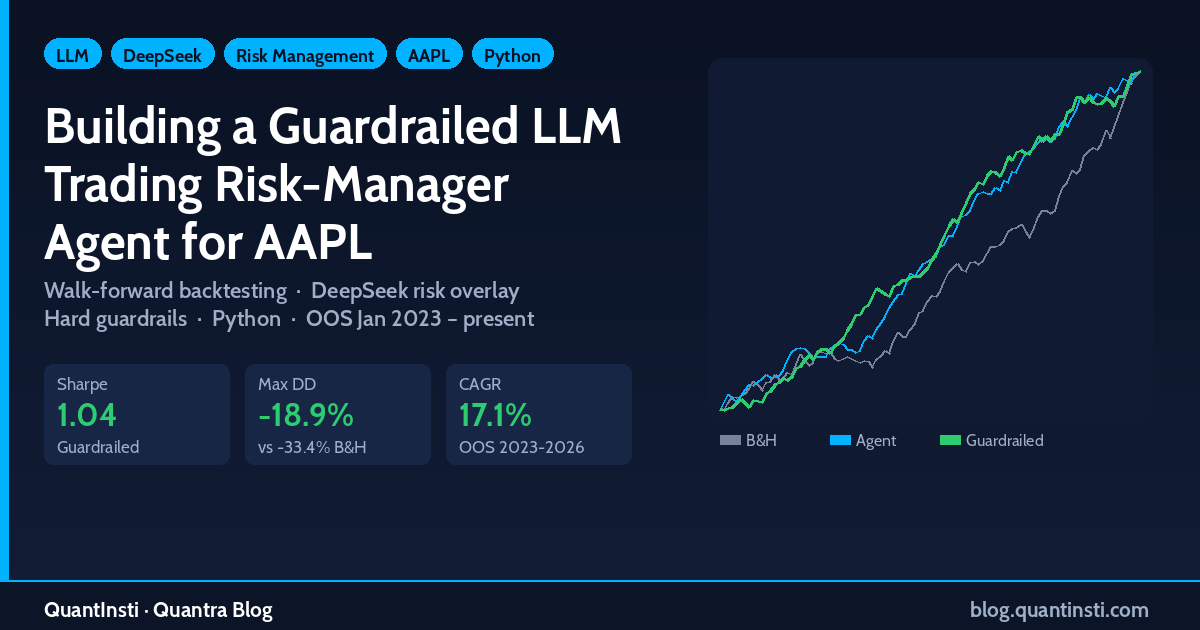
When verified against out-of-sample (OOS) data spanning from January 2023 to the present, the results illustrate the trade-offs inherent in risk-managed algorithmic strategies. While a pure buy-and-hold strategy on a high-growth stock like AAPL might yield a higher cumulative annual growth rate (CAGR) during sustained bull markets, the risk-managed LLM approach provides a significantly lower maximum drawdown.
Data from the 2023–2026 period indicates that while the LLM-assisted strategy may trail in pure return, it consistently demonstrates a more favorable risk-adjusted profile. During periods of high market stress, the guardrails effectively trimmed exposure, preventing the compounding of losses. The divergence between the "Agent-only" and "Agent-plus-Guardrails" equity curves highlights the efficacy of the safety layer, which, while reducing overall CAGR by a marginal amount, successfully protected capital during sharper corrections.
Industry Implications and Future Research
The implications for institutional and retail quantitative trading are significant. This strategy proves that LLMs do not need to replace the core trading engine; rather, they serve as a powerful "overlay" for existing systems. The ability of an LLM to parse human-readable, state-based logic allows for more flexible, adaptive strategies than those constrained by static, hard-coded rules.
Future iterations of this research are focusing on several key areas:
- Multi-Horizon Momentum: Incorporating 5-day and 63-day cumulative returns to provide the model with a better understanding of trend maturity.
- Macro Regime Filters: Using broader market indicators, such as the S&P 500’s position relative to its 200-day moving average, to provide a wider context for individual stock movements.
- Earnings Blackouts: Automatically forcing a neutral stance during quarterly earnings releases to mitigate gap-risk, an event-based approach that removes the model’s reliance on historical pattern-matching for news-driven volatility.
Expert Perspectives on AI in Quantitative Finance
While the adoption of AI in finance is accelerating, caution remains the industry standard. Financial analysts note that the reliance on LLMs introduces "black box" elements that require strict validation protocols. The use of strict JSON-formatted outputs and retry mechanisms within the current code reflects a broader industry movement toward "constrained AI," where the model’s creative potential is harnessed within the strict bounds of programmatic necessity.
Furthermore, the cost-efficiency of modern models, such as DeepSeek, has lowered the barrier to entry for these sophisticated frameworks. An entire month of walk-forward backtesting can be conducted for under $0.10 in API costs, making it a viable tool for individual traders and small firms alike.
Conclusion: A Framework for Continuous Improvement
The current iteration of this strategy is not a definitive solution but a foundation for further inquiry. It demonstrates that the value of AI in trading is derived from the augmentation of human decision-making and risk control. By systematically moving away from the "prediction" trap and toward "regime-aware risk management," developers are creating systems that are more resilient to the inherent uncertainties of the financial markets.
As the field of "agentic AI trading" continues to evolve, the emphasis will likely remain on transparency, rigorous backtesting, and the maintenance of human-directed guardrails. The strategy described herein offers a replicable, logical framework for those looking to explore the intersection of artificial intelligence and quantitative finance, providing a scalable model that can be refined through iterative research and development. The objective remains clear: not to guess what the market will do, but to define precisely how much risk the portfolio should assume in any given, observed state of the world.