Part 6 of 6 Statistical Arbitrage for Independent Traders: A Comprehensive Analysis of Triangulated Strategies and Modern Quantitative Infrastructure

The landscape of quantitative trading for independent operators has undergone a profound structural shift over the past decade. Historically, statistical arbitrage—specifically equity pairs trading—was dominated by well-capitalized institutional hedge funds operating ultra-low-latency execution systems. However, retail and independent quantitative traders are increasingly deploying sophisticated, factor-driven strategies that leverage cloud infrastructure, programmatic APIs, and advanced machine learning filters. At its core, statistical arbitrage operates on the principle of mean reversion: two economically related financial instruments drift apart in price temporarily, and the trader bets on their eventual convergence. While traditional pairs trading remains the canonical execution method for this approach, it suffers from severe capital inefficiency and signal wastage, making it suboptimal for solo quantitative operators managing finite pools of capital.
To overcome these structural limitations, quantitative researchers have pioneered Triangulated Statistical Arbitrage. This advanced methodology bypasses the rigid, binary constraints of traditional pairs trading by constructing a clean, ranked universe of high-probability pairs, flattening those pairs into distinct per-ticker views, and subsequently aggregating across the broader network. Instead of trading isolated pairs, the operator manages a diversified portfolio of individual ticker legs. This approach optimizes capital allocation, increases signal robustness, and mitigates the idiosyncratic risks associated with single-pair breakdowns. Recent live production data indicates that properly resourced triangulated frameworks generate vastly superior risk-adjusted returns compared to legacy dual-leg models, fundamentally altering how independent traders approach market-neutral strategies.

The Chronology of Research and Development
The evolution of Triangulated Statistical Arbitrage did not occur in a vacuum; it represents the culmination of a rigorous, multi-month development and live-testing lifecycle conducted within quantitative research communities. The timeline of this financial engineering initiative highlights the iterative nature of modern algorithmic trading strategy design:
- Months 1 through 2 (Upstream Universe Construction): Researchers focused intensely on the foundational layer of the strategy—pair selection. Abandoning traditional, computationally heavy cointegration tests in favor of direct return-based mean-reversion metrics, the team processed over 24 months of historical equity data across thousands of candidate stocks to build a reliable monthly pair universe.
- Months 3 through 4 (Network Triangulation and Aggregation): The framework shifted from a pair-centric view to a ticker-centric view. Algorithms were developed to aggregate z-scores across multiple overlapping pairs for a single equity asset, resolving the capital inefficiency of traditional pairs trading while filtering out middle-distribution market noise.
- Month 5 (Feature Integration and False-Signal Reduction): Research expanded into exogenous data layers, specifically examining volume asymmetries, news sentiment, and earnings surprises. While volume-based features proved redundant when combined with robust upstream pair selection, earnings surprise filters demonstrated a critical capability in identifying fundamental price realignments versus temporary technical divergences.
- Month 6 and Beyond (Live Production Deployment): Following extensive backtesting and community-driven stress testing, the production version of the Triangulated Statistical Arbitrage framework was deployed into live trading environments, supported by real-time end-of-day and intraday hourly spread data APIs.
Deconstructing the Three-Tiered Methodological Framework
The success of a production-grade statistical arbitrage system relies on a strict hierarchy of operational components. Quantitative analysis reveals that not all parts of the pipeline contribute equally to final portfolio alpha; rather, the system exhibits a pronounced law of diminishing marginal returns.
1. High-Quality Pair Selection: The Load-Bearing Foundation
Pair selection represents the single most critical determinant of strategy success, accounting for an estimated 80% to 90% of total system performance. If the foundational universe of pairs contains structurally broken or non-converging assets, no downstream signal processing or machine learning filter can rescue the portfolio.
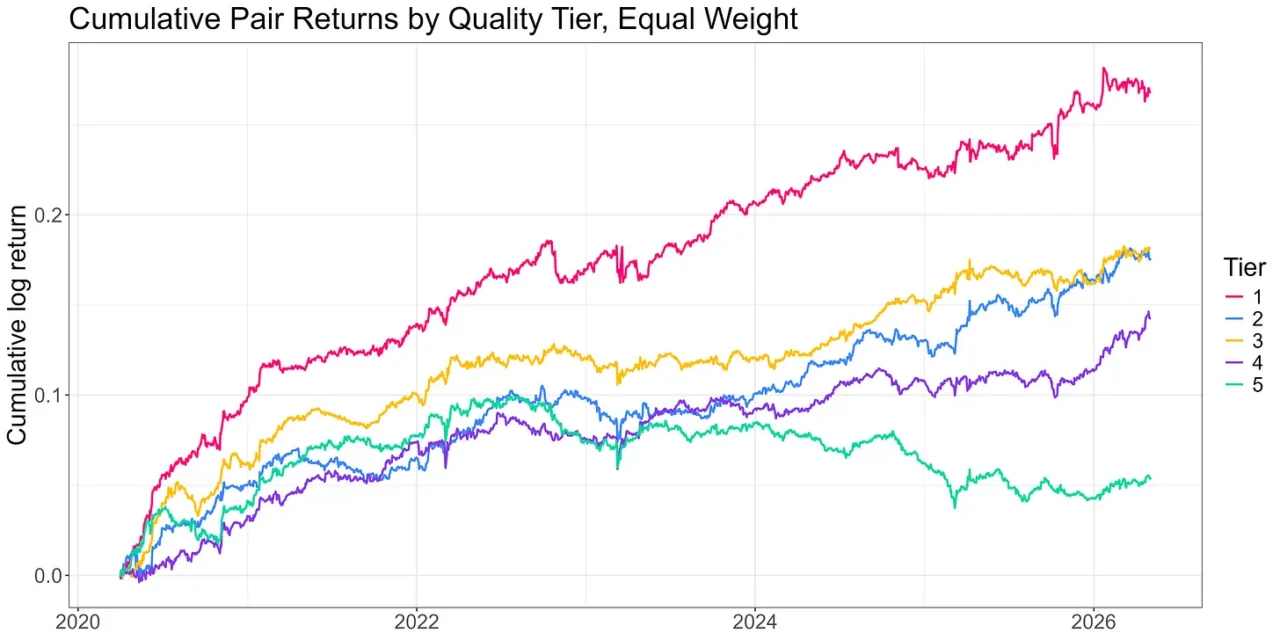
In advanced quantitative frameworks, pair quality is evaluated through two primary metrics. The first measures frictionless returns generated by trading mean reversion over a specified lookback window, ensuring that buying the undervalued asset and shorting the overvalued asset yields positive returns in a theoretical zero-cost environment. The second metric measures convergence consistency, verifying whether a spread reliably returns to its historical mean after diverging, rather than drifting indefinitely or converging purely by random chance at the tail end of a formation period.
By exporting the top 10% of pairs derived from this unconventional ranking system—while enforcing strict economic and liquidity constraints—researchers create a stratified hierarchy. When divided into five operational tiers, empirical data confirms a stark divergence in performance. Tier 1 pairs consistently achieve annualized Sharpe ratios approximately four times higher than Tier 5 pairs. This upstream curation dwarfs any marginal alpha generated by downstream signal modifications, underscoring the necessity of painstaking, careful data preparation over naive algorithmic brute force.
2. Triangulation and Consistency: Solving Capital Inefficiency
Traditional pairs trading forces an operator to lock up capital in rigid two-legged structures, often leading to uninvested cash buffers and ignored signals. Triangulated Stat Arb solves this by translating pair relationships into a unified network of individual ticker views.
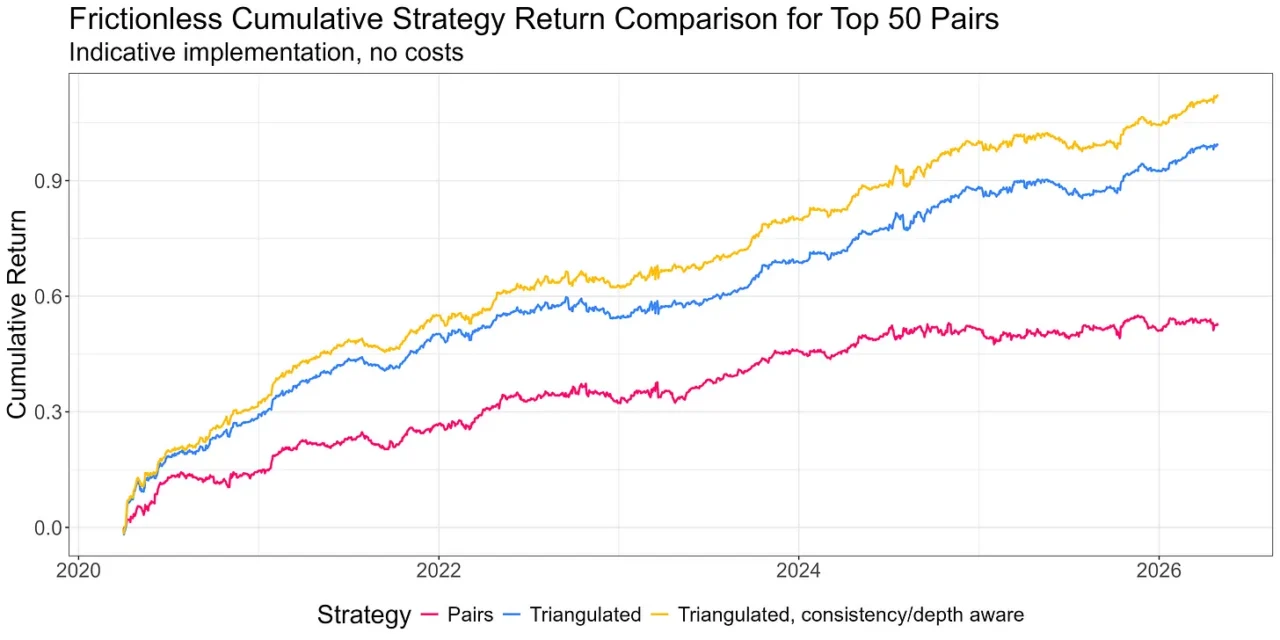
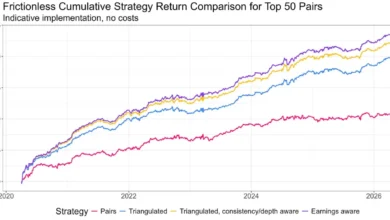
For every equity ticker appearing within the approved pair universe, the algorithm evaluates every pair containing that specific asset. Each relationship generates a directional view and a standardized z-score indicating deviation from the rolling mean. Aggregating these views provides a powerful, multi-corroborated consensus signal. Furthermore, empirical testing demonstrates that restricting execution to the tails of the aggregated distribution—discarding the noisy middle 50% of names—materially enhances risk-adjusted returns. A portfolio constructed using triangulated, depth-aware, and consistency-filtered ticker legs vastly outperforms an equal-weighted basket of raw pairs.
3. Exogenous Filtering: Avoiding Fundamental Re-pricing Traps
A statistical arbitrage signal identifies price divergence but cannot inherently determine the underlying economic catalyst driving the separation. A spread that triggers a short position on an expensive leg behaves identically whether the movement is caused by temporary institutional flow (which is highly fadable) or a permanent fundamental re-pricing driven by unexpected corporate news (which destroys the mean-reversion thesis).
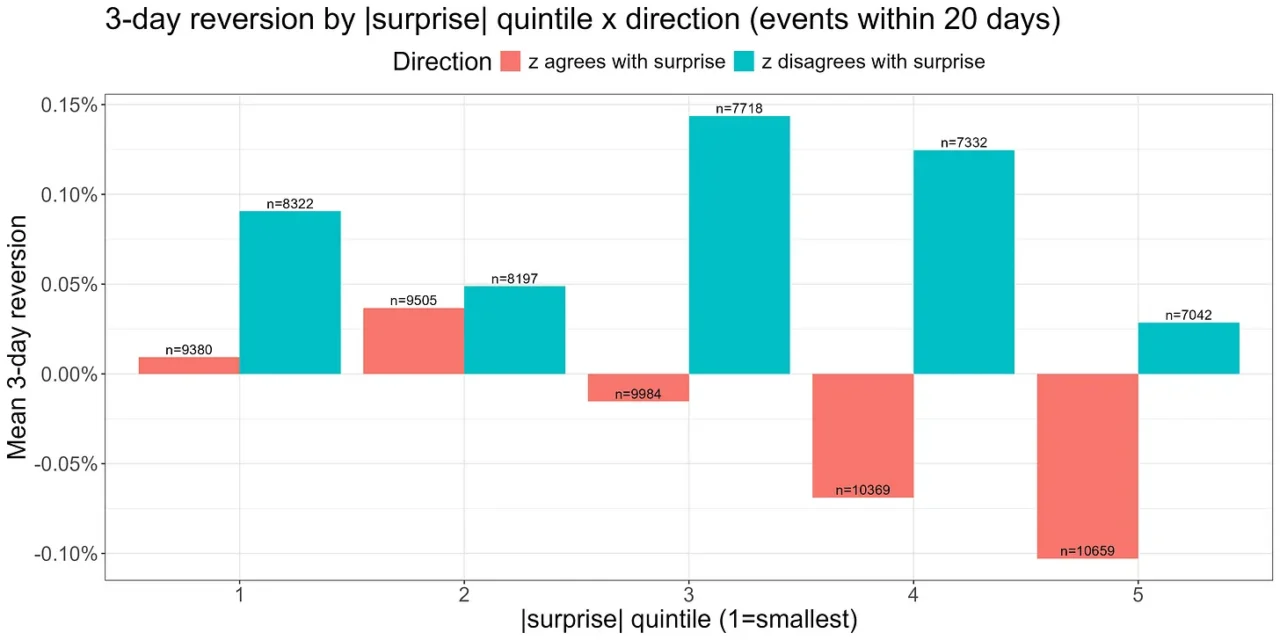
To prevent catastrophic drawdowns from "getting run over" by structural market shifts, modern frameworks integrate event-driven filters. While volume-based asymmetry features often yield redundant information once upstream pair quality is optimized, earnings surprise filters provide a vital protective barrier. Empirical return distributions indicate that when a stock diverges in the direction of an unexpected earnings surprise during its formation period, subsequent price reversion collapses; instead, the asset frequently exhibits return continuation driven by post-earnings announcement drift. Consequently, integrating systematic earnings filters successfully eliminates false mean-reversion signals, adding a crucial layer of downside protection to live portfolios.
Industry Implications and Quantitative Infrastructure
The democratization of quantitative finance has created new paradigms for independent operators. Building and maintaining the data infrastructure required to execute Triangulated Statistical Arbitrage—involving the daily ingestion, cleaning, and ranking computation of hundreds of thousands of equity pairs—typically exceeds the operational budgets and engineering bandwidth of solo traders.
Industry experts emphasize that centralized research platforms and specialized API feeds are bridging this gap. By providing pre-computed foundational universes, historical datasets, and customizable configuration notebooks, modern quantitative ecosystems empower independent traders to calibrate parameters such as universe size, signal thresholds, no-trade buffers, and leverage to match their individual risk tolerances and account sizes.
Ultimately, the implementation of Triangulated Statistical Arbitrage proves that sustainable edge in modern equity markets stems from structural clarity rather than computational complexity. By understanding the strict hierarchy of alpha generation—where meticulous upstream pair selection forms the bedrock, network triangulation maximizes capital efficiency, and event filters protect against structural shocks—independent operators can successfully navigate complex quantitative markets while retaining complete operational independence.