Another Subprime Auto Dealer-Lender, America’s Car-Mart, Files for Bankruptcy, Sells its Assets, Wipes Out Stockholders


America’s Car-Mart, a prominent player in the subprime auto lending sector, officially filed for prepackaged Chapter 11 bankruptcy this week, marking a significant milestone in the ongoing decline of the specialized used-vehicle financing industry. The company, which has long operated by pairing high-margin vehicle sales with high-interest, in-house loans for credit-challenged consumers, saw its financial architecture collapse under the weight of mounting delinquencies and unsustainable debt obligations.
Alongside the parent company, five key subsidiaries—including Colonial Auto Finance, Texas Car-Mart, Colonial Underwriting, and Auto Finance Investors—have also sought bankruptcy protection. These entities have requested that the court handle their cases under joint administration to streamline the restructuring process.
The Asset Sale and Corporate Future
Under the terms of the proposed prepackaged plan, America’s Car-Mart has entered into an agreement to sell substantially all of its operating assets to Cardinal Asset Holdings LLC. This investment group was formed specifically to acquire the dealer chain’s infrastructure. Crucially, the deal involves the sale of the business assets rather than the corporate entity itself.
The company has indicated that the proceeds from this sale should provide sufficient liquidity to settle obligations with unsecured trade creditors. However, the outlook for existing shareholders is grim; the remaining corporate shell is widely expected to be left with little to no value, effectively wiping out equity holders. The proceedings remain subject to court oversight, and the company has signaled that it will entertain higher or better bids should they emerge during the bankruptcy process.
Interestingly, the leadership at the helm of the acquiring entity, Cardinal Asset Holdings, carries significant institutional memory. The CEO of Cardinal, Tilman J. Falgout III, served as the chairman of America’s Car-Mart until 2011. His current professional portfolio includes roles as a Senior Executive Advisor at the private equity firm Brookside Equity Partners and as the Chairman of the dealer chain Superior Auto Group.
A Chronology of Decline
The collapse of America’s Car-Mart did not occur in a vacuum; it is the culmination of a multi-year erosion of the subprime auto market. As of July 31, the company reported operating 94 dealerships, a stark contrast to its previous footprint, having already shuttered 60 locations in an attempt to stem operational losses.
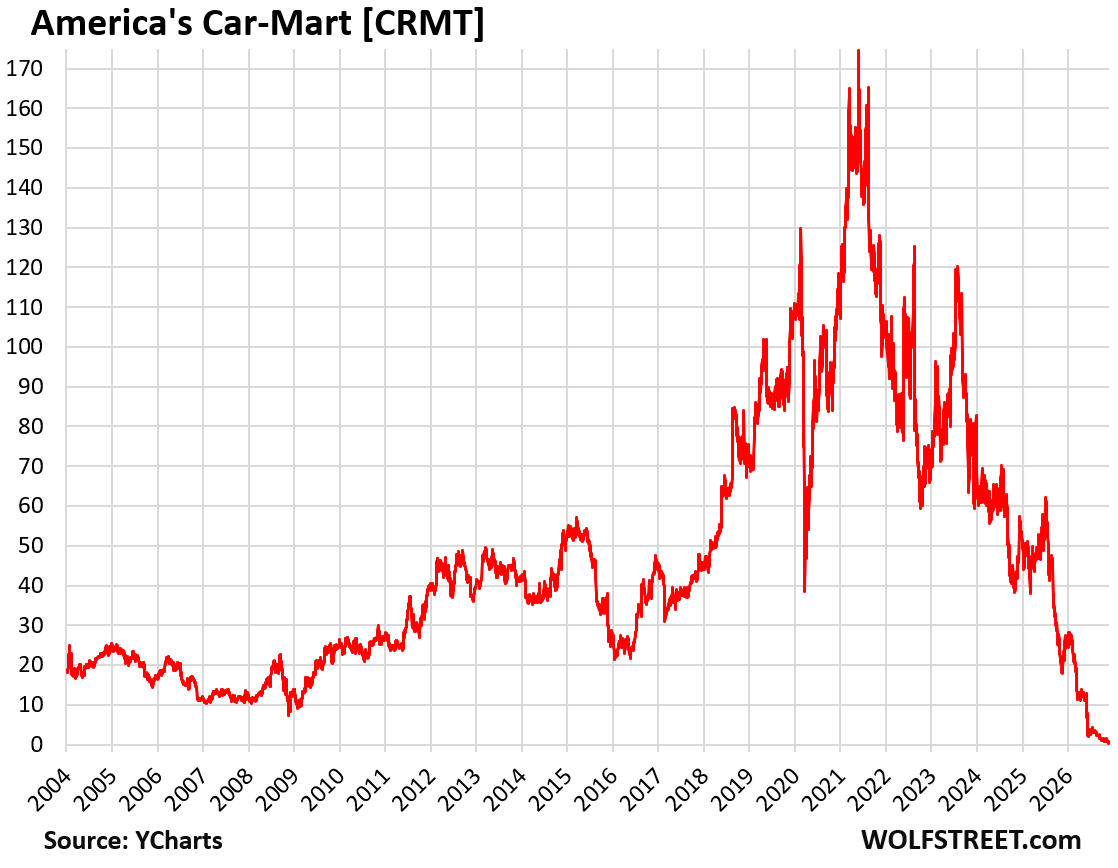
The first public signs of structural distress emerged in December 2023, when the company issued a sobering confession regarding its financial health. The market reaction was swift, with shares [CRMT] plummeting 21% in a single session. This drop was part of a larger trend, as the stock had already lost 61% of its value from its all-time high of $174.52, achieved during the liquidity-rich era of May 2021.
By November 2024, the situation had deteriorated further, with the stock officially entering the "imploded" category—defined by a decline of at least 70% from its peak. Today, the stock is effectively a penny stock, trading at approximately 31 cents. The broader sector has suffered similar fates; in October 2025, the industry witnessed the high-profile collapse of Tricolor, another major subprime dealer-lender, which failed amid intense scrutiny and allegations of fraud regarding its lending practices and securitization reports.
The Mechanics of the Failure: Debt and DIP Financing
The immediate catalyst for the bankruptcy filing was the company’s inability to service a $300 million senior secured loan held by Silver Point Capital. Throughout 2026, the company engaged in multiple rounds of negotiations to extend the maturity of this debt and waive covenant violations. In June 2026 alone, the credit agreement was amended to provide temporary relief, a maneuver that cost the company $18 million in lender fees.
Following these unsuccessful attempts to restore financial stability, the company secured a $60 million "Debtor-in-Possession" (DIP) financing package, also provided by Silver Point Capital. DIP financing is a critical, albeit expensive, lifeline that allows a company to continue day-to-day operations while in bankruptcy. These loans carry a significant premium, with interest rates currently calculated at the Secured Overnight Financing Rate (SOFR) plus 10.50%, placing the cost of capital at approximately 14.4%.
Furthermore, the agreement includes a "roll-up" provision, where $65 million of the existing defaulted debt is converted into the new, higher-priority DIP facility. This move effectively moves Silver Point Capital to the front of the line in terms of repayment priority, further marginalizing other stakeholders.
Industry-Wide Implications and Market Squeeze
The business model of subprime dealer-lending relies on a delicate balance: purchasing older vehicles at wholesale prices, selling them at significant markups, and profiting from the interest spread on high-risk loans. These loans are then bundled into Asset-Backed Securities (ABS) and sold to institutional investors.
This model became increasingly untenable as the Federal Reserve raised policy interest rates. When risk-free Treasury bills began yielding over 4% to 5%, the appetite for subprime-backed securities waned. Investors who had previously accepted a 5% yield on ABS when interest rates were near zero demanded significantly higher returns to compensate for the default risks. This created a "funding gap" where the cost of originating loans far outpaced the ability to sell those loans into the secondary market.
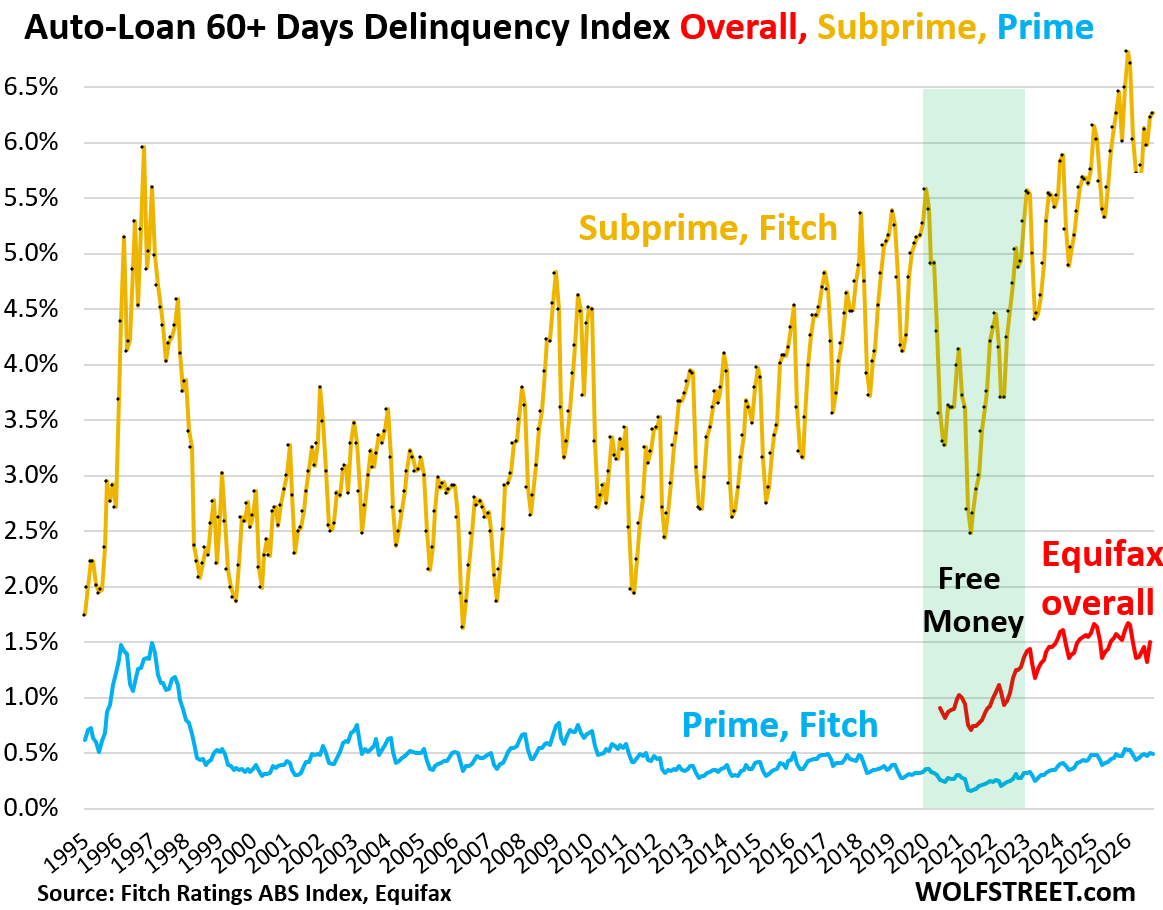
Compounding these macroeconomic pressures were the internal failures of reckless underwriting. As consumer credit quality tightened, the volume of non-performing loans began to spike. Fitch Ratings has tracked a consistent rise in default rates for subprime auto ABS, with new highs recorded in late 2025 and throughout 2026. The collapse of major players like Tricolor exacerbated these trends, as the liquidations of their portfolios flooded the market with distressed assets, further suppressing recovery values.
The Broader Economic Context
The delinquency rates for subprime auto loans are now reaching levels that pose systemic questions for the auto financing sector. Recent data indicates that the 60-plus day delinquency rate for auto loans has shown a consistent upward trajectory. While prime auto loans remain relatively stable, the subprime segment—which represents the primary customer base for dealers like America’s Car-Mart—is showing clear signs of exhaustion.
For consumers, the failure of America’s Car-Mart creates immediate uncertainty. While the company has stated that its remaining 94 dealerships will continue to operate during the bankruptcy process, the long-term management of these subprime portfolios remains an open question. If these assets are eventually liquidated or sold to third-party debt collectors, the frequency and intensity of collection efforts could increase, potentially creating a secondary wave of financial pressure on the most vulnerable borrowers.
The bankruptcy of America’s Car-Mart serves as a definitive case study in the risks of the subprime auto-finance loop. When the cycle of "easy money" dries up, and the underlying assets—used vehicles—cannot sustain the inflated price points required to keep the lending profitable, the entire structure is prone to rapid, cascading failure. For institutional investors, the "A-rated" slices of subprime ABS are no longer viewed with the same confidence as they were in the mid-2020s. As the court prepares to oversee the sale of these assets, the industry will be watching closely to see if any buyer can successfully navigate the wreckage left behind by a model that prioritized volume and high-interest yield over sustainable credit quality.