Average 401k Balance by Age — How Your Savings Stack Up (And What You Actually Need for FI)

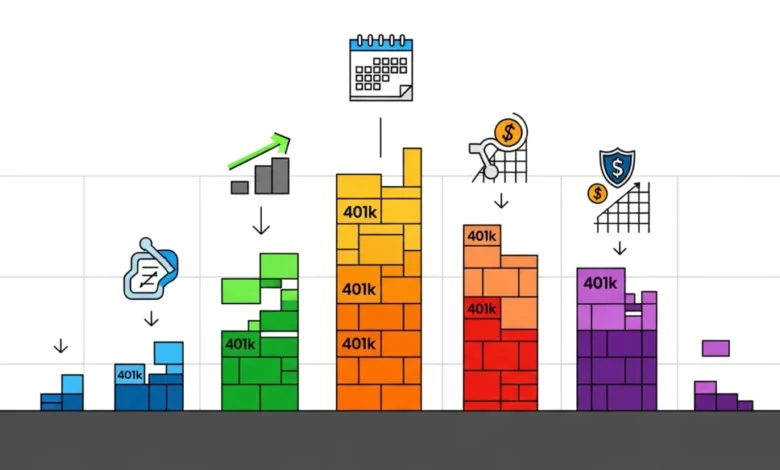
For those pursuing Financial Independence (FI) or early retirement, these national benchmarks serve as a sobering baseline. While traditional retirement planning focuses on reaching a target by age 65, the FI community utilizes these figures to measure the "gap" between conventional savings rates and the aggressive targets required to exit the workforce decades ahead of schedule.
Statistical Disparities: Average vs. Median Balances
In financial reporting, the distinction between "average" and "median" is not merely academic; it represents the difference between a skewed perception of wealth and the actual midpoint of the population. The average 401(k) balance is calculated by dividing the total assets by the number of participants. Consequently, individuals with multi-million dollar balances pull the average upward, creating an inflated sense of security for the general public.
In contrast, the median represents the exact middle point: half of the population has more, and half has less. In every age bracket, the average 401(k) balance is typically two to three times higher than the median. For example, in the 45–54 age group, the average balance is approximately $179,200, while the median is just $61,530. This suggests that while a few individuals are exceptionally well-prepared, the typical worker in their peak earning years has saved significantly less than what traditional models recommend for a comfortable retirement.
Data Breakdown by Age Group
Based on 2023 plan year data, the following figures represent the current state of 401(k) savings in the United States:
- Under 25: The entry-level workforce holds an average balance of $7,351, with a median of $2,816. The deferral rate for this group is approximately 7%.
- Ages 25–34: As careers stabilize, the average rises to $37,557, but the median remains modest at $14,933.
- Ages 35–44: In the middle of the career arc, the average hits $97,020, while the median sits at $36,117.
- Ages 45–54: During peak earning years, the average reaches $179,200, yet the median is only $61,530.
- Ages 55–64: Approaching traditional retirement age, the average is $256,244, but the median is $89,716.
- Ages 65 and Older: For those at or past retirement age, the average is $272,588, with a median of $87,725.
These figures highlight a critical vulnerability: half of all Americans aged 55 to 64 are entering their final decade of work with less than $90,000 in their primary employer-sponsored retirement account.
The FI-Adjusted Benchmark: A Different Standard
For individuals targeting Financial Independence, the national medians are often viewed as a cautionary tale rather than a goal. The FI movement operates on the "Rule of 25," which dictates that one must accumulate 25 times their annual expenses to sustain a 4% safe withdrawal rate indefinitely.
Under this framework, a household spending $60,000 per year requires an FI number of $1.5 million. When compared to the national median for a 45-year-old ($61,530), the "FI Gap" becomes apparent. To retire at age 50, a 35-year-old would ideally need approximately $480,000 already invested to stay on track, assuming a 7% real annual return. The disparity between the $36,117 national median and the $480,000 FI target illustrates why aggressive savings rates—often 30% to 50% of income—are the primary lever for early retirement.
The Concept of Coast FI
A pivotal milestone in the journey to financial independence is "Coast FI." This is the point where an individual has enough in their retirement accounts that, even without further contributions, the balance will grow to reach the full FI number by their target retirement age through compound interest alone.
For instance, a 35-year-old with a $1.25 million FI target for age 60 would reach Coast FI once they have approximately $230,000 invested. Reaching this milestone fundamentally alters an individual’s relationship with labor, often allowing them to transition to lower-stress "Barista FI" roles or part-time work, as they no longer need to save for the future, only cover their current lifestyle expenses.
Strategic Accumulation by Decade
To bridge the gap between the national median and financial independence, financial experts suggest a decade-by-decade strategy focused on tax optimization and contribution discipline.
The Foundation: Your 20s
The primary objective for workers in their 20s is to secure the employer match. This is often described as a "guaranteed 100% return" on investment. Data shows that a ten-year head start can result in a nearly $400,000 difference in final balances due to the power of compounding. For those starting at age 22, the goal is to automate a 15% savings rate before lifestyle inflation takes root.
The Acceleration: Your 30s
In the 30s, the focus shifts to maximizing tax-advantaged buckets beyond the 401(k), such as Health Savings Accounts (HSAs) and Roth IRAs. This decade is often where "lifestyle creep"—the tendency to increase spending as income rises—becomes the greatest threat to FI. High-earners in this bracket often prioritize the traditional 401(k) to lower their current taxable income while simultaneously building a "bridge fund" in a taxable brokerage account to fund the years prior to age 59½.
The Optimization: Your 40s
By the 40s, savers should conduct a comprehensive gap assessment. This involves calculating total investable assets across all platforms—401(k), Roth IRA, HSA, and taxable accounts. If the total is not trending toward 15–20 times annual expenses, the 40s represent the final window for significant course correction. Strategies like the "Roth Conversion Ladder" become relevant here, allowing future retirees to access traditional 401(k) funds penalty-free five years after conversion.
The Final Stretch: 50s and Beyond
For those aged 50 and older, the IRS allows "catch-up contributions." For the 2026 tax year, the limit for 401(k) contributions is $23,500, with an additional $7,500 allowed for those over 50, totaling $31,000. Under the SECURE 2.0 Act, a "super catch-up" provision for those aged 60–63 further increases these limits. Additionally, the "Rule of 55" allows employees who leave their jobs in or after the year they turn 55 to take penalty-free distributions from their current 401(k).
The Multi-Bucket Approach to FI
A common misconception in retirement planning is that the 401(k) is the sole vehicle for wealth. In reality, a robust FI plan utilizes a "stack" of accounts with varying tax treatments:
- Traditional 401(k): Best for high-income years to reduce immediate tax liability.
- Roth IRA: Provides tax-free growth and tax-free withdrawals in retirement.
- Health Savings Account (HSA): Often called the "triple tax advantage" account (tax-deductible contributions, tax-free growth, and tax-free withdrawals for medical expenses).
- Taxable Brokerage Account: Essential for early retirees as it provides liquidity without age-based withdrawal penalties.
The order of operations typically recommended by financial advisors starts with capturing the employer match, followed by maxing out an HSA, then a Roth IRA, and finally returning to max out the remainder of the 401(k) limit.
Policy Implications and Economic Context
The data surrounding 401(k) balances arrives amid significant legislative shifts. The SECURE 2.0 Act has introduced provisions designed to bolster these numbers, including mandatory automatic enrollment for new plans and increased portability of accounts between employers. These changes aim to address the "leakage" that occurs when workers cash out small 401(k) balances during job transitions—a practice that disproportionately affects younger workers and significantly hinders long-term growth.
Furthermore, the economic environment of the mid-2020s, characterized by fluctuating inflation, has put the "4% Rule" under scrutiny. While the rule remains a standard benchmark, some analysts suggest a more conservative 3.3% to 3.5% withdrawal rate for early retirees to account for longer retirement horizons and potential periods of lower market returns.
Conclusion: Beyond the Average
While the average 401(k) balance by age provides a snapshot of national wealth, it is an insufficient metric for personal success. The data reveals that the typical American is under-saved for a traditional retirement, let alone an early one. For the individual, the path forward involves ignoring the "average" and focusing on the personal FI number.
Closing the gap requires a disciplined focus on the variables within one’s control: the savings rate, the reduction of investment fees, and the strategic use of tax-advantaged accounts. As the median data suggests, those who rely on the status quo may find themselves among the 50% of retirees with less than $90,000 in their accounts. Conversely, those who treat financial independence as a solvable math problem can use these benchmarks as a springboard to build a life defined by autonomy rather than age.