Build Alpha Integrates Advanced LLM Orchestrator and AutoTune Engine to Revolutionize Quantitative Trading Strategy Generation

Quantitative trading software provider Build Alpha has officially launched its new Large Language Model (LLM) orchestrator and AutoTune system, marking a significant evolution in how algorithmic trading strategies are developed, tested, and deployed. Historically, algorithmic strategy generation relied heavily on static genetic algorithms configured manually by human researchers. By introducing a real-time AI orchestration layer that sits on top of these genetic algorithms, Build Alpha aims to eliminate the traditional bottlenecks of parameter tuning, signal discovery, and cross-session learning.
Background Context and Technological Evolution
For decades, quantitative finance has utilized genetic algorithms to comb through massive search spaces of historical market data. These algorithms operate by mimicking natural selection: they mutate, cross over, and evaluate thousands of candidate trading rules based on a predefined fitness function, such as the Sharpe ratio, Sortino ratio, or compound annual growth rate (CAGR).
However, genetic algorithms have always suffered from a structural limitation. They are exceptional at searching inside a rigidly defined box of parameters—such as the length of a moving average or the threshold of a Relative Strength Index—but they are entirely blind to whether the box itself is placed in a productive region of the financial markets. If a researcher sets the wrong initial constraints, signal pools, or regime filters, the genetic algorithm will spend hours optimizing strategies that ultimately lead nowhere. Traditionally, overcoming this limitation required constant human intervention: a quantitative researcher had to monitor simulations, interpret performance plateaus, manually adjust hyperparameters, and restart the simulation.
The integration of the LLM orchestrator changes this dynamic by automating the hyperparameter loop. Rather than merely acting as a passive chatbot that provides static insights, the LLM functions as an active research assistant that reads the output of the genetic engine in real time, diagnoses performance plateaus, and dynamically alters the search parameters to redirect the algorithm toward more promising market territory.
The Mechanism of the AutoTune Orchestrator
The core architecture of Build Alpha divides the optimization process into two distinct tiers: parameter optimization and hyperparameter optimization. The built-in C++ optimized genetic algorithm handles the heavy lifting of parameter tuning at machine speed. Simultaneously, the LLM orchestrator manages the hyperparameter layer.
When an AutoTune session begins, the user selects their preferred AI provider—such as OpenAI’s ChatGPT, Anthropic’s Claude, Google’s Gemini, xAI’s Grok, or DeepSeek—and inputs their local API key. Build Alpha routes calls directly using the user’s credentials without utilizing intermediary proxies, ensuring data privacy and adherence to standard API pricing tiers.
As the genetic algorithm runs, the orchestrator monitors the progression of candidate strategies. If the search hits a mathematical plateau and ceases to yield improvements, the AI intervenes. Instead of forcing human traders to manually readjust constraints, the LLM evaluates the failure points, changes the search boundaries, and re-initializes the genetic algorithm in a fresh region of the market. Throughout this process, users can track every decision through an integrated message panel that logs the model’s reasoning, the exact settings changed, and the expected outcomes.
Expanding the Signal Universe and Custom Feature Engineering
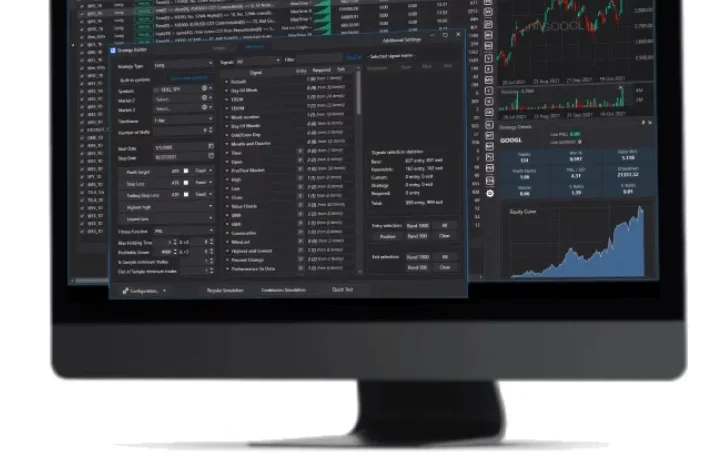
Beyond managing search parameters, the orchestrator possesses the unique ability to expand the underlying signal universe dynamically. Build Alpha natively features over 7,000 signals spanning price action, technical indicators, volume, volatility, seasonality, market breadth, sentiment, yield curves, macroeconomic reports, commitment of traders (COT) data, news feeds, and options flow.
The LLM orchestrator is not restricted to choosing from this pre-existing library. During an active simulation, the model can conceptualize and write definitions for brand-new trading signals—such as custom volatility-adjusted market breadth metrics—and feed them directly into the genetic engine. These AI-invented signals are then subjected to the exact same rigorous validation pipeline as the platform’s native indicators.
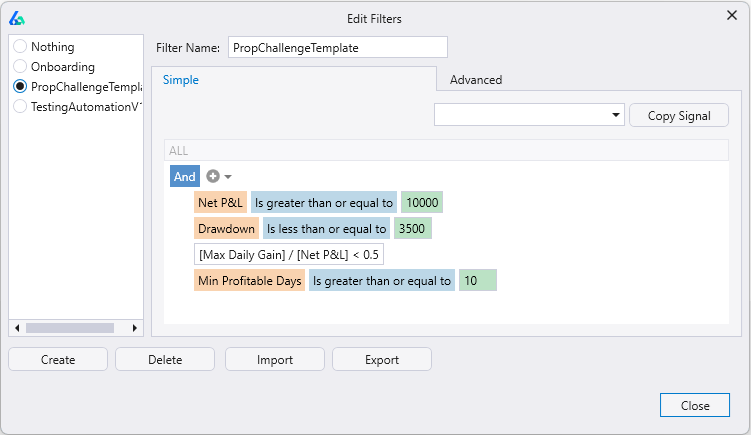
Every candidate strategy must pass stringent robustness gates, including noise tests, walk-forward analysis, Monte Carlo simulations, and random benchmarking. Furthermore, the platform accommodates strict risk management frameworks, including native templates aligned with proprietary trading firm (prop firm) rules such as daily loss limits, maximum drawdown thresholds, profit targets, and consistency scores. Once validated, any strategies incorporating LLM-invented signals can be exported directly into native code for major execution platforms, including TradeStation, NinjaTrader, MultiCharts, MetaTrader 4 and 5, TradingView, Interactive Brokers, and Python.
Persistent Cross-Session Memory Architecture
A persistent limitation of typical artificial intelligence workflows is conversational amnesia; once a chat session closes, all context and accumulated knowledge disappear. Build Alpha has addressed this challenge by developing a persistent memory store residing locally on the user’s machine.
When a simulation concludes, the LLM orchestrator generates a structured summary of the session’s insights. It records which hyperparameter shifts were successful, which signal combinations proved ineffective, and what lessons were learned regarding specific market regimes. These summaries are tagged according to the underlying asset, timeframe, direction, signal pool, and fitness function used.
When a trader initiates a new research session, the orchestrator queries this memory store using a proprietary similarity-scoring algorithm. If the user previously ran simulations on E-mini S&P 500 futures or crude oil markets, the new session does not start from a blank slate. Instead, it leverages the historical learnings of past sessions, effectively compounding the software’s utility over time and accelerating the discovery of viable market edges.
Implications for Quantitative Research and Industry Outlook
The introduction of self-improving algorithmic orchestrators represents a paradigm shift for independent quantitative researchers, family offices, and proprietary trading desks. By bridging the gap between automated strategy generation and high-level hyperparameter governance, tools like Build Alpha drastically reduce the time required to research and validate institutional-grade trading systems.
Industry analysts note that while AI-driven orchestration significantly accelerates the research lifecycle, it does not manufacture alpha out of thin air. Market conditions, economic cycles, and structural liquidity remain the ultimate determinants of trading profitability. Nevertheless, by removing the human bottleneck from the iterative search process, platforms like Build Alpha empower individual developers to conduct research workflows that previously required the dedicated computing resources and manpower of institutional quantitative funds.