Build Alpha Announces Major Release Featuring LLM Orchestration, Sequence Workflows, and Advanced Portfolio Tools

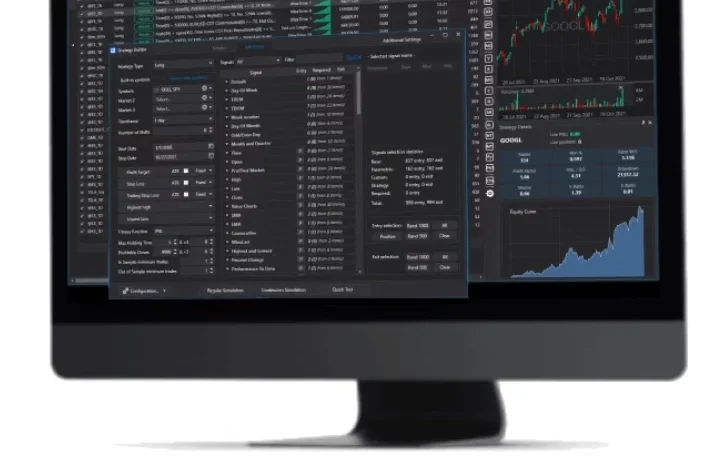
Quantitative research and algorithmic trading platform Build Alpha has officially launched one of its most comprehensive software updates to date. The newly released version introduces four foundational features designed to fundamentally alter how systematic trading strategies are developed, tested, and optimized: LLM Orchestration, Sequence Workflows, Portfolio Search, and an upgraded Portfolio Suggest v2. Together, these tools push the platform deeper into full quantitative research pipeline territory, bridging the gap between independent retail developers and institutional-grade infrastructure by enabling AI-driven automation, machine learning integration, and multi-round research within a single configuration session.
The release arrives at a transformative time for the quantitative finance industry. Over the past decade, systematic trading has evolved from a domain restricted to elite hedge funds and proprietary trading desks into an accessible discipline for independent developers and retail quants. However, a significant operational bottleneck has historically remained: the manual labor of hyperparameter tuning, strategy validation, and portfolio assembly. By combining genetic algorithms with modern large language models (LLMs) and advanced portfolio-level optimization, Build Alpha aims to eliminate these manual barriers, allowing algorithms to reason through structural market changes and optimize collective performance rather than isolated backtests.
AI-Driven Strategy Automation Through LLM Orchestration
At the center of the new update is the LLM Orchestration feature, which connects Build Alpha directly to a wide array of leading artificial intelligence models, including OpenAI’s ChatGPT, Anthropic’s Claude, Google’s Gemini, xAI’s Grok, DeepSeek, Mistral, and Perplexity. Furthermore, any OpenAI-compatible large language model routed through OpenRouter can be integrated.
Rather than acting merely as a chatbot interface, the LLM functions as a meta-level machine learning controller. Traders configure their baseline search parameters—such as target signals, fitness functions, robustness gates, and proprietary firm risk rules—and enable the AutoTune function. As the genetic algorithm executes its search, the connected LLM evaluates the output, identifies performance plateaus, determines whether the search is operating within a productive region, and dynamically adjusts hyperparameters between rounds.
This creates an autonomous feedback loop without human intervention. Crucially, the system records an exhaustive audit log of every round, decision, and underlying rationale provided by the model. For developers requiring strict control or compliance, the feature is entirely optional and can be disabled to rely solely on the built-in genetic algorithm. Additionally, the LLM orchestrator is capable of writing custom signal definitions mid-session, subjecting them to the same rigorous validation pipeline as native indicators. Through persistent memory across sessions, the orchestrator retains learned patterns over days, weeks, and months, becoming progressively tailored to a user’s specific research preferences.
Streamlining Multi-Round Research with Sequence Workflows
Historically, building a robust institutional-grade trading strategy required a tedious multi-step manual process: conducting a broad search across a decade of historical price data, narrowing the criteria for recent market regimes, passing candidates through walk-forward validation and Monte Carlo permutation filters, and finally isolating strategies that met stringent Sharpe ratio and trade-count thresholds.
Build Alpha’s new Sequence Workflows automate this entire sequence. Users can configure a multi-round research pipeline where each individual round possesses its own date range, performance filters, advanced robustness constraints, and advancement criteria. These advancement rules are fully composable. For example, a researcher can program a pipeline to advance to the next phase when 20 strategies are discovered or after six hours of runtime—whichever occurs first—while establishing a hard stop if fewer than five strategies clear the hurdle within the allotted window.
This automation transforms overnight research from a speculative gamble into a deterministic pipeline. Traders wake up either to a curated list of strategies that have survived every user-defined stress test or to a clear indication that current market conditions or constraints yielded no viable candidates, thereby saving hundreds of hours of manual configuration.
Portfolio-Level Optimization: Portfolio Search and Portfolio Suggest v2
A recurring vulnerability in independent algorithmic trading is the reliance on isolated, single-strategy backtests. Historically, developers would generate hundreds of strategies independently, select the ones with the most visually appealing equity curves, and combine them into a portfolio, hoping they would perform well together. Build Alpha addresses this structural flaw through two distinct portfolio-centric tools: Portfolio Search and Portfolio Suggest v2.
Portfolio Search changes the fundamental objective of the generation engine. Instead of evaluating candidate strategies in isolation, the genetic algorithm searches for strategies that actively complement an existing basket. By prioritizing low correlation, smooth aggregate equity curves, and optimal marginal contributions, the system routinely selects candidate strategies that might look mediocre or unglamorous on a standalone basis but offer immense diversification value when combined with existing assets.
Conversely, Portfolio Suggest v2 approaches the problem from the opposite direction. Designed for traders who already possess a pool of candidate strategies, Suggest v2 surfaces valid combinations based on strict user-defined parameters. The updated tool introduces sophisticated correlation limits, performance thresholds, and a vital one-position-per-symbol compliance toggle tailored to prop firm regulations. Furthermore, the results interface now features explicit weight and sizing columns, allowing developers to inspect individual asset allocations within a basket instantly.
Advanced Feature Engineering and Prompt-to-Signal Preview
To expand the expressive vocabulary available to both human researchers and the LLM orchestrator, the update introduces three new event-aware signals:
- EventPriceCustom: Stores a specific numerical value, such as a price or technical indicator, whenever a defined condition is met, allowing historical comparison hours or days later.
- EventVWAP: Computes the volume-weighted average price anchored to any user-defined event, moving beyond traditional daily session boundaries.
- CountSinceEvent: Quantifies the frequency of one market event occurring since the last occurrence of another, capturing intraday market character critical for mean-reversion models.
Accompanying these signals is a preview of Prompt to Signal, an AI-assisted tool embedded within the Custom Indicators Editor. Developers can describe desired indicators in plain English—such as requesting a volatility compression signal preceding a breakout—and the AI generates a fully functional, validated signal definition. Crucially, these AI-generated signals are fully compatible with Build Alpha’s multi-platform code exporters, rendering clean code for NinjaTrader, TradeStation, MetaTrader (MQL4/MQL5), TradingView Pine Script, MultiCharts, and Python environments.
Workflow Enhancements and Platform Support
Beyond core algorithmic upgrades, the release incorporates several vital workflow enhancements designed to streamline daily operations:
- Re-run Active Strategies: Enables users to re-simulate all saved strategies in a common portfolio up to the current date with a single click.
- Post-Simulation Filtering: Allows researchers to apply retroactive filters—such as tighter drawdown gates or adjusted Sharpe thresholds—to existing results without re-running computations.
- Extended CFD Support: The custom symbol editor now fully accommodates Contract for Difference (CFD) instruments, enabling international users to configure tick values, margins, commissions, and slippage accurately.
- Enhanced Generation Controls: Features such as "Require One From Group" and "Require Exits" give developers deterministic control over strategy composition and risk management rules.
Broader Implications for the Quantitative Industry
The integration of advanced large language models with institutional-grade quantitative backtesting infrastructure represents a significant maturation of retail trading technology. Historically, the competitive moat enjoyed by institutional hedge funds and proprietary trading firms relied heavily on proprietary pipeline automation, massive compute resources, and specialized multi-round validation teams.
By encapsulating these complex methodologies into a configurable desktop environment, Build Alpha continues to democratize advanced quantitative research. However, industry analysts note that while tools like LLM Orchestration and Sequence Workflows lower the technical barrier to strategy creation, they also place a higher premium on sound economic reasoning. The ease of generating automated strategies necessitates rigorous out-of-sample testing and risk management to prevent curve-fitting and over-optimization in live market deployment.
Looking ahead, Build Alpha leadership has confirmed that the next development milestone will focus on introducing a native live execution layer featuring streaming profit-and-loss tracking and real-time position monitoring, moving the platform one step closer to a complete end-to-end quantitative ecosystem. Existing license holders can access the current update immediately through their registered accounts, while prospective users can review licensing details and platform documentation directly on the official Build Alpha website.