Integrating Local Large Language Models with Scikit-Learn Using Scikit-Ollama for Privacy-First Text Classification

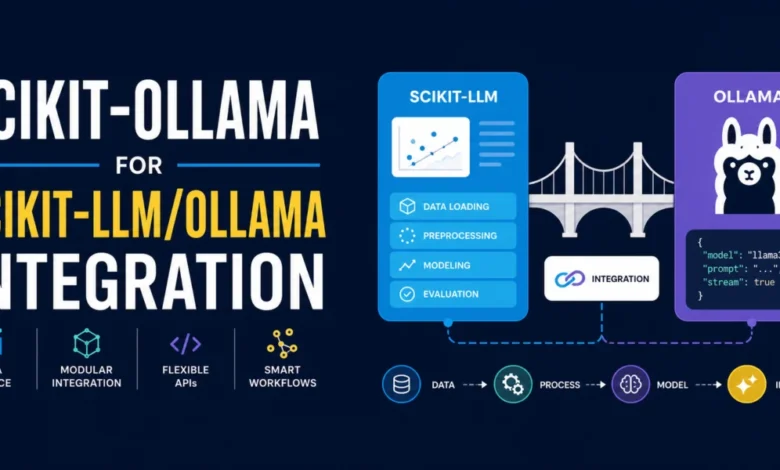
The landscape of machine learning is currently undergoing a significant paradigm shift as the integration of Large Language Models (LLMs) moves from centralized cloud-based APIs to local, decentralized environments. At the forefront of this transition is scikit-ollama, a specialized library designed to bridge the gap between the familiar, industry-standard scikit-learn interface and the robust capabilities of locally hosted models via the Ollama framework. This development marks a critical juncture for data scientists and developers who require the reasoning power of generative AI without the associated risks of data leakage, high latency, or the recurring costs of proprietary API subscriptions.
The Convergence of Traditional ML and Generative AI
For over a decade, scikit-learn has served as the backbone of the Python machine learning ecosystem, providing a consistent API for classification, regression, and clustering. However, traditional supervised learning requires significant quantities of labeled data—a resource that is often expensive and time-consuming to acquire. The emergence of LLMs introduced the concept of zero-shot learning, where a model can perform tasks it was not explicitly trained for by leveraging its broad internal knowledge base.
Despite the power of LLMs, the initial wave of integration relied heavily on cloud providers like OpenAI or Anthropic. For enterprise environments handling sensitive information, such as medical records or financial transactions, the requirement to transmit data to external servers often created insurmountable regulatory and security hurdles. The release of open-weights models like Meta’s Llama 3 and Mistral has changed the equation, allowing for high-performance inference on consumer-grade hardware. Scikit-ollama acts as the technical conduit for this "local-first" AI movement, allowing users to treat a 70-billion parameter model with the same syntactic simplicity as a classical logistic regression.
Technical Architecture and Implementation
The integration of local LLMs into a scikit-learn workflow necessitates a sophisticated abstraction layer. Scikit-ollama, which builds upon the foundations of the scikit-llm project, utilizes the Ollama runtime to manage the lifecycle of models on the user’s machine. Ollama functions as a background service that optimizes model execution across CPUs and GPUs, while scikit-ollama provides the Pythonic wrappers necessary to convert text data into structured prompts and back into categorical labels.
To implement this workflow, developers must adhere to specific environment requirements. Currently, scikit-ollama requires Python 3.9 or higher to ensure compatibility with modern asynchronous libraries and type-hinting standards. The installation process is streamlined through standard package managers, but the underlying power comes from the local model repository. By running a command such as ollama pull llama3, a user downloads a quantized version of the model, which is then accessible to the Python environment.
The library’s primary innovation lies in the ZeroShotOllamaClassifier. Unlike traditional classifiers that learn patterns from a training set, this class utilizes "in-context learning." When the fit() method is called, it does not adjust internal weights; instead, it registers the candidate labels that the model should consider during inference. This approach drastically reduces the time from data acquisition to model deployment, as the "training" phase is effectively instantaneous.
Case Study: Zero-Shot Sentiment Analysis on Local Hardware
To demonstrate the efficacy of this integration, researchers and developers have frequently turned to sentiment analysis—a classic NLP task. Using a dataset of movie reviews, the scikit-ollama workflow begins by loading raw text strings. In a traditional scikit-learn pipeline, this would require extensive preprocessing, including tokenization, stop-word removal, and vectorization (such as TF-IDF or Word2Vec).
With scikit-ollama, these steps are bypassed. The ZeroShotOllamaClassifier takes the raw text and constructs a prompt that instructs the local Llama 3 model to categorize the text into predefined labels such as "positive," "negative," or "neutral." The local model performs a semantic analysis of the review, identifying nuances like sarcasm or complex sentence structures that traditional bag-of-words models might miss.
During the predict() phase, the library manages the communication with the local Ollama server. It ensures that the model’s output is constrained to the valid labels provided during the fit() stage. This "syntactic constraint" is crucial; without it, a standard LLM might provide a long-form explanation rather than a single-word classification. By enforcing this structure, scikit-ollama ensures that the output is compatible with other scikit-learn tools, such as classification reports and confusion matrices.
Data Privacy and Regulatory Implications
The shift toward local inference is not merely a matter of technical preference but a response to a tightening global regulatory environment. The implementation of the General Data Protection Regulation (GDPR) in Europe and the California Consumer Privacy Act (CCPA) in the United States has placed strict limitations on how personal data can be processed.
In many industries, "data residency" is a non-negotiable requirement. By using scikit-ollama, organizations can ensure that their data never leaves their local network. This air-gapped approach to AI eliminates the risk of man-in-the-middle attacks during data transmission and ensures that proprietary datasets are not used to train the next generation of public models by cloud providers. Furthermore, for companies operating in regions with unstable internet connectivity, local models provide a level of operational resilience that cloud-dependent systems cannot match.
Economic Analysis: Local vs. Cloud Inference
While the initial setup of local LLMs requires an investment in hardware—specifically GPUs with sufficient Video RAM (VRAM)—the long-term economic benefits are substantial. Cloud-based LLM providers typically charge based on "tokens," which include both the input text and the generated output. For high-volume applications, these costs can scale linearly and unpredictably.
In contrast, once a local machine or server is provisioned, the marginal cost of an additional inference task is virtually zero, limited only by electricity consumption. For a company processing millions of text records for sentiment analysis or document classification, the transition to local models can result in a 90% or greater reduction in operational expenditure over a 24-month period. Moreover, the use of quantized models (e.g., 4-bit or 8-bit versions) allows these tasks to be performed on mid-range hardware, such as Apple’s M-series chips or NVIDIA’s RTX consumer cards, further lowering the barrier to entry.
Chronology of the Local AI Movement
The development of tools like scikit-ollama is the result of a rapid series of breakthroughs in the open-source community:
- February 2023: Meta releases the original LLaMA weights, sparking a wave of innovation in local model execution.
- March 2023: The "llama.cpp" project demonstrates that LLMs can run efficiently on consumer hardware using quantization.
- Late 2023: Ollama is launched, providing a user-friendly interface for managing local models on macOS, Linux, and Windows.
- Early 2024: The scikit-llm project gains traction by bringing LLM capabilities to the scikit-learn ecosystem.
- Mid 2024: Scikit-ollama is introduced as a specialized extension to specifically leverage the Ollama runtime, providing a seamless experience for local-only workflows.
Broader Impact and Future Outlook
The democratization of AI through libraries like scikit-ollama has profound implications for the future of software development. We are moving toward an era where "Intelligence as a Service" is replaced by "Intelligence as a Utility," baked directly into local applications.
As model efficiency continues to improve, we can expect the integration between classical machine learning and generative AI to deepen. Future iterations of these libraries may support local fine-tuning (via techniques like LoRA), allowing users to not only use models for zero-shot tasks but to also adapt them to specific domains using local data. This will enable a new class of hyper-specialized models that excel in niche fields like legal discovery, localized dialect translation, and specific industrial sensor analysis.
In conclusion, scikit-ollama represents more than just a technical bridge; it is a manifestation of the growing demand for sovereign, private, and cost-effective artificial intelligence. By maintaining the familiar interface of scikit-learn, it allows the current generation of data scientists to upgrade their workflows with the latest advancements in LLM research without abandoning the tools and best practices that have defined the field for years. As local hardware continues to evolve and open-source models close the performance gap with their proprietary counterparts, the adoption of local-first AI frameworks is poised to become the standard for responsible and efficient machine learning.
Related posts: