Market Sentiment Gauges and Corporate Financing Trends Shape Modern Investment Strategies as SpaceX and AI Infrastructure Reach Critical Valuations

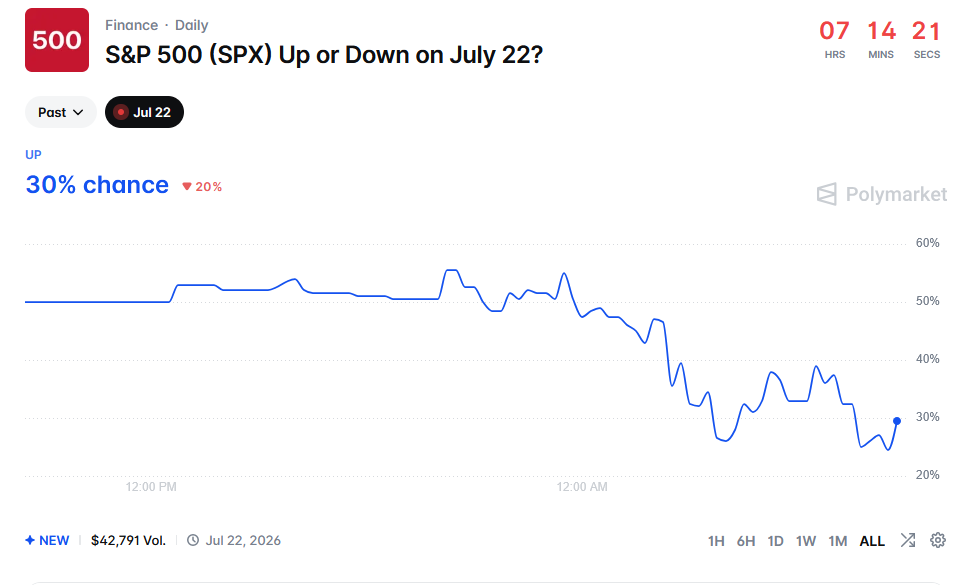
The landscape of financial forecasting and corporate investment is undergoing a significant transformation as decentralized prediction markets, complex energy-bond correlations, and unconventional financing models in the artificial intelligence sector redefine how market participants interpret value and risk. Recent data from Polymarket, a leading decentralized prediction platform, has highlighted a growing divergence between traditional sentiment indicators and real-money bets regarding the daily performance of the S&P 500. On a recent trading day, Polymarket contracts implied only a 30% probability of an "up open" for the index, despite the S&P 500 having gained nearly 1% during the previous session. This prediction proved accurate as the market opened lower, suggesting that these niche platforms may capture a more nuanced, real-time investor mindset than traditional surveys.

The Evolution of Sentiment Analysis: Prediction Markets vs. Traditional Tools
The rise of prediction markets represents a shift in how financial sentiment is quantified. Unlike consumer confidence surveys, which often reflect retrospective opinions or are subject to psychological biases, prediction markets require participants to commit capital to a specific outcome. This "skin in the game" mechanism is designed to filter out noise and prioritize information that traders believe is actionable.
While tools like the Chicago Board Options Exchange (CBOE) Volatility Index (VIX) or options skew provide insights into institutional positioning, they are often criticized for being stale or reacting to historical hedging needs rather than immediate catalysts. Polymarket’s daily S&P 500 contracts, by contrast, are updated in real-time as global headlines break, offering a granular look at short-term expectations. However, the reliability of these markets remains under scrutiny due to fluctuating liquidity. Recent reports indicate that trading volume on these daily up/down contracts has been cooling; for instance, a July 21 contract saw only $20,156 in total volume. This decline in participation raises questions about the "wisdom of the crowd" when the crowd itself is thinning, potentially reducing the value of such platforms as a broad sentiment gauge.
The Energy-Bond Nexus: Oil Prices as a Driver of Yields
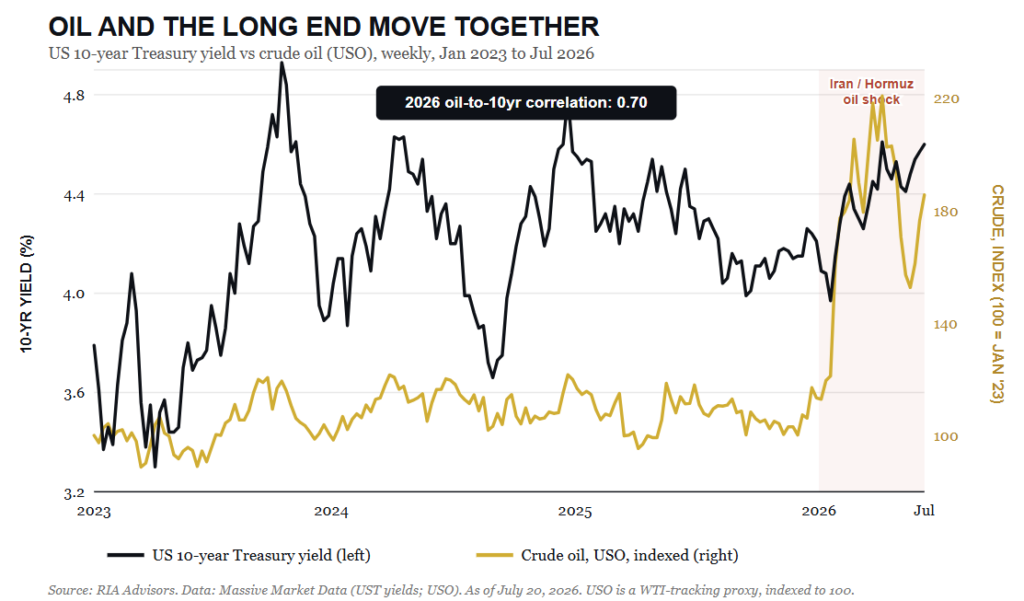
Beyond sentiment, the structural relationship between commodity prices and fixed-income markets is currently dominating the macro-economic narrative. Financial analysts have observed a tightening correlation between West Texas Intermediate (WTI) crude oil and the 10-year Treasury yield. Since mid-February, following a series of escalations in Middle Eastern conflicts, this correlation has fluctuated between 0.70 and 0.75.
As of late July, WTI crude has been trading near $86 a barrel, with Brent crude approaching $92. This upward pressure is largely attributed to supply-side risks, including strikes on Iranian interests and renewed threats by Houthi rebels to international shipping lanes. The 10-year Treasury yield has responded in kind, firming to 4.60%, while the 30-year yield reached 5.11%. Market analysts argue that this "backup" in the long end of the bond curve is primarily an oil-driven inflation premium rather than a reflection of robust economic growth or fresh fiscal concerns.
Supporting data suggests that underlying disinflation remains intact when energy costs are excluded. One-year market inflation expectations have actually fallen from 3.5% in May to approximately 2.4% in July. This discrepancy suggests that the bond market is currently "paying up" for energy security rather than bracing for a "hotter" economy.
Strategic Scenarios for Fixed-Income Investors
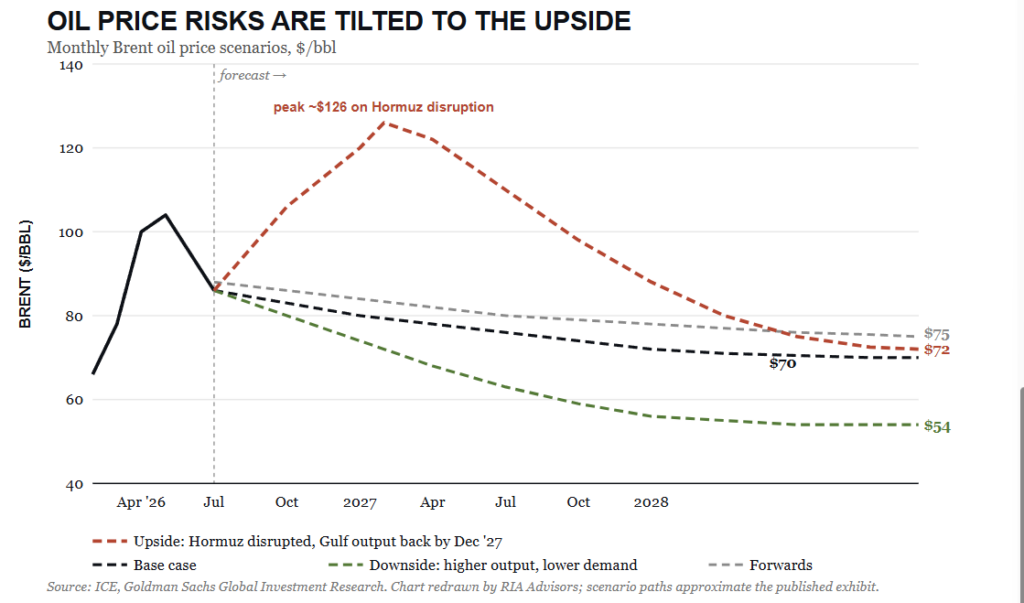
The future of bond yields appears inextricably linked to the trajectory of the oil market. Investment banks, including Goldman Sachs, have outlined three primary scenarios for crude oil through 2028:

- The Base Case: Crude prices are expected to drift into the low $70s as supply stabilizes and demand moderates, leading to a bleed-out of the inflation premium in bonds.
- The Downside Case: Higher-than-expected production coupled with softer global demand could take crude toward $55, potentially triggering a significant rally in long-duration bonds.
- The Upside Case: A prolonged disruption in the Strait of Hormuz could push Brent crude back toward $125 by 2027, forcing yields higher and punishing duration-heavy portfolios.
For portfolio managers, the current environment presents a tactical dilemma. While two of the three likely paths for oil point toward lower prices—which would favor buying bonds at current yields—the "upside tail risk" of a geopolitical shock remains high. Consequently, many advisors are maintaining shorter-duration positions, waiting for a resolution to regional tensions before "laddering" into longer-term holdings.
The AI Infrastructure Buildout: AMD, Anthropic, and Circular Financing
In the technology sector, the race to dominate artificial intelligence (AI) infrastructure has led to the emergence of unconventional financing arrangements. Advanced Micro Devices (AMD) recently announced a significant deal with Anthropic, an AI safety and research company. Under the agreement, Anthropic will purchase up to 2 gigawatts of AMD’s latest-generation Instinct MI450 chips, with deliveries slated to begin in the first half of 2027.
However, the deal includes a "circular financing" wrinkle that has drawn the attention of financial analysts. Alongside the hardware purchase agreement, AMD has committed to investing as much as $5 billion in Anthropic, subject to certain contingencies. This arrangement effectively means that AMD’s capital is helping to fund Anthropic’s ability to purchase AMD’s hardware.
While such vendor financing is not illegal and has been utilized by other industry leaders like Nvidia, it complicates the interpretation of "organic demand." When a chipmaker supplies the capital that generates its own orders, the resulting revenue is not strictly an "arm’s length" transaction. Investors are increasingly tasked with deciphering how much of the reported AI demand is driven by market necessity versus capital injections from the suppliers themselves. This distinction is critical for evaluating the long-term sustainability of the AI hardware boom and the true valuation of the companies involved.
SpaceX and the Math of Exponential Growth
The aerospace sector is also facing valuation scrutiny following the historic initial public offering (IPO) of SpaceX. Although the company’s market capitalization briefly touched $2.5 trillion before settling near $1.84 trillion, the "price of admission" for new investors remains steep. To deliver a reasonable 20% annual return from current levels, SpaceX would need to achieve an annualized revenue growth rate of between 41% and 67% for the next decade.
To put this in perspective, even Amazon—during its most aggressive phases of e-commerce and cloud dominance—struggled to maintain such growth rates at a similar scale. While Elon Musk has forecasted $1 trillion in annual revenue for SpaceX by 2030, Wall Street analysts from firms like Morgan Stanley and Goldman Sachs remain significantly more conservative in their modeling.

The valuation of SpaceX is largely predicated on the success of its Starlink satellite internet constellation and the operationalization of the Starship launch system. While SpaceX is widely regarded as a generational company with a near-monopoly on heavy-lift launches, the financial math suggests that it must perform flawlessly across all business segments to justify its current market cap.
Chronology of Recent Market Events
- Mid-February: Geopolitical tensions escalate, beginning the current cycle of oil and bond yield correlation.
- May: One-year market inflation expectations peak at 3.5% before beginning a steady decline.
- June: SpaceX completes the largest IPO in history, setting a new benchmark for private-turned-public valuations.
- July 21: Polymarket records a significant drop in S&P 500 contract volume, signaling a potential cooling in retail prediction market participation.
- Late July: AMD and Anthropic announce their $5 billion strategic partnership and hardware deal, highlighting the prevalence of circular financing in AI.
Broader Implications for Global Markets
The convergence of these trends suggests a market that is increasingly reliant on complex, interdependent factors. The accuracy of prediction markets like Polymarket, despite low volume, indicates that traditional sentiment tools may be losing their edge in a fast-paced, digital-first trading environment. Simultaneously, the heavy influence of energy prices on the bond market complicates the Federal Reserve’s task of managing inflation without stifling growth.

In the corporate sphere, the use of vendor financing in the AI sector may be creating a "valuation halo" that masks the actual pace of technology adoption. If the capital flow from chipmakers to AI startups slows, the "demand" for high-end hardware could face a sharp correction.
For investors, the takeaway is one of cautious diversification. Whether navigating the bond market’s sensitivity to oil, the AI sector’s financing maneuvers, or the high-stakes growth requirements of aerospace giants, the current environment demands a rigorous, data-driven approach. As the "tools in the toolbox" expand to include blockchain-based predictions and sophisticated correlation models, the ability to distinguish between signal and noise remains the most valuable asset in modern finance. The collective mindset of the market is shifting, and those who can interpret these new signals—while respecting the gravity of historical math—will be best positioned to manage the risks of the coming decade.