MEXC Bolsters Market Transparency with September 2026 Proof of Reserves Report Confirming Significant Asset Over-Collateralization

In an era where the integrity of digital asset exchanges is under constant scrutiny, the global trading platform MEXC has officially released its Proof of Reserves (PoR) report for September 2026. Verified by the independent cybersecurity and audit firm Hacken, the report serves as a critical disclosure mechanism, confirming that user assets held on the platform are not only fully backed but, in many cases, held in significant excess relative to platform liabilities. This latest data, captured via a snapshot on September 10, 2026, reinforces the platform’s commitment to the industry-standard "Merkle Tree" verification method, allowing individual users to independently verify the inclusion of their holdings within the aggregate audit.
The Landscape of Crypto Transparency and the Role of PoR
The concept of Proof of Reserves emerged as a vital response to the systemic collapses witnessed in the cryptocurrency market during 2022. Following the catastrophic failure of several major centralized exchanges, the industry faced a crisis of confidence. In response, platforms like MEXC adopted monthly PoR reporting as a cornerstone of their operational transparency. By utilizing cryptographic proofs, exchanges can demonstrate that they maintain sufficient on-chain assets to cover user liabilities without compromising the privacy of individual accounts.
For MEXC, the September 2026 report marks a continuation of a rigorous, long-term policy of self-regulation. By partnering with Hacken—a leader in blockchain security audits—MEXC subjects its infrastructure to intense scrutiny, covering the entirety of the reserve lifecycle: from the Proof of Liabilities (calculating user balances) to the Proof of Ownership (confirming control over wallet addresses) and the final Reserves Calculation.
Breakdown of September 2026 Reserve Ratios
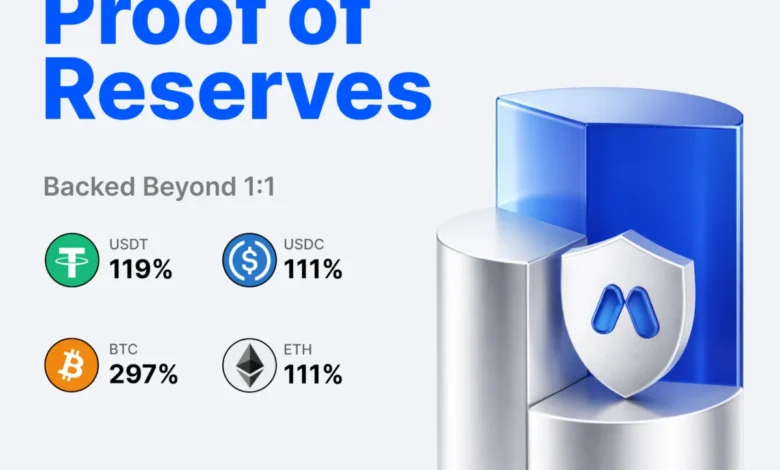
The audited data released by MEXC highlights a robust financial posture across its most traded assets. As of the snapshot date of September 10, 2026, the platform maintained reserve ratios that significantly exceed the industry-standard 100% threshold.
The reserve ratios for the primary assets are detailed as follows:
- Bitcoin (BTC): The platform’s BTC reserve ratio reached 297%, a notable increase from the 288% reported in August 2026. MEXC currently holds 12,202.13 BTC, effectively covering the 4,106.57 BTC in verified user holdings.
- Tether (USDT): As the primary liquidity vehicle for the platform, the USDT reserves stand at 119%. The exchange holds 1,818,202,910.24 USDT against total user liabilities of 1,526,526,878.38 USDT.
- USD Coin (USDC): The platform maintains a 111% reserve ratio, with 299,925,929.77 USDC held against 269,894,125.25 USDC in user deposits.
- Ethereum (ETH): Similar to its stablecoin holdings, the ETH reserve ratio sits at 111%, with 58,917.60 ETH backing the 53,243.98 ETH owed to users.
These figures illustrate a conservative treasury management strategy, where the platform maintains a significant buffer to mitigate against market volatility and potential liquidity stress.
Institutional Safeguards: Insurance Funds and Risk Management
Beyond the immediate PoR figures, MEXC has structured its risk management framework around two primary pillars: the Futures Insurance Fund and The Guardian Fund. These entities act as a "last line of defense" for users in the event of extreme market dislocations.
The Futures Insurance Fund, which specifically addresses losses incurred from liquidations during periods of high market volatility, currently maintains a balance of approximately 798 million USDT. This fund is designed to absorb the costs of "clawbacks" or socialized losses, ensuring that traders who are not liquidated do not see their gains diluted by market-wide volatility events.
Concurrently, The Guardian Fund serves as a broader safety net. With a current balance of $101 million, this dual-reserve structure, which holds both USDT and BTC, provides a comprehensive insurance layer for platform-related operational issues. The company has publicly outlined a strategic roadmap to expand this fund to $500 million within the next two years, signaling a long-term commitment to capital adequacy.
Executive Perspective: The Responsibility of Trust
In his statement regarding the release of the September report, Vugar Usi, CEO of MEXC, emphasized that the shift toward radical transparency is not merely a marketing tool but an existential requirement for the future of digital finance.
"Protecting user assets and earning their trust are fundamental responsibilities, not optional commitments," Usi noted. He further highlighted the distinction between blind faith and verifiable data, stating, "In an industry where confidence has been tested time and again, transparency must be demonstrated through actions that users can independently verify. Our commitment is to continue raising the standard for transparency, accountability, and asset protection."
By providing these verifiable snapshots, the platform aims to shift the burden of proof from the exchange’s public relations department to the immutable nature of the blockchain itself.
Implications for the Broader Crypto Market
The publication of this report comes at a time when the convergence between Traditional Finance (TradFi) and Decentralized Finance (DeFi) is accelerating. As institutional investors enter the space and retail participation grows, the demand for "audit-ready" exchanges has become a competitive differentiator.

Analysts observe that the increase in the BTC reserve ratio from 288% to 297% in a single month suggests a strategic effort by the platform to increase its liquidity cushion in anticipation of market shifts. This trend of over-collateralization provides a degree of comfort to participants who rely on MEXC for high-frequency trading or long-term asset custody.
However, the industry remains cautious. While Proof of Reserves is a vital metric, financial experts remind users that PoR only provides a snapshot of solvency at a specific moment in time. It does not account for operational risk, regulatory changes, or the integrity of internal hot wallet management. Therefore, the industry consensus remains that PoR should be viewed as one component of a larger "due diligence" framework that includes security audits, regulatory compliance, and historical performance.
A Chronology of MEXC’s Transparency Efforts
The September 2026 report is the latest in a series of monthly disclosures that have defined MEXC’s operational philosophy over the past three years.
- 2018: MEXC is founded with a focus on providing a 0-fee gateway to global digital assets.
- 2022 (Late): In the wake of major industry insolvencies, MEXC accelerates its push for PoR, implementing Merkle Tree verification for its user base.
- 2024–2025: The platform expands its asset coverage and formalizes the "Guardian Fund" structure to include a clear growth target of $500 million.
- September 2026: MEXC achieves a new peak in its Bitcoin reserve ratio (297%), maintaining its streak of monthly audits conducted by Hacken.
Conclusion and Future Outlook
As of mid-September 2026, MEXC remains a significant player in the global exchange ecosystem, servicing over 170 markets with a model that combines traditional exchange services with tokenized asset exposure. By maintaining a 0-fee trading structure while simultaneously increasing the size of its reserve buffers, the platform is betting that transparency and user safety will be the primary drivers of growth in the latter half of the decade.
For users wishing to verify their own holdings, the platform continues to offer the Merkle Tree verification tool on its official website, providing a direct link between the aggregate audit report and individual account balances. As the digital asset market continues to mature, the precedent set by these monthly audits will likely become the minimum requirement for any exchange aiming to maintain a global, institutional-grade reputation.
Investors and users are encouraged to review the full audit report on the MEXC Proof of Reserves page, keeping in mind that while these figures demonstrate robust solvency, they do not eliminate the inherent risks associated with digital asset market volatility. As always, market participants are advised to conduct their own due diligence and assess their individual risk tolerance before engaging in complex trading activities.