Navigating the Unprecedented Federal Reserve Rate Hike Amid Geopolitical Supply Shocks and Emerging AI Productivity Gains

The Federal Reserve’s recent decision to implement a 25-basis-point interest rate hike has ignited intense debate across financial markets, standing out as a policy move unlike any observed over the past three decades. Breaking sharply from historical precedents established since 1994, today’s macroeconomic landscape features economic growth comfortably hovering at trend levels, while core consumer price index (CPI) inflation remains only slightly elevated. Crucially, the recent upward ticks in inflation are predominantly driven by geopolitical supply shocks rather than an overheated, demand-driven economy. With the federal funds rate already sitting nearly two percentage points higher than gross domestic product growth, and 10-year real interest rates pressing against 15-year highs, monetary policy is unquestionably restrictive. Analysts argue that the central bank is effectively fighting the bond market rather than battling rampant inflation, aggressive demand, or the normalization of loose monetary policy. This unique divergence raises valid concerns of a potential policy error, as fundamental economic indicators do not justify additional tightening.

Historical Context and Market Performance Following Tightening Cycles
To understand the current market turbulence, financial strategists frequently look back at historical tightening cycles to gauge how equities typically behave after a central bank initiates rate hikes. Research from Goldman Sachs spanning seven tightening cycles back to 1988 reveals a distinct and repeatable pattern. Historically, equities tend to slide by roughly 2% over the initial three months following a first rate hike, experience choppy consolidation through the middle of the year, and ultimately recover to finish twelve months out with an average gain of approximately 9%. Similarly, analysis by LPL Financial across six cycles dating back to 1994 points to comparable outcomes, showing a 6.7% average gain and a 10.7% median return over a one-year horizon.
However, these encouraging annualized figures mask the considerable volatility investors must endure in the interim. Schwab’s historical data highlights that the average maximum drawdown during the first year of a tightening cycle is 14%, with a 12% drop typically occurring within the first six months. This dichotomy presents a persistent dilemma for market participants: while the twelve-month outlook often normalizes, navigating the turbulent middle phase of the cycle can severely test investor conviction. Reinforcing this cautious outlook, the Federal Reserve’s economic projections have steadily shifted, with expectations for 2027 growth moving from 3.6% earlier in the year up to 4.1%.
Sector Leadership and Real-Time Market Reactions
The practical implications of a rate-hiking cycle become most apparent when examining sector-specific leadership, where historical templates offer remarkably specific guidance. Comprehensive studies by Barclays covering five distinct tightening cycles since February 1994 demonstrate that three months after an initial rate hike, the S&P 500 declines by a median of 3.9%, the Russell 2000 small-cap index falls by 7.2%, and the financial sector underperforms significantly with a median loss of 8.4%. Notably, the energy sector historically stands alone as the only major segment to deliver a positive median return during these initial phases, while value stocks consistently outperform growth equities, particularly within small-cap allocations.
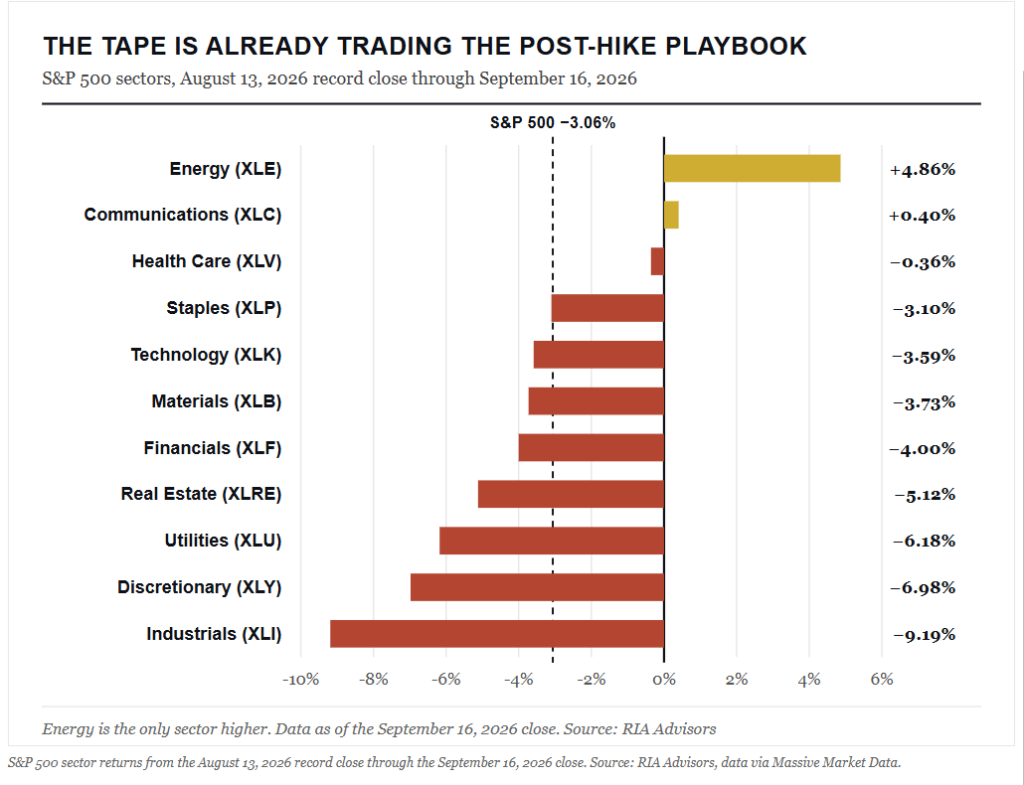
This historical playbook has begun playing out in real time following recent market peaks. Since mid-August record closes, the energy sector has advanced by nearly 5%, maintaining its position as the sole major sector in positive territory. Conversely, defensive and economically sensitive areas have faced substantial pressure, with industrials declining sharply and small-cap equities significantly underperforming the broader index. Value shares, growth stocks, and high-beta assets have all experienced notable pullbacks, with high-beta equities losing more than twice the value of low-volatility counterparts. Market technicians observe that major equity indices are currently trading below their 50-day moving averages while maintaining a cushion above their rising 200-day moving averages. With relative strength index (RSI) metrics signaling a soft rather than oversold market environment, portfolio managers continue to emphasize quality and value, utilizing conservative cash buffers yielding stable returns to navigate ongoing uncertainty.

Artificial Intelligence Integration and Economic Productivity
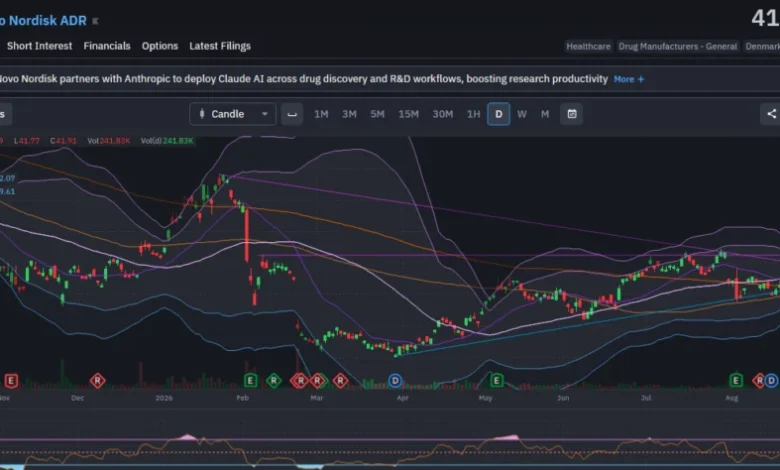
While monetary policy dominance weighs heavily on near-term sentiment, structural shifts driven by artificial intelligence are concurrently beginning to leave a tangible imprint on non-technology sectors of the global economy. A prominent example is the recent strategic partnership announced between pharmaceutical giant Novo Nordisk and AI developer Anthropic. By integrating Anthropic’s specialized scientific platform, Claude Science, Novo Nordisk aims to accelerate drug discovery pipelines, strengthen software development infrastructure, and enhance automation across production facilities. This collaboration mirrors similar high-profile alliances forged across the pharmaceutical industry involving major enterprises such as Eli Lilly, Merck, and Roche.
This wave of enterprise adoption underscores the reality that the economic benefits of artificial intelligence extend far beyond the headline-grabbing expansion of data center infrastructure and semiconductor manufacturing. Corporate leadership has increasingly emphasized the dual-nature advantage unlocked by these technologies. As noted by industry executives, artificial intelligence serves as a multi-pronged catalyst capable of driving top-line revenue growth by accelerating commercial pipelines and identifying target markets more efficiently, while simultaneously compressing operational cost structures to achieve more with fewer resources.
While advanced AI models have yet to independently secure regulatory approvals for novel drug discoveries, the immediate efficiency gains derived from automated research processes and advanced data reasoning represent a crucial productivity milestone. Economists suggest that this simultaneous expansion of revenue-generating capabilities and cost-efficiency will ultimately filter through to corporate profit margins and broader macroeconomic gross domestic product metrics. For investors grappling with the timing of technological payoffs outside the technology sector, these enterprise integrations offer concrete evidence that productivity enhancements are steadily transitioning from theoretical projections into active corporate balance sheets.