The Astronomical Valuation of SpaceX: Evaluating the $1.84 Trillion IPO and the Historical Precedents of Hyper-Growth

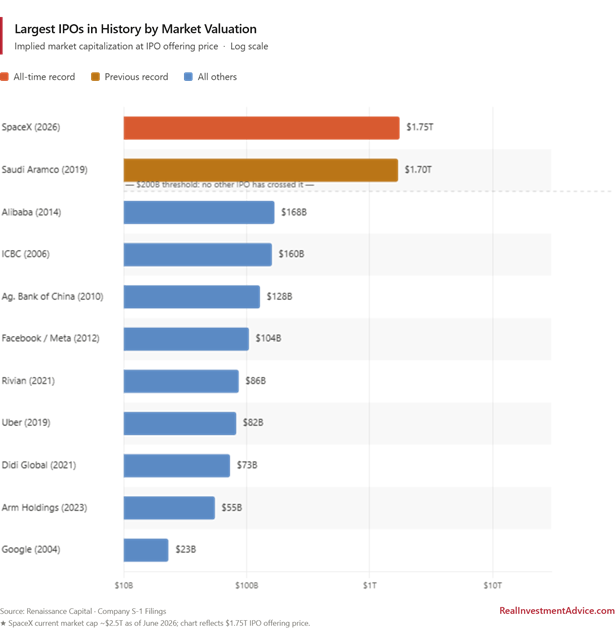
SpaceX’s historic initial public offering in June 2025 has redefined the boundaries of private equity and public market transitions, raising $75 billion and establishing an initial valuation of $1.77 trillion. This milestone officially marked the largest IPO in global history, surpassing previous records held by state-owned enterprises and tech giants alike. The entity, which now encompasses the core aerospace launch business, the Starlink satellite internet constellation, and the recently integrated artificial intelligence venture xAI, saw its market capitalization surge to a peak of $2.5 trillion within its first week of trading. This momentary spike briefly placed SpaceX on par with Amazon as the fifth-largest publicly traded company in the world. However, as the initial euphoria of the public debut begins to normalize, market analysts are turning their focus toward the fundamental realities underlying this unprecedented valuation.
The enthusiasm surrounding SpaceX persists despite the company reporting a net loss of nearly $5 billion for the 2025 fiscal year. With a current market capitalization hovering around $1.84 trillion, it is evident that investors are not prioritizing immediate profitability. Instead, the market is aggressively pricing in a trajectory of astronomical growth, betting that the company’s dominance in low-Earth orbit (LEO) and its expansion into AI-driven aerospace solutions will yield returns that mirror or exceed the greatest corporate success stories of the last thirty years. To justify a valuation of nearly $2 trillion for a company generating less than $20 billion in annual revenue, SpaceX must achieve a level of sustained expansion that has rarely been witnessed in the history of capitalism.
A Comparative Analysis: The Amazon Playbook
To provide a framework for SpaceX’s current valuation, financial historians and analysts frequently point to Amazon as the most relevant proxy. Amazon, like SpaceX, spent years as a money-losing enterprise while building out massive, capital-intensive infrastructure. Investors who maintained their positions through the volatility of the dot-com era and a decade of negligible earnings were eventually rewarded with a 3,300-fold return, representing an annualized growth rate of approximately 32% over nearly three decades.
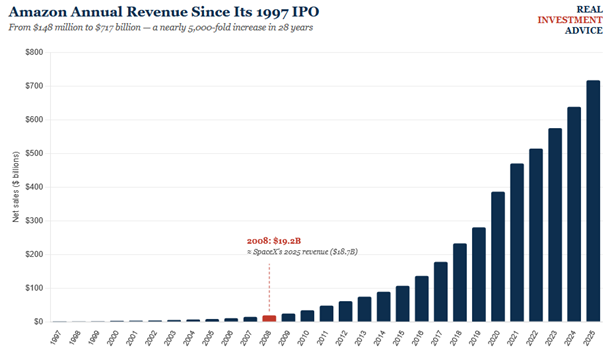
When Amazon went public in May 1997, it was valued at a modest $438 million with annual revenues of $148 million. At the time, its price-to-sales (P/S) multiple was roughly 3x—a figure considered generous for a startup but grounded in the reality that the company was doubling its revenue every year. As Amazon transitioned from an online bookseller to a global logistics and cloud computing powerhouse, its revenue trajectory became one of the most remarkable in corporate history. By 2008, eleven years after its IPO, Amazon’s revenue reached $19.2 billion. By 2025, that figure climbed to $716 billion, placing it alongside Walmart as one of the highest-revenue-generating entities in the United States.
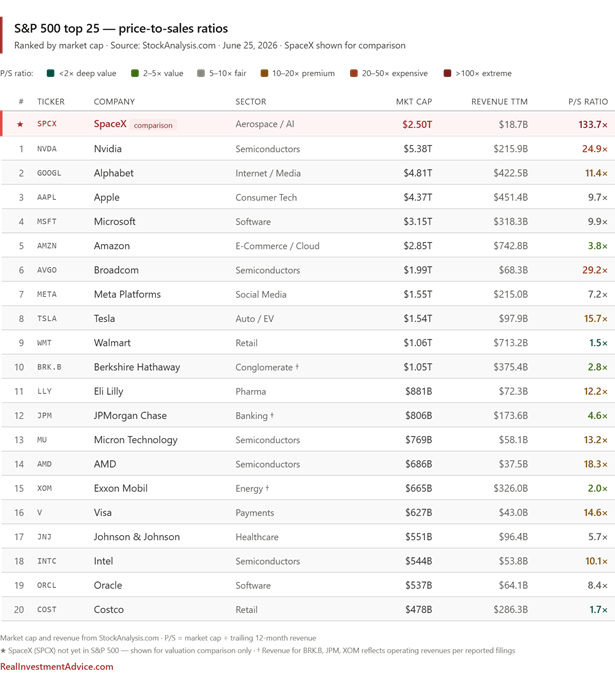
The challenge for SpaceX lies in the starting point of its public journey. While Amazon began its 5,000-fold revenue climb from a base of $148 million, SpaceX is entering the public market with a revenue base of $18.7 billion—nearly identical to Amazon’s 2008 levels. However, in 2008, Amazon’s market capitalization was approximately $40 billion, implying a P/S multiple of 2x. In contrast, SpaceX’s $1.84 trillion market cap on $18.7 billion in sales results in a P/S multiple nearing 100x. This indicates that the market is currently pricing SpaceX at roughly 50 times the multiple it awarded Amazon when it was at a similar revenue stage.
The Revenue Engines: Launch, Starlink, and xAI
The justification for such a significant premium rests on the perceived "moat" SpaceX has built around its core business segments. Unlike the retail sector, which is defined by thin margins and intense competition, SpaceX operates in industries with high barriers to entry and significant pricing power.
The launch business remains the backbone of the company’s operational identity. With the Starship program moving toward full operational status, SpaceX has achieved a near-monopoly on heavy-lift capabilities and rapid-relaunch technology. This vertical integration allows the company to dictate market rates while simultaneously lowering its own internal costs for deploying Starlink satellites.

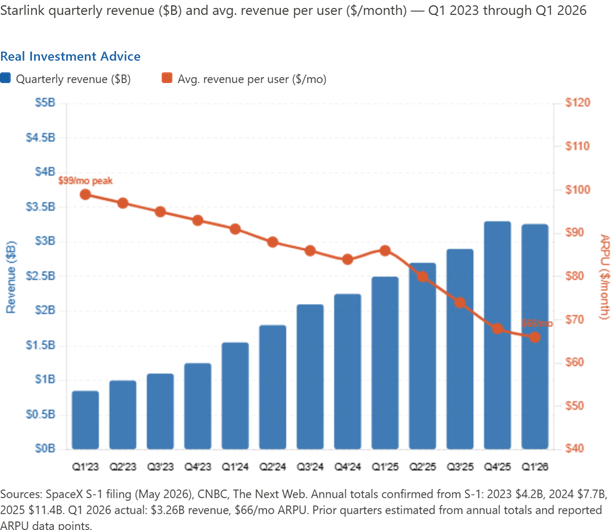
Starlink represents the company’s most immediate path to high-margin recurring revenue. As of 2025, the satellite internet service has moved beyond the consumer pilot phase into a critical infrastructure provider for maritime, aviation, and government sectors. The subscriber economics of Starlink provide a predictable cash flow that traditional aerospace companies, reliant on lumpy government contracts, cannot match.
Furthermore, the integration of xAI into the SpaceX ecosystem adds a layer of speculative value. By leveraging AI for autonomous spacecraft operations, advanced materials science, and global data routing for Starlink, xAI is positioned to capture a share of the burgeoning artificial intelligence market. Proponents argue that SpaceX is not merely a rocket company but a global data and logistics utility, justifying a multiple more akin to a software-as-a-service (SaaS) giant than a hardware manufacturer.
Quantifying the Implied Growth Rate
To satisfy the expectations of public shareholders, SpaceX must achieve a growth rate that defies historical norms for a company of its size. If we assume that investors demand a 20% annual return—a conservative figure compared to the historical returns of hyper-growth stocks—SpaceX’s market capitalization would need to reach approximately $11.4 trillion by mid-2036.
To reach an $11.4 trillion valuation, the revenue requirements are staggering. The final outcome depends heavily on the P/S multiple the market is willing to pay for a mature SpaceX. If the company eventually trades at a P/S multiple of 5x (similar to the current valuation of high-performing tech hardware companies), it would need to generate $2.28 trillion in annual revenue by 2036. For context, this is more than triple the current revenue of Amazon or Walmart.

Even under a more aggressive scenario where SpaceX maintains a "premium" P/S multiple of 20x—a level currently reserved for high-margin AI leaders like Nvidia and Broadcom—the company would still need to produce $570 billion in annual revenue. Achieving this would require a compound annual growth rate (CAGR) that exceeds 40% for over a decade, starting from a multi-billion dollar base. Historically, growth rates of this magnitude are significantly easier to achieve when a company is small; maintaining them as a trillion-dollar entity is a feat that has never been accomplished.
Official Projections and Wall Street Skepticism
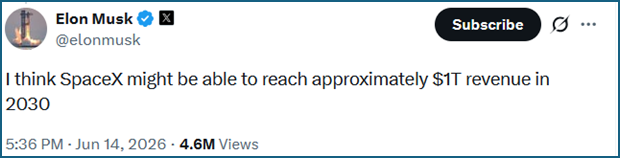
The discrepancy between Elon Musk’s internal targets and Wall Street’s analytical models remains a central point of debate. Following the IPO, Musk suggested on social media that SpaceX could grow from $18.7 billion in 2025 to $1 trillion in revenue by 2030. This would represent a 53-fold increase in just five years, or a CAGR of approximately 122%. Such a trajectory would be more than double Amazon’s best-ever growth period, despite SpaceX starting from a base that is 126 times larger than Amazon’s was at its IPO.
Institutional underwriters have provided more tempered forecasts. Morgan Stanley’s models project 2030 revenue at approximately $330 billion, while Goldman Sachs estimates roughly $470 billion. While these figures represent massive growth, they are less than half of Musk’s stated goal.
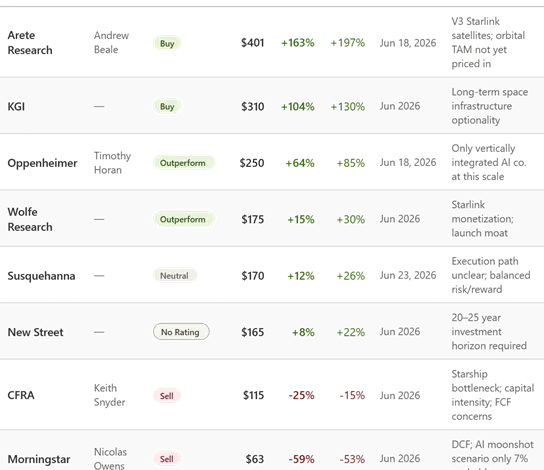
Analyst sentiment remains sharply divided, as evidenced by the wide range of price targets. Morningstar has set a fair value estimate for SpaceX at $63 per share, suggesting that the current market price is significantly overextended. Conversely, New Street Research initiated coverage with a target of $165, though they noted that investors would likely need a 20- to 25-year time horizon for the company’s fundamentals to catch up with its valuation. The total range of analyst targets—stretching from $63 to over $400—highlights the unprecedented difficulty in valuing a company that aims to colonize Mars while simultaneously monopolizing global internet and orbital transport.

The Risks of High-Multiple Valuations
The risks of a 100x P/S multiple were famously summarized by Scott McNealy, the former CEO of Sun Microsystems, following the dot-com crash. McNealy noted that at 10 times revenue, a company would have to pay out 100% of its revenue as dividends for ten years just to give investors a ten-year payback—assuming zero cost of goods sold, zero expenses, zero taxes, and zero R&D. SpaceX’s current multiple is nearly ten times higher than the level McNealy was criticizing.
For SpaceX to avoid a significant market correction, it must not only grow its revenue but also drastically improve its margins to justify its stay in the "trillion-dollar club." The $5 billion loss in 2025 serves as a reminder that space remains a capital-intensive frontier. Every successful launch is balanced by the massive R&D costs of Starship and the ongoing expense of satellite replenishment.
Broader Impact and Market Implications
The performance of SpaceX as a public entity will likely serve as a bellwether for the "New Space" economy. A successful trajectory would validate the massive influx of private capital into aerospace ventures, potentially leading to a wave of IPOs from competitors such as Blue Origin or Relativity Space. However, if SpaceX struggles to meet its lofty growth targets, it could signal a cooling period for the entire sector, as investors recalibrate their expectations for the profitability of orbital enterprises.
Furthermore, the SpaceX IPO has significant implications for the broader indices. At a $1.8 trillion valuation, the company’s stock movements now exert substantial influence on the S&P 500 and the Nasdaq-100. The volatility inherent in a high-growth, high-multiple aerospace stock introduces a new layer of risk for passive investors and pension funds that now hold SpaceX as a core component of their portfolios.

Conclusion
SpaceX has undoubtedly achieved what was once thought impossible, disrupting a stagnant aerospace industry and building a global telecommunications network in record time. However, the transition from a private visionary project to a public corporate titan brings the "gravity" of fundamental analysis into play. To justify its current valuation, SpaceX must execute a growth plan that is historically unprecedented in scale, duration, and efficiency.
While Elon Musk’s track record suggests that betting against his ventures is a high-risk proposition, the mathematical reality of compounding from a $1.84 trillion base presents a formidable challenge. As the company moves toward the second half of the decade, the focus will shift from successful rocket landings to the cold, hard metrics of the balance sheet. Whether SpaceX can transcend the limits of financial forecasting or if its valuation will eventually be brought back to Earth remains the most significant question in the modern financial landscape.