Quantitative Analysis of SEC Form 4 Insider Purchases Reveals Short-Term Market Associations but Limited Long-Term Predictive Power

The public disclosure of insider trading activity serves as a vital component of market transparency, yet the systematic utility of this information for external investors remains a subject of intense quantitative scrutiny. Between January 1, 2022, and June 30, 2026, researchers conducted a comprehensive event study analyzing 1,345,036 non-derivative transaction rows filed with the U.S. Securities and Exchange Commission (SEC). The study, which isolates C-suite purchase filings, demonstrates that while insider purchases are statistically associated with positive abnormal returns in the immediate aftermath of a filing, these effects diminish significantly over longer time horizons.
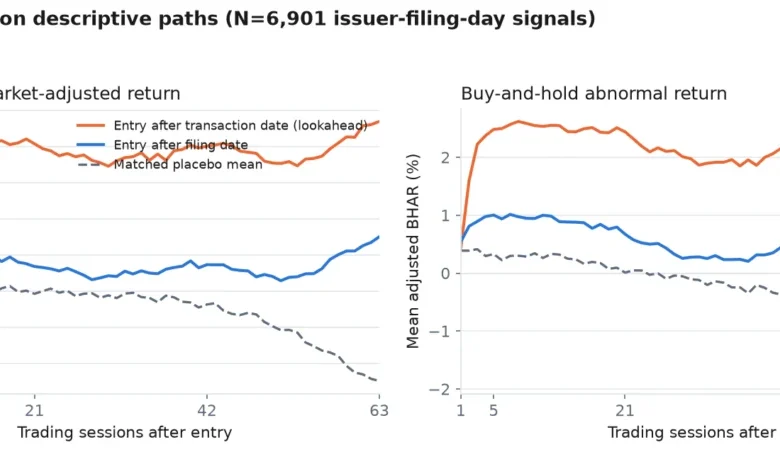
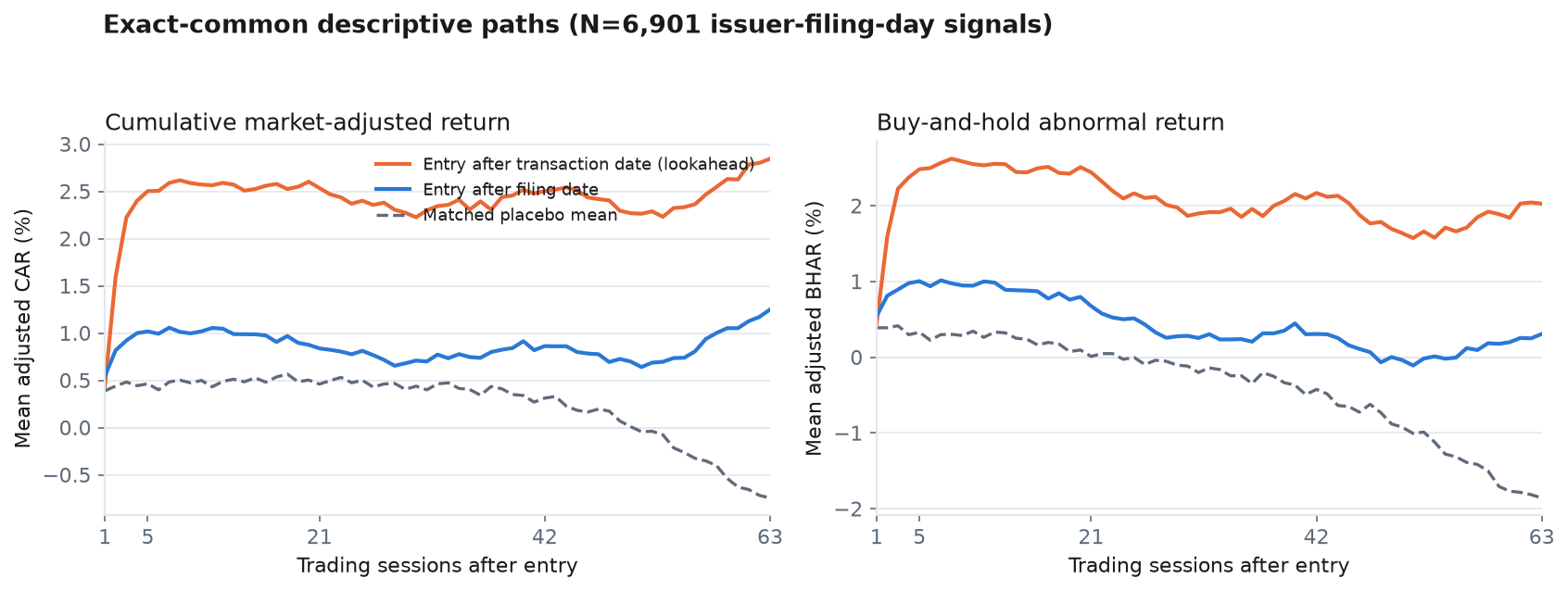
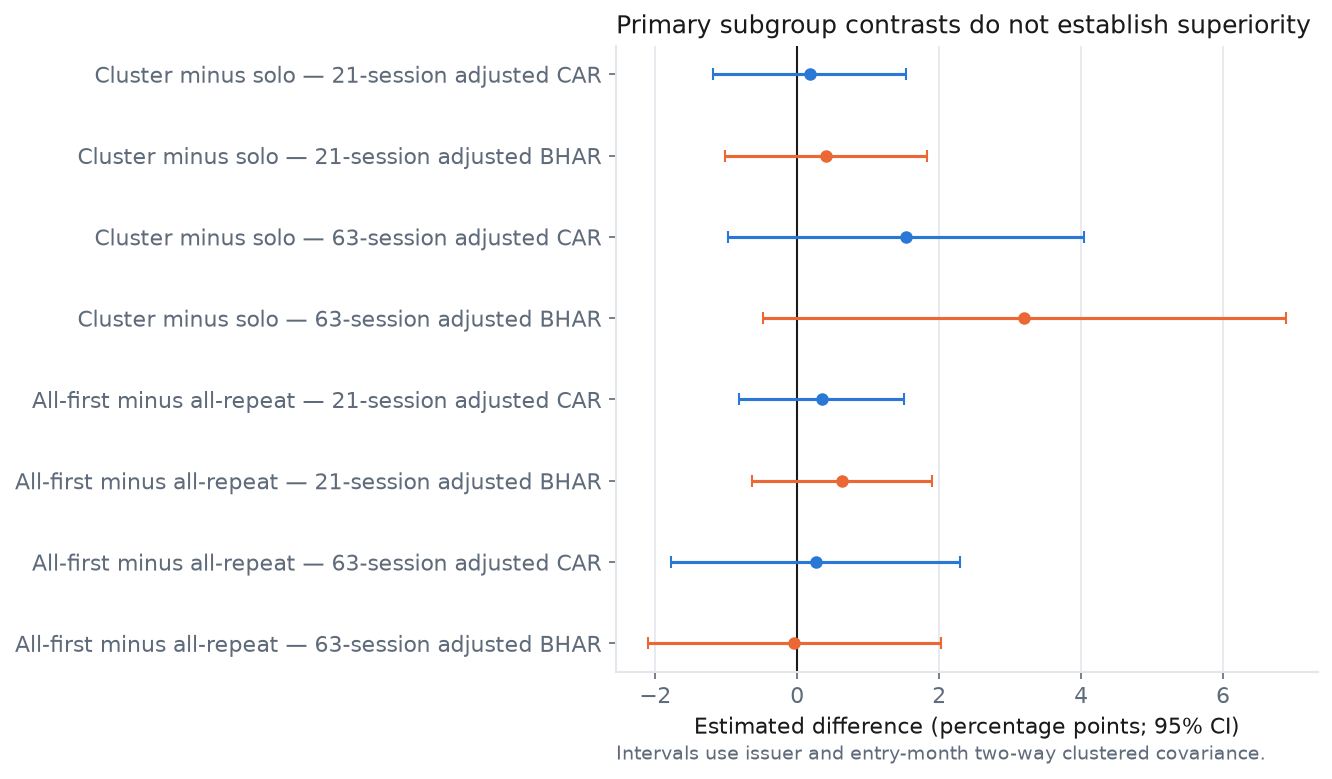
The research funnel, designed to strip away noise and non-informative disclosures, reduced the raw data to 11,957 component events. After filtering for price validation, issuer-day aggregation, and the exclusion of multi-owner filings, the study identified 7,406 public signals. The primary finding indicates that the SPY-adjusted mean cumulative abnormal return (CAR) for the session immediately following an insider purchase filing is +0.534%. By the fifth session, this figure rises to +1.009%. However, when extending the observation window to 21 and 63 trading sessions, the adjusted CAR confidence intervals widen to include zero, suggesting that the initial market reaction does not necessarily translate into a durable, exploitable alpha for external market participants.
The Anatomy of Insider Disclosure
Section 16 of the Securities Exchange Act of 1934 requires officers, directors, and beneficial owners of more than 10% of a registered equity class to report changes in ownership. While these filings are public, the structure of the data often leads to misinterpretations. For instance, the "P" transaction code denotes an open-market or private purchase, but it does not specify the venue of the trade. Furthermore, the practice of joint filing—where multiple beneficial owners report the same transaction—can create "double-counting" in simplified research models.
By normalizing these records, the current analysis excludes all joint filings to ensure that each signal represents a distinct economic event. This methodological rigor is essential, as previous academic work, such as the seminal research by Lakonishok and Lee (2001), highlighted that purchase activity is highly concentrated and informative in smaller firms. Similarly, Cohen, Malloy, and Pomorski (2012) differentiated between "opportunistic" and "routine" traders. The present study addresses this by filtering out transactions affirmatively marked as Rule 10b5-1 plan trades, focusing instead on discretionary activity that is not contractually mandated.
Methodological Rigor and Data Integrity
A significant challenge in analyzing SEC data is the handling of corporate actions and filing lags. The study utilized a two-level aggregation strategy: first, grouping transactions by accession, issuer, owner, and date; and second, collapsing these into a single "issuer-day" signal. This prevents a single, highly active insider from skewing the results by generating multiple filings for the same transaction on the same day.
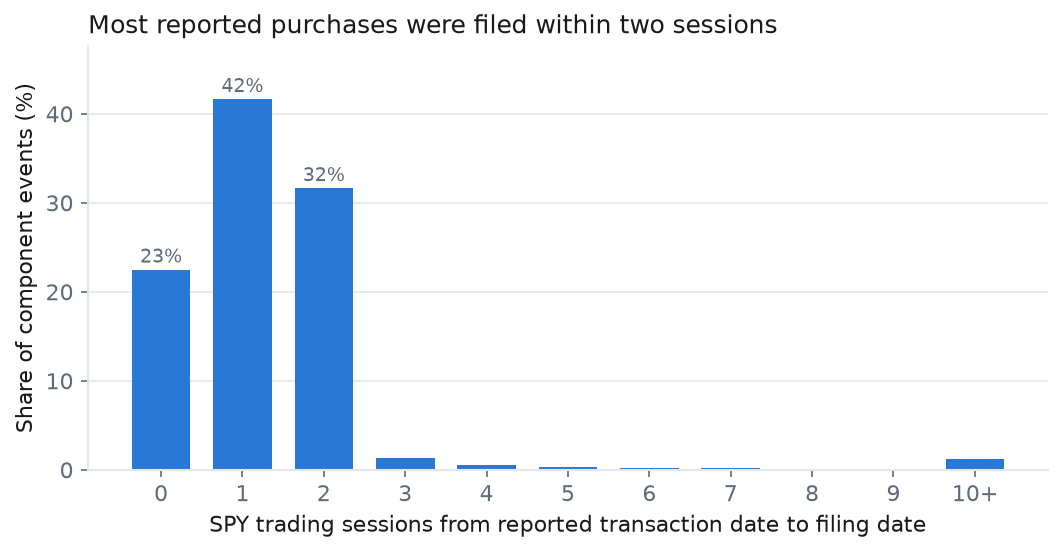
The research also incorporated a strict "fill-price anchor" to validate reported data against historical price records. By comparing the reported Volume Weighted Average Price (VWAP) against the reconstructed nominal closing price of the security, the study successfully screened for potential unit errors, ticker mismatches, and data anomalies. This step is critical because historical "raw" data often includes unadjusted values that do not account for stock splits or dividends, which could lead to significant errors in return calculations.
Comparative Analysis of Filing vs. Transaction Dates
One of the most revealing aspects of this study is the comparison between filing-date entries and transaction-date entries. Many historical studies have been criticized for "lookahead bias," where the analysis assumes an investor acts on the date the transaction occurred, despite the fact that the public does not learn of the trade until the Form 4 is filed with the SEC.
The data shows that transaction-date entry models consistently yield higher return estimates—often by over 1.5 percentage points at the 63-session mark—simply because they include the price appreciation that occurs between the date of the trade and the date of the filing. By using the filing date as the entry point, this study provides a more accurate, albeit more conservative, reflection of what an actual investor could achieve in the market.
Statistical Inference and Market Sensitivity
To ensure the reliability of the results, the study employed the Cameron-Gelbach-Miller two-way clustered covariance estimator, which accounts for both issuer and calendar-month dependencies. This is particularly important in financial event studies, where signals occurring in the same month may be influenced by systemic market factors rather than firm-specific news.
While a fitted market model (which regresses stock returns against SPY returns) suggested larger abnormal returns of up to +6.560% at the 63-session mark, the researchers cautioned against over-interpreting these figures. The sensitivity analysis revealed that these larger estimates are heavily dependent on negative pre-event "alpha" values. Consequently, the researchers treated the market model as a secondary sensitivity check rather than the headline result, reinforcing the study’s commitment to a conservative, transparent interpretation of the data.
Broader Implications and Market Impact
The study’s findings contribute to a growing body of literature suggesting that while insider purchases provide a credible signal of management’s confidence in their firm’s prospects, they are not a "silver bullet" for investment strategy. The lack of a persistent, statistically significant drift at the 63-session horizon highlights the efficiency of modern markets in incorporating public disclosure into security pricing.
For regulators and policymakers, the study underscores the importance of the Rule 10b5-1(c) reporting requirements. The SEC’s 2023 mandate for clearer disclosure of trading plans has significantly improved the quality of data available to researchers. By analyzing the "AFF10B5ONE" flag in the SEC’s submission files, researchers can now more effectively isolate discretionary purchases from systematic, rule-based trades.
Limitations of the Current Research
The researchers acknowledged several inherent limitations, emphasizing that this study should be viewed as an observational analysis rather than a causal proof. Firstly, the results are conditional on Yahoo Finance coverage, meaning that delisted, distressed, or extremely small companies—which might have provided the most dramatic return signals—were excluded from the final sample.
Secondly, the study does not account for transaction costs, market impact, or the liquidity constraints that a real-world trader would face. For instance, in nearly 10% of the signals analyzed, the insider’s purchase volume exceeded 100% of the median daily dollar volume of the stock. While this reflects the insider’s disclosure, it does not imply that a portfolio manager could replicate these entries without moving the market price, thereby eroding potential returns.

Conclusion and Future Outlook
The evidence presented confirms that insider purchases are a meaningful signal of positive short-term performance, yet the "drift" often cited in earlier decades appears far more elusive in the current market environment. The research serves as a cautionary tale against over-reliance on simplistic backtests, advocating instead for the rigorous, systematic cleaning of SEC filing data.
As financial data pipelines become more sophisticated, the ability to parse and analyze these disclosures in real-time will remain a priority for institutional investors. However, as the author Mikhail Makeev notes, the primary value of such research lies not in finding an "edge," but in the methodology itself—preserving filing time, clustering for statistical dependency, and rigorously defining the population being studied.
For market participants, the takeaway is clear: while insiders often buy when they believe their stock is undervalued, the market typically adjusts to this information within a few trading sessions. Any potential alpha beyond that point remains subject to the broader volatility and systemic risks inherent in the equity markets, rather than the singular influence of an insider’s transaction.
References and Further Reading
- Cameron, A. C., Gelbach, J. B., & Miller, D. L. (2011). "Robust Inference with Multiway Clustering." Journal of Business & Economic Statistics.
- Cohen, L., Malloy, C., & Pomorski, L. (2012). "Decoding Inside Information." The Journal of Finance.
- Jeng, L. A., Metrick, A., & Zeckhauser, R. (2003). "Estimating the Returns to Insider Trading: A Performance-Evaluation Perspective." Review of Economics and Statistics.
- Lakonishok, J., & Lee, I. (2001). "Are Insider Trades Informative?" The Review of Financial Studies.
- U.S. Securities and Exchange Commission (2026). Insider Transactions Data Sets. Available at: https://www.sec.gov/data-research/sec-markets-data/insider-transactions-data-sets.