Caterpillar Inc. at a Crossroads: Analyzing the Industrial Giant’s Explosive Growth and Future Outlook


Caterpillar Inc., the undisputed titan of global heavy machinery, has undergone a profound transformation in investor perception over the past five years. Once viewed primarily as a bellwether for cyclical industrial demand, the company has pivoted toward a narrative of structural growth, fueled by the infrastructure demands of the artificial intelligence (AI) era and a renewed focus on global electrification. With shares climbing more than 100% over the past year alone and an staggering 291% over the last five years, the market is currently grappling with whether this industrial stalwart is fairly valued or if it has reached a peak that leaves it vulnerable to a broader economic correction.
A Century of Industrial Dominance
Founded in 1925 through the merger of the Holt Manufacturing Company and the C. L. Best Tractor Co., Caterpillar has spent nearly a century defining the physical landscape of the modern world. Headquartered in Irving, Texas, the firm maintains a presence in almost every corner of the globe, providing the backbone for construction, mining, and energy sectors. Its portfolio spans from iconic yellow excavators and dozers to high-performance engines and turbines that power remote mining sites and, increasingly, the massive energy grids required by modern data centers.
The company’s longevity is matched by its commitment to shareholder returns. Remarkably, Caterpillar has paid a cash dividend every year since its formation in 1925. Perhaps even more impressively, it has achieved the status of a Dividend Aristocrat, having raised its annual dividend payout for 32 consecutive years. This history of financial discipline provides a psychological floor for investors, even during periods of significant market turbulence.
The AI-Industrial Convergence
While construction and mining remain the core pillars of Caterpillar’s revenue, the company has successfully integrated itself into the high-growth narrative of the AI revolution. The connection is twofold. First, Caterpillar’s technological advancements in autonomy and predictive maintenance have transformed its machines from simple mechanical tools into data-harvesting assets. Through the use of onboard sensors and real-time telematics, Caterpillar equipment can now optimize fuel consumption, predict mechanical failures before they occur, and navigate complex terrain without human intervention.
Second, and perhaps more vital to its recent valuation surge, is the role of power generation in the data-center buildout. As hyperscalers like Microsoft, Amazon, and Google race to build the massive data centers required to power Large Language Models (LLMs), the demand for electricity has skyrocketed. These facilities require massive, reliable, and uninterrupted power supplies. Caterpillar’s power-generation systems, including its sophisticated diesel and gas turbines, have become essential infrastructure for these projects. By positioning its energy division as a critical supplier to the digital infrastructure boom, Caterpillar has successfully decoupled part of its revenue stream from the traditional volatility of the commodities and construction cycles.

Chronology of Recent Market Performance
The trajectory of Caterpillar’s stock has been nothing short of historic. Following the global lockdowns of 2020, the industrial sector saw a period of supply-chain constrained growth. However, as the post-pandemic stimulus hit global infrastructure markets, Caterpillar’s performance accelerated.
- 2021–2022: Caterpillar navigated significant inflationary pressures, successfully passing cost increases to customers through pricing power, which protected its operating margins.
- 2023: The stock began a major re-rating as investors realized the sustained demand for infrastructure, both in the United States via the Infrastructure Investment and Jobs Act and globally in developing markets.
- 2024: The "AI data center" thesis took hold. Investors began assigning a premium to companies that provided the physical "picks and shovels" for the digital age, causing CAT to reach new record highs.
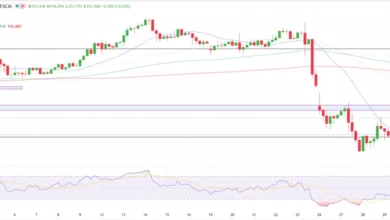
- Mid-2026: After hitting all-time highs, the stock underwent a 26% correction. Analysts largely viewed this as a healthy unwinding of a valuation expansion that had seen the forward P/E ratio reach a 10-year high.
Financial Health and Margin Expansion
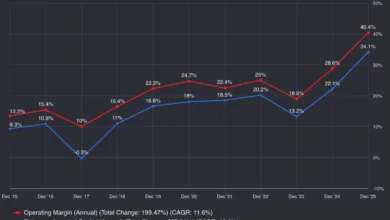
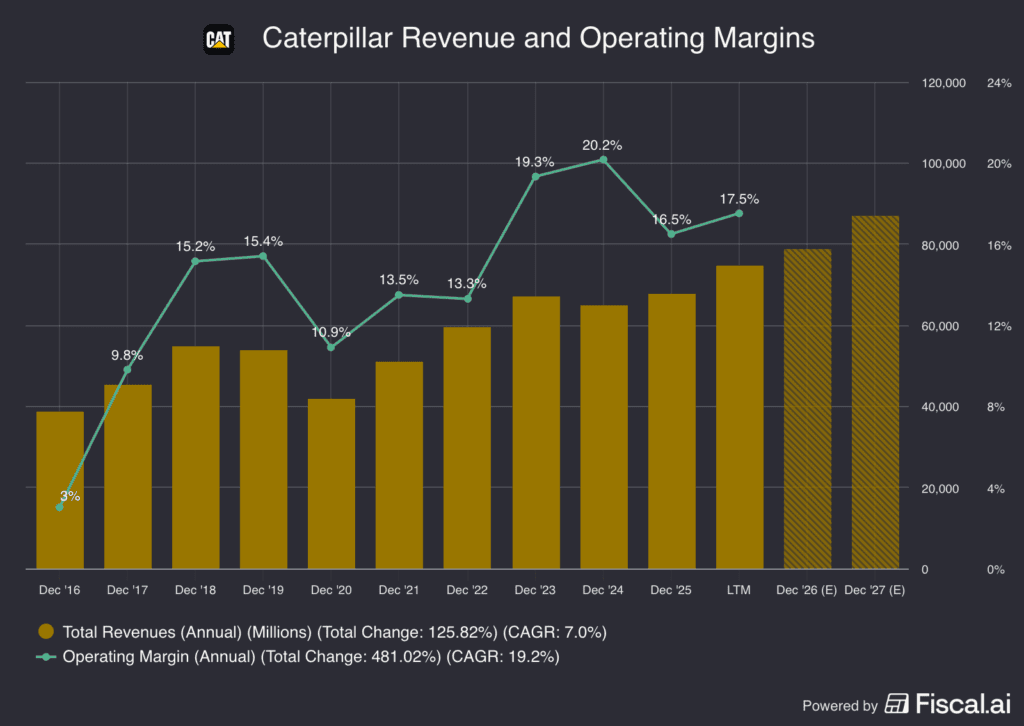
Caterpillar’s financial profile has seen a significant transformation over the last decade. Operating margins, which were historically squeezed by the cyclical nature of its end markets, have shown remarkable resilience. Following a dip in 2025, operating margins rebounded to 17.5%, a testament to the company’s internal efficiency initiatives and a pivot toward higher-margin service and software-based revenue.
Current projections from institutional analysts suggest that revenue will continue to trend higher through at least 2028. This growth is supported by a robust backlog of orders. Earnings growth is expected to outpace revenue growth, indicating that management is successfully squeezing more profit from each unit sold. Despite this, the stock’s rapid rise has compressed its dividend yield, which currently sits at approximately 0.75%. While this may not appeal to traditional income-focused investors, the growth-oriented market has largely looked past the yield in favor of capital appreciation.
Valuation and the PEG Ratio Analysis
Valuation remains the central point of contention among institutional analysts. With a forward P/E ratio that has hovered at historic highs, Caterpillar is no longer trading as a "cheap" industrial stock. However, a closer look at the PEG ratio—which adjusts the P/E for expected earnings growth—suggests that the valuation is not as bloated as it appears at first glance.
Because Caterpillar is expected to maintain double-digit earnings growth, the PEG ratio remains within a reasonable range for a dominant market leader. This suggests that while the stock is expensive compared to its own historical average, it is priced in line with the high expectations for its future earnings trajectory. The recent 26% correction was a critical event, as it served to wash out speculative froth and provided a more stable entry point for long-term institutional investors who were previously sidelined by the stock’s parabolic climb.
Risks to the Bull Case
Despite the optimism, the risks associated with Caterpillar are significant and inherent to its business model. The primary concern is cyclicality. Caterpillar remains a "pro-cyclical" stock; if the global economy enters a recession, construction and mining activity are typically the first areas to see sharp declines.
Furthermore, the company is sensitive to:
- Commodity Price Volatility: If the prices of copper, iron ore, or oil drop significantly, mining companies often scale back their capital expenditures, leading to a direct drop in demand for new machinery.
- Geopolitical and Tariff Risks: As a global entity with a massive supply chain, Caterpillar is uniquely exposed to trade wars and protectionist policies. Any disruption to the flow of raw materials or finished goods could severely impact margins.
- Credit Risk: Through its "Cat Financial" arm, the company provides financing to its customers. A sharp rise in interest rates or a systemic failure among its customer base could lead to increased credit losses and a deterioration of its balance sheet.
- Multiple Compression: If the market loses its appetite for "growth-industrial" stocks, or if the company fails to meet its aggressive earnings targets for consecutive quarters, the stock could face further multiple compression, regardless of the strength of its underlying business.
The Path Forward: Implications and Outlook
The consensus price target for Caterpillar currently stands at approximately $1,006 per share, representing an implied upside of roughly 18% from current levels. This outlook suggests that the street remains largely bullish, banking on the company’s ability to sustain its margins and continue capitalizing on the energy and infrastructure needs of the next decade.
The broader implication of Caterpillar’s success is that the traditional industrial sector is being redefined. It is no longer just about moving dirt; it is about the intersection of heavy machinery, autonomous software, and high-capacity power generation. Companies that successfully bridge the gap between "old economy" hardware and "new economy" software and energy needs are being rewarded with premium valuations.
For investors, the bottom line is clear: Caterpillar has evolved from a simple commodity-linked industrial play into a critical piece of the global infrastructure puzzle. While the cyclical risks remain, the company’s ability to maintain high margins and its strategic positioning in the data-center energy market provide a powerful tailwind. The current period of market adjustment represents a critical test for the stock, as investors determine whether the current valuation accurately reflects the company’s long-term growth potential or whether the cyclical nature of its business will ultimately demand a more cautious approach. As the company looks toward 2028, its performance will likely remain a bellwether for the health of the global economy and the continued pace of digital and physical infrastructure investment.