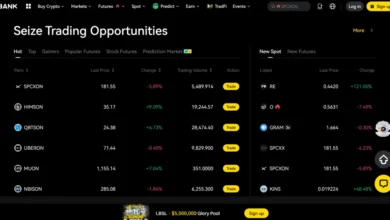
Stock-Linked Memecoins: Issuance, Liquidity, and the Emerging AMM Stack Analysis by HTX Research


Apia, Samoa – HTX Research, the dedicated analytical and investigative arm of the global digital asset platform HTX, has published a comprehensive new report examining a novel frontier in decentralized finance (DeFi): stock-linked memecoins. Titled Stock-Linked Memecoins: Issuance, Liquidity, and the Emerging AMM Stack, the systematic study explores an emerging asset category that materialized rapidly following the debut of the Robinhood Chain. These unconventional tokens are paired directly with tokenized public equities—such as major technology and corporate names including NVIDIA (NVDA), Tesla (TSLA), HIMS, and Micron Technology (MU)—utilizing them variously as quote assets, narrative anchors, or primary liquidity bases.
According to the findings compiled by HTX Research, this hybrid financial architecture effectively bridges traditional public-equity price discovery, decentralized crypto-native attention loops, automated market maker (AMM) inventory mechanics, and continuously traded digital sentiment into a cohesive, highly dynamic market structure. While the report acknowledges a viable short-term growth trajectory for these instruments, it cautions that long-term durability and structural survival remain contingent upon several rigorous conditions being met simultaneously.
The Genesis of a Hybrid Market Structure
The intersection of decentralized finance and traditional equities is not entirely new, but the emergence of stock-linked memecoins represents a distinct evolutionary phase. Defined as second-order equity exposures, these tokens function differently than traditional financial derivatives. While a standard stock token provides a first-order price anchor derived from underlying traditional market valuations, the paired memecoin trades on the cultural cachet, breaking news, viral events, and broader social sentiment surrounding that specific enterprise.
Crucially, the resulting market dynamics often exhibit volatility magnitudes far exceeding those of the underlying equities. Consequently, analysts at HTX Research describe these instruments less as legally structured equity derivatives and more as "attention derivatives" built upon equity themes.
The launch environment for this phenomenon has been significantly catalyzed by the technical and brand architecture of the Robinhood Chain. By leveraging a recognized retail-equity brand name alongside recognizable company symbols rather than abstract real-world asset (RWA) narratives, the ecosystem achieved immediate cultural resonance. Furthermore, integration with decentralized trading venues like Uniswap ensured deep liquidity pools from inception, while automated tooling—such as the O1 Launchpad—streamlined the mechanics of selecting a stock token, generating a memecoin, deploying a Uniswap v4 market, and programmatically allocating trading fees. Data cited by DeFiLlama highlights the rapid scale of this ecosystem, recording approximately $901 million in Total Value Locked (TVL) and $1.727 billion in 24-hour decentralized exchange (DEX) volume across the Robinhood Chain as of early September 2026.
Multi-Hop Routing and the Mechanics of Attention Toll Collection
The financial value generated by stock-linked memecoins extends far beyond the surface-level valuation of the memecoin itself. Under the hood of modern automated market makers and multi-pool routing systems, a trader executing a purchase order for a stock-linked memecoin may traverse a complex infrastructural path. A typical transaction could route capital sequentially from Wrapped Ether (WETH) to a stablecoin like USDG, onward to a specific stock token, and finally into the target memecoin.
This intricate routing means that a single user trade can generate protocol and liquidity provider (LP) fees across multiple liquidity pools simultaneously. During periods of intense, short-lived market attention spikes, trading volume surges while liquidity depths often remain relatively thin. In these high-pressure windows, liquidity providers function effectively as the ecosystem’s primary toll collectors on market attention.
However, HTX Research underscores a critical economic reality: high nominal fee generation does not inherently equate to high net profitability for market participants. Liquidity providers face substantial structural risks that can easily eclipse headline fee income. These hazards include out-of-range position adjustments, one-sided inventory accumulation, impermanent loss, market closures during traditional stock-exchange off-hours, premiums or discounts on underlying stock tokens, and the depreciation of incentive reward tokens.
As the report emphasizes, yields collected through fees are compensation for risk rather than risk-free interest. Liquidity providers continuously shoulder the risk of filling orders at unfavorable prices, while traders bear the primary risk of selecting volatile tokens during shifting market regimes.

Deconstructing the 100,000% APY Illusion
Much of the speculative retail interest surrounding stock-linked memecoins has been fueled by eye-catching metrics displayed on various analytics interfaces, where annualized percentage yields (APY) for supplying Uniswap v4 liquidity to these pools have occasionally exceeded 100,000%. HTX Research’s report systematically deconstructs these figures, explaining the underlying mathematical illusions driven by short observation windows, sudden volume spikes, small initial TVL bases, and aggressive compounding extrapolations.
To illustrate the distortion, the report notes that if a modest liquidity position of $100,000 generates $200 in fees over a single hour, a simple linear annualization produces a misleading rate of approximately 1,752%. When hourly compounding is applied to that same short-term sample, the resulting figure balloons into an astronomical percentage. Furthermore, annualized metrics are heavily skewed by denominator effects; when a memecoin experiences a rapid valuation collapse, dividing relatively constant fee income by a drastically reduced ending TVL results in an artificially inflated displayed yield.
To combat these misleading representations, HTX Research proposes a more rigorous analytical metric: the fee-coverage multiple. This metric divides realized fees and monetized incentives by the total losses incurred relative to a simple hold portfolio, alongside rebalancing and hedging costs. According to the research framework, only a fee-coverage multiple exceeding one indicates that the market-making operation has successfully compensated for its underlying risks.
Despite their flaws, extreme APY figures still hold informational value as a barometer for order flow density relative to effective market depth. Professional liquidity providers are advised to treat these high yields as a "flow radar" rather than a guaranteed return promise.
Four Core Conditions for Long-Term Viability
To determine whether stock-linked memecoins will mature into a durable, institutionalized market segment or remain a transient speculative fad, HTX Research outlines four fundamental conditions that must be systematically evaluated:
- Sustainable Fee Generation Beyond Subsidies: Can the protocols maintain robust trading volumes and fee yields once initial liquidity mining incentives and promotional subsidies expire?
- Inventory Management and Risk Mitigation: Do liquidity providers have access to reliable hedging mechanisms to manage the overnight gaps and structural imbalances caused by traditional stock market closures?
- Regulatory and Infrastructure Resilience: How do underlying stock token issuers manage regulatory scrutiny, custody verification, and the operational risks associated with bridging traditional equities onto decentralized rails?
- User Base Maturation: Will market participation broaden beyond short-term speculative traders to include institutional actors capable of providing stable, long-term depth?
If these four conditions are met, stock-linked memecoins could successfully evolve into a high-volatility, highly efficient front end for the digital "internetization" of global equities, cementing issuance platforms and advanced AMM stacks as permanent fixtures of modern financial architecture. Conversely, if these conditions fail, the current market enthusiasm will likely be categorized as a temporary phenomenon driven by low float assets, heavy subsidization, cheap issuance mechanisms, and transient retail attention.
Broader Implications and Strategic Outlook
The findings from HTX Research highlight a broader philosophical shift in how digital asset markets interact with traditional finance. Rather than attempting to bypass traditional asset classes, modern decentralized finance is increasingly finding ways to wrap, gamify, and hyper-accelerate traditional equities through crypto-native primitives.
Nevertheless, the overarching takeaway from the report is a call for methodological rigor. Headline figures such as six-digit annualized yields should never serve as the endpoint of financial research. Instead, market participants must dissect underlying structures, fee attribution pathways, and hidden risk vectors before drawing conclusions from superficial data points.
HTX Research has confirmed it will continue tracking issuance trends, liquidity shifts, and user composition changes across the Robinhood Chain and comparable ecosystems, delivering data-backed, structural analysis to the digital asset community.
About HTX Research
HTX Research operates as the dedicated analytical arm of the HTX Group, tasked with executing rigorous investigations, publishing comprehensive market reports, and delivering expert evaluations across the cryptocurrency, blockchain technology, and decentralized finance sectors. Grounded in data-driven insights and strategic foresight, HTX Research aims to support informed decision-making, shape industry perspectives, and foster a deeper understanding of evolving global market dynamics within the digital asset economy.