Zilliqa Network Halts Native Transactions Following Critical Ledger App Vulnerability as ZIL Faces Delisting Risk and Institutional Setbacks

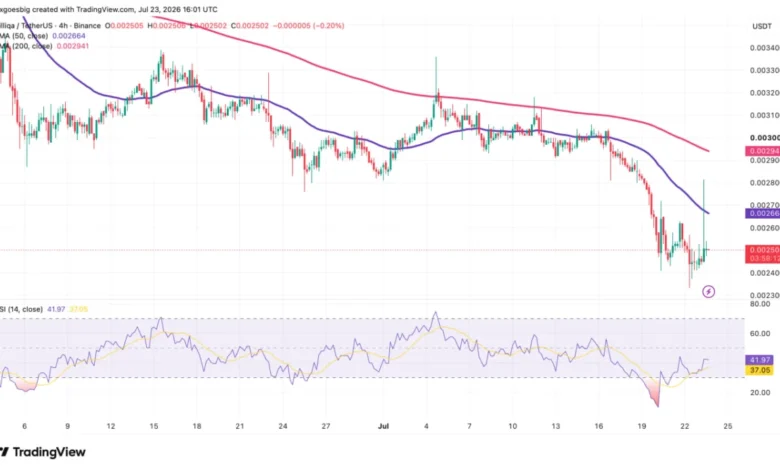
The Zilliqa (ZIL) blockchain ecosystem is currently navigating one of its most significant technical and reputational crises since its inception, following the suspension of all native, non-EVM transactions on July 22, 2024. The halt was triggered by the discovery of a critical vulnerability within the Zilliqa Ledger application, a flaw that dates back to 2019 and potentially exposes the private keys of any user who has signed multiple transactions using the hardware wallet. As the network remains in a state of partial paralysis, the native ZIL token has experienced heightened volatility, bouncing off a recent low of $0.0023 to trade near $0.0025, even as it faces the looming threat of delisting from major exchanges like Upbit.
The Genesis of the Crisis: A Five-Signature Vulnerability
The core of the issue lies not within the Zilliqa blockchain protocol itself, but in the specific code used by the Ledger hardware wallet application to sign native Zilliqa transactions. Unlike Ethereum-compatible transactions that utilize the Elliptic Curve Digital Signature Algorithm (ECDSA), Zilliqa’s native layer employs Schnorr signatures. This cryptographic scheme is often praised for its efficiency and shorter signature lengths, but it requires the generation of a unique, truly random number—known as an ephemeral nonce—for every single signature.
According to a detailed postmortem released by the Zilliqa engineering team, the Ledger app’s randomness generation was flawed. Instead of producing a completely independent nonce for each transaction, the app produced a pattern that became increasingly predictable over time. Engineers discovered that if a single wallet address signed approximately five native transactions using the buggy Ledger app, the mathematical relationship between those signatures allowed an external observer to reconstruct the wallet’s private key. Because blockchain data is public by design, an attacker would only need to scan the Zilliqa ledger for accounts with five or more native signatures to potentially drain those funds without ever touching the user’s physical Ledger device.
Chronology of the Network Suspension and Exploitation
The timeline of the event suggests a rapid escalation from a localized security concern to a full-scale network emergency. On July 19, 2026, Zilliqa’s internal monitoring systems detected transaction patterns that were inconsistent with normal user behavior. These patterns suggested that an automated actor was specifically targeting high-value wallets with a history of frequent native signatures.
By July 20, the situation intensified when KuCoin, a major cryptocurrency exchange, flagged suspicious activity and shared data that helped confirm the exploitation was active. This collaboration led to the grim realization that a partner exchange’s cold wallet had already been compromised and drained of ZIL tokens. On July 21, the root cause was isolated to the Ledger app’s nonce-handling code. Recognizing that every Ledger user was a sitting duck as long as native transactions were permitted, Zilliqa took the drastic step of suspending all native (non-EVM) transactions on July 22.
This suspension creates a unique paradox for security. In a typical hack, users are told to move their funds to a new wallet immediately. However, in this instance, the act of signing a "rescue" transaction could provide the final piece of data an attacker needs to solve for the private key. Furthermore, even if a user’s key is already solved, the network halt prevents the attacker from moving the funds, but it also prevents the legitimate owner from securing them. This "Mexican Standoff" is the primary reason the network remains halted while developers finalize a specialized recovery plan.

Market Reaction and Technical Indicators
The market’s response to the technical failure has been characterized by a mixture of panic selling and speculative bottom-fishing. After plunging to a multi-year low near $0.0023 on July 22, ZIL saw a modest recovery to $0.002502 by July 23. Despite this 8% bounce, the technical outlook remains decidedly bearish.
The ZIL/USDT pair is currently trading well below its 50-period Exponential Moving Average (EMA) of $0.002664 and its 200-period EMA of $0.002941. In technical analysis, these downward-sloping averages act as dynamic resistance zones. For a true trend reversal to occur, ZIL would need to reclaim these levels with significant volume—a difficult task given the current fundamental uncertainty.
The Relative Strength Index (RSI) recently dipped into the "oversold" territory near 20, which often precedes a temporary price bounce. While the RSI has since climbed to 41.97, it remains below the neutral 50 mark, suggesting that the recent price increase is a technical correction rather than a fundamental shift in sentiment. The market appears to be waiting for a definitive resolution to the network halt and a clear statement from exchanges regarding the asset’s listing status.
Exchange Oversight and Delisting Risks
The South Korean exchange Upbit, which commands significant influence over ZIL’s liquidity, has officially designated the token as a "cautionary asset." This designation is a formal warning to investors and often serves as a precursor to delisting if the underlying project fails to resolve its issues within a specified timeframe. Upbit has specifically requested that the vulnerability be addressed and network stability restored by August 2026.
Other exchanges, including KuCoin and Binance, have paused deposits and withdrawals of native ZIL to protect users from potential losses. The loss of exchange support would be a devastating blow to Zilliqa’s liquidity and its ability to attract new capital. The project’s leadership is currently in a race against time to satisfy exchange requirements while ensuring that the "un-halting" of the network does not lead to a mass-drainage of user funds by waiting bots.
Impact on Institutional Roadmaps and Long-term Strategy
The timing of this vulnerability is particularly damaging for Zilliqa’s 2026 strategic objectives. Throughout the first half of the year, the Zilliqa Group has been marketing the network as a "compliance-ready" settlement layer designed for institutional use. The project had scheduled the launch of several regulated enterprise transaction flows for the third quarter of 2026.
Institutional partners—such as banks, payment processors, and supply chain firms—prioritize two factors above all else: network uptime and the integrity of custody solutions. A network-wide halt, even if necessary for security, undermines the promise of 24/7 availability. More importantly, the fact that a flaw in a widely trusted hardware wallet could expose private keys for seven years raises difficult questions about the vetting process for the network’s bespoke cryptographic implementations.

The incident has reignited the debate within the blockchain community regarding the use of non-standard signature schemes. While Schnorr signatures offer technical advantages, the ubiquity of the Ethereum Virtual Machine (EVM) and its ECDSA standard means that those tools are more heavily audited and tested. By moving away from the "tried and true" paths of the industry, bespoke networks like Zilliqa take on significant "implementation risk," as demonstrated by this Ledger app flaw.
The Path to Recovery: Technical and Social Challenges
Zilliqa has confirmed that a corrected version of the Ledger app has been developed in coordination with Ledger’s security team. However, deploying a patch is only the first step. The patch prevents future transactions from leaking data, but it cannot change the fact that the signatures already recorded on the blockchain have already compromised existing keys.
The proposed recovery plan likely involves a network upgrade or a coordinated "rescue" period. One possibility is a hard fork or a protocol-level change that allows users to migrate their balances to new addresses through a secure, non-native signature path (such as using an EVM-compatible wallet like MetaMask, which was unaffected by the bug). However, any such move requires extreme precision to ensure that attackers cannot use the same mechanism to claim the funds first.
The social challenge is equally daunting. Zilliqa must rebuild trust with a community that has seen its assets frozen and its security guarantees questioned. The project’s ability to navigate this crisis will depend on its transparency in the coming weeks and its ability to adhere to the strict timelines set by exchanges like Upbit.
As of late July 2026, the Zilliqa network remains in a state of high alert. While the ZIL token has shown some resilience in price, the fundamental hurdles—recovering compromised funds, satisfying regulatory-minded exchanges, and salvaging an institutional reputation—remain the primary obstacles to the network’s survival. The coming weeks will determine whether Zilliqa can emerge as a more robust, battle-tested protocol or if this 2019-era bug will mark the beginning of a terminal decline for the once-promising sharding pioneer.