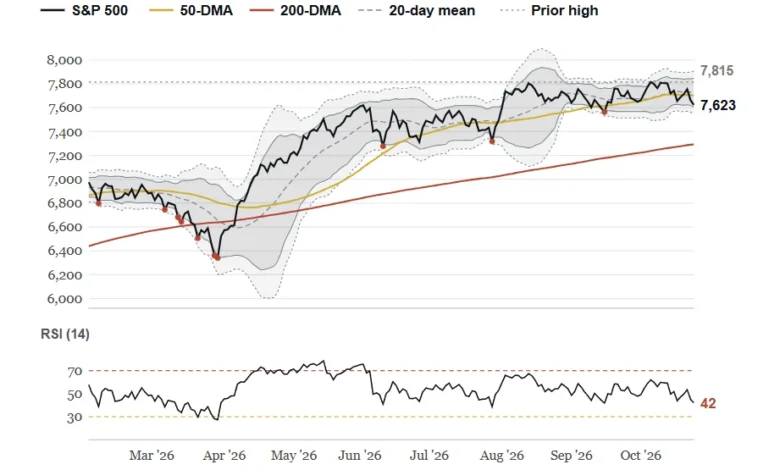
Financial markets faced a turbulent period ending October 24, 2026, marked by shifting equity leadership, surging energy costs, and the re-emergence of traditional cross-asset correlations. The S&P 500 finished the week at 7,623.68, down 0.4%, recording its second consecutive weekly loss. While headline indexes reflected modest pullbacks, underlying sector rotations and macroeconomic catalysts dictated market direction. Technology shares experienced a sharp correction led by mega-cap stalwarts, whereas cyclical and defensive equities displayed relative resilience. Simultaneously, the traditional stock-bond correlation—long scrutinized for its behavior during inflationary regimes—showed signs of returning to historical norms as bond prices responded to emerging growth anxieties.
The week’s equity market volatility was catalyzed predominantly by corporate earnings announcements and shifting macroeconomic indicators. Meta Platforms reported financial results that exceeded headline consensus earnings estimates but revealed its first cash outflow in over a decade. The outflow was driven by aggressive artificial intelligence infrastructure spending that outpaced immediate cash inflows. Concurrently, Meta announced a two-for-one stock split and the issuance of non-voting shares to sustain its capital-intensive data center buildout.
The announcement triggered a 7% single-day decline in Meta shares on Thursday, dragging the Philadelphia semiconductor index down by 6.7% and pushing the Nasdaq Composite to its worst single-session performance since early June. In commodity markets, Brent crude oil settled at $116.72 per barrel, reaching a six-month high and adding inflationary pressure to an already sensitive macroeconomic landscape. Despite the technology rout, the Dow Jones Industrial Average managed a weekly gain of approximately 1.4%, supported by broad-based rotation into value sectors and defensive equities such as energy and consumer staples.

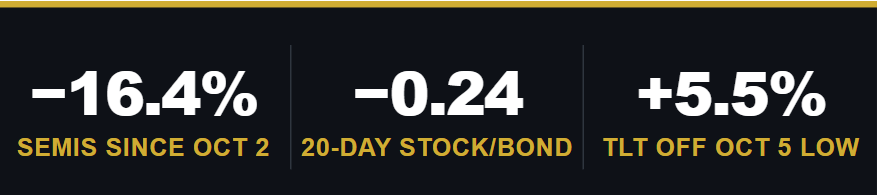
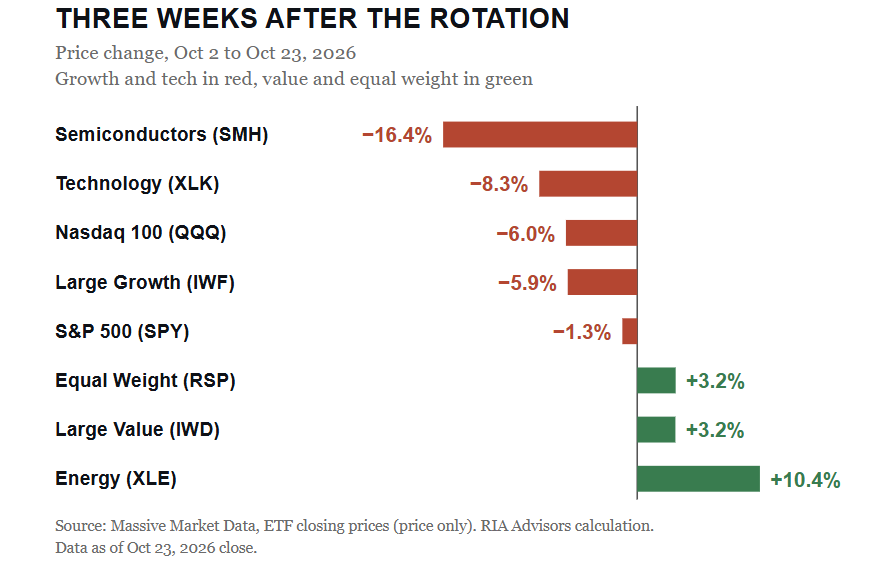
Market analysts noted that the technology sector’s pullback was not an isolated reaction to Meta’s cash flow statement, but rather a technical correction long overdue. Entering October, technology allocations sat in the 96th percentile of the past five years, with the technology ETF (XLK) trading 7.3% above its 50-day moving average and the semiconductor ETF (SMH) sitting 10.7% above its respective benchmark. Adhering to fundamental market mean-reversion principles, the subsequent rotation shifted capital away from overbought growth segments toward under-allocated value assets. Since early October, SMH dropped 16.4% and XLK fell 8.3%, while equal-weight S&P 500 indices and large-cap value benchmarks gained 3.2%, and energy equities surged 10.4%.

Technical indicators across major equity indices at the close of the week highlighted a critical testing ground for market momentum. The S&P 500 settled 2.4% below its record close of 7,815 reached on October 6. The index tested its 100-day moving average at 7,605, while remaining comfortably above its 200-day moving average of 7,293, confirming that the broader long-term structural uptrend remains intact. Furthermore, Friday’s close landed just above the lower two-standard-deviation Bollinger Band at 7,604, a technical floor that marked short-term lows in March, June, late July, and mid-September of the same year.

Market breadth metrics indicated a significant divergence between mega-cap technology and the broader market. While technology, industrials, and communications lagged, eight out of eleven market sectors outperformed the broader index based on their distance from 50-day moving averages. Energy, health care, and consumer staples emerged as the more stretched sectors, prompting portfolio rebalancing discussions among institutional strategists regarding profit-taking in crowded trades and selective accumulation in oversold sectors.
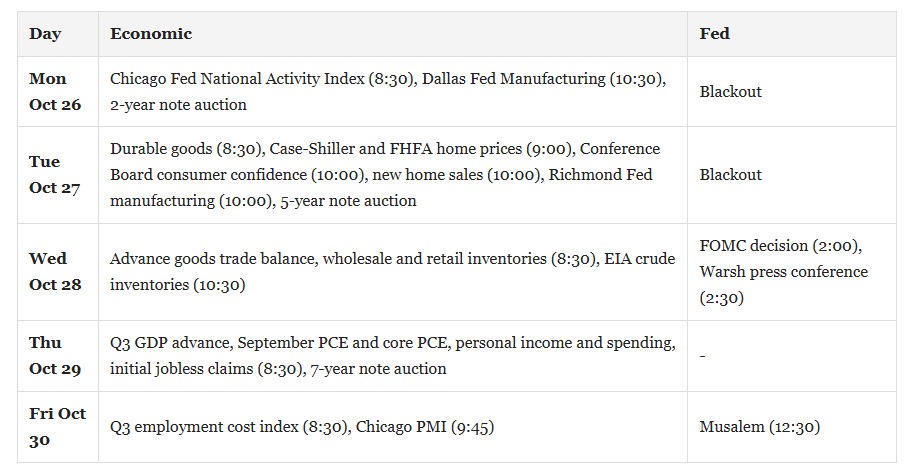
The upcoming week presents a substantial test for institutional portfolios, with approximately 44% of the S&P 500 scheduled to report third-quarter financial results. Key reports include technology heavyweights Microsoft and Alphabet releasing earnings after the market close on Wednesday, followed by Amazon on Thursday. Investors will scrutinize these statements for quantifiable returns on massive artificial intelligence capital expenditures. In addition, Visa and Mastercard will provide vital data points regarding consumer spending health, while energy majors Exxon and Chevron will report financial results against the backdrop of elevated Brent crude prices.
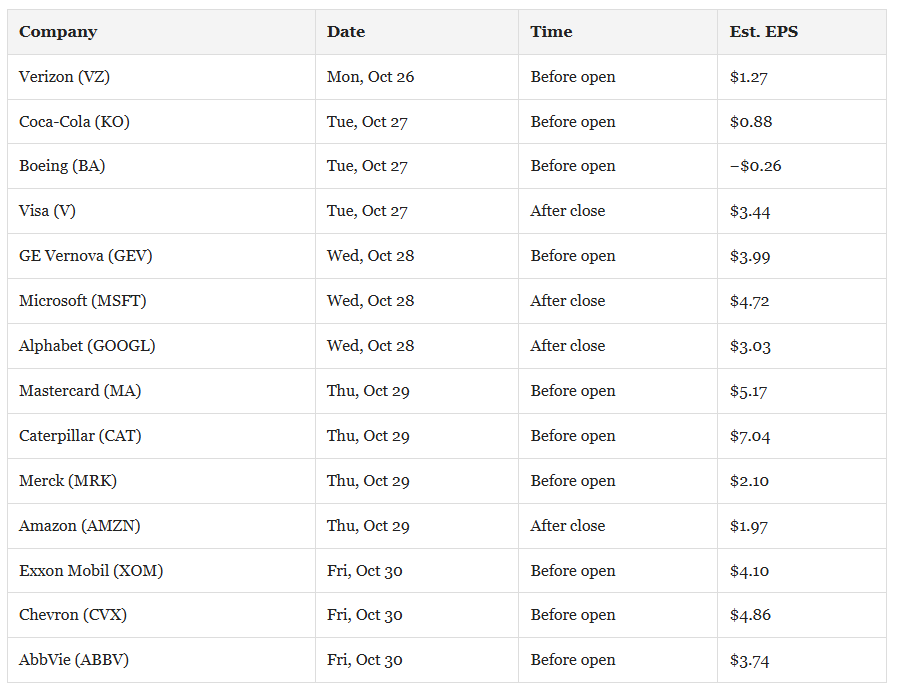
On the macroeconomic front, the Federal Open Market Committee (FOMC) is scheduled to announce its interest rate decision, accompanied by Federal Reserve Chair press conferences. Market consensus widely anticipates the central bank to maintain the federal funds rate in the 3.75% to 4.00% range following adjustments in September. However, bond market rallies leading into the announcement have tempered immediate rate hike expectations. Thursday’s economic calendar features the release of third-quarter Gross Domestic Product (GDP) growth figures—expected to register near 3%—alongside the September Personal Consumption Expenditures (PCE) price index. Headline inflation is projected to tick up to 3.6% from 3.4%, with core inflation estimated at 3.1%. Friday’s employment cost index will provide critical insight into wage pressures and labor market dynamics.

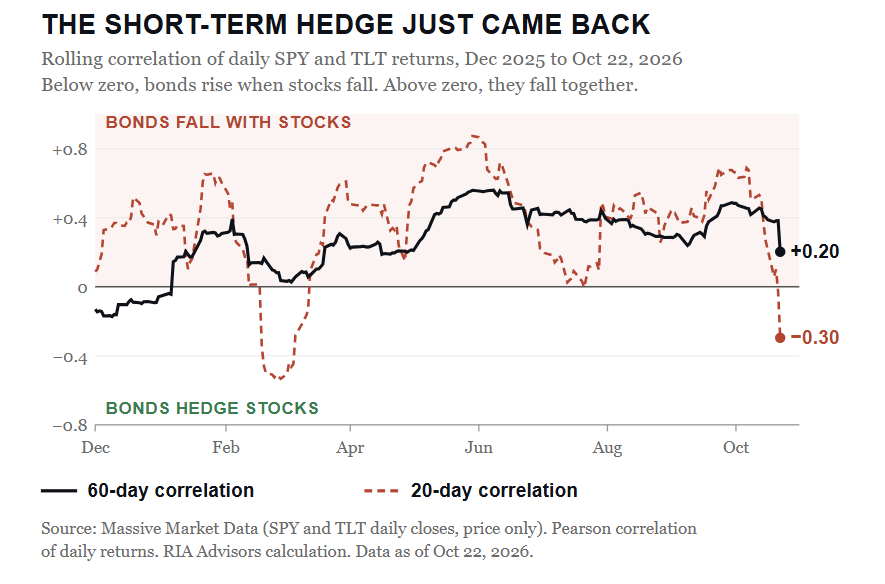
The interaction between equities and fixed-income assets remained a central focal point for institutional asset allocators. For decades, the traditional 60/40 portfolio relied on long-term U.S. Treasuries to act as a reliable hedge during equity drawdowns. Research published by Federal Reserve economists Canlin Li and Emre Yoldas on October 16 highlighted that the correlation between U.S. stock returns and changes in the 10-year Treasury yield averaged +0.40 between 2000 and 2021, before shifting downward to negative territory in subsequent years. Historically, bond prices rose when stocks fell, insulating diversified portfolios from growth shocks.
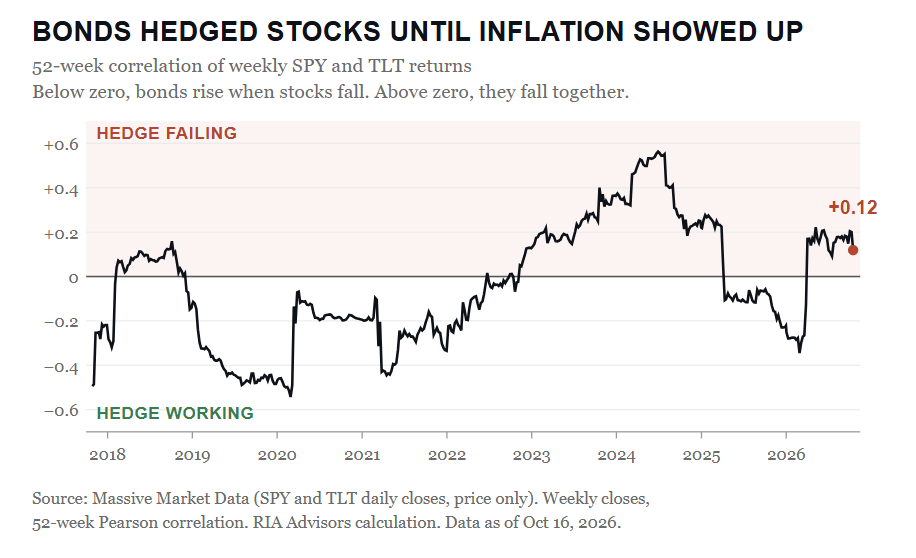
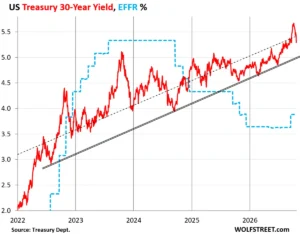
However, the resurgence of supply-side inflation in 2022 and mid-2025 disrupted this dynamic. When inflation stems from commodity supply shocks—such as spikes in global oil prices—rather than a demand-driven overheating economy, bond yields rise alongside inflation expectations, causing both stocks and bonds to experience synchronized drawdowns. The 10-year Treasury yield climbed from 4.18% at the start of the year to 5.31% by early October, mirroring a rise in headline CPI from 2.4% to 3.7%.

Despite these periodic dislocations, fixed-income analysts emphasize that bonds do not function as a direct hedge against inflation; rather, they serve as a shock absorber against the economic slowdowns that persistent inflation ultimately triggers. As supply-side inflation burns out due to constrained consumer purchasing power and reduced discretionary spending, economic growth cools, prompting central banks to ease monetary policy and driving bond prices higher. Recent market sessions demonstrated this mechanism in action: during the recent equity market pullback, the 20-day correlation between the S&P 500 (SPY) and long-term Treasuries (TLT) slipped into negative territory, reaching -0.30, while long-term Treasury exchange-traded funds moved above their 50-day moving averages.
Investment strategists advise maintaining disciplined portfolio structures rather than abandoning traditional fixed-income allocations due to short-term correlation breakdowns. By sizing bond sleeves appropriately for risk mitigation and recognizing that fixed income acts as a buffer against growth shocks rather than immediate inflation spikes, portfolios can better weather macroeconomic transitions. As upcoming corporate earnings reports, Federal Reserve policy statements, and vital inflation data release over the coming days, market participants will closely monitor whether technical support levels hold and if cross-asset correlations firmly re-establish their historical defensive properties.