HaasOnline Launches Smart Trade Beta on TradeServer Cloud to Revolutionize Manual Trading Discipline

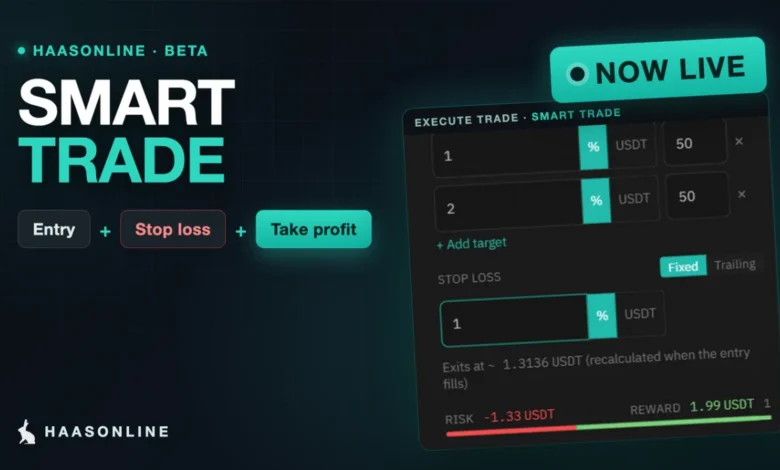
HaasOnline has officially entered the beta phase for its latest feature, Smart Trade, integrated directly into the HaasOnline TradeServer Cloud platform. This development marks a significant shift for the firm, which has historically been synonymous with complex algorithmic trading bots and custom HaasScript development. By introducing a streamlined tool for manual traders, the company is bridging the gap between high-frequency automated strategies and the intuitive, discretionary decision-making processes favored by many active market participants.
The core objective of Smart Trade is to provide a layer of systematic risk management to manual orders. In a volatile cryptocurrency market where price swings can occur in seconds, the ability to pre-define exit strategies—specifically take-profit and stop-loss levels—before a trade is even executed is a critical component of institutional-grade trading hygiene.
The Evolution of Automated Trading Interfaces
Historically, the evolution of crypto trading tools has followed a distinct trajectory. Early market participants relied heavily on manual order entry via exchange web interfaces, which often lacked advanced order types. As the market matured, the demand for automation grew, leading to the rise of sophisticated trading bots. However, these tools often presented a high barrier to entry, requiring users to possess coding skills or a deep understanding of quantitative strategies.
HaasOnline’s introduction of Smart Trade acknowledges a middle ground: the discretionary trader who performs their own technical analysis but requires a reliable "safety net" to ensure their emotional state does not override their original risk management plan. By allowing users to set exit parameters directly within the platform, HaasOnline is addressing the psychological pitfalls of manual trading, such as "revenge trading" or the tendency to move stop-loss orders further away when a trade begins to turn against a position.
Functionality and Technical Implementation
The mechanics of Smart Trade are designed for rapid deployment. When a user navigates to the "Execute Trade" panel, represented by a dollar sign icon, they can toggle the Smart Trade feature. This action allows the user to specify their entry point, desired profit target, and acceptable stop-loss threshold before the trade is broadcast to the exchange.
One of the most notable features is the "Lots" system, which allows users to manage multiple concurrent trades on a single spot market. In a spot market environment, a trader might simultaneously maintain a long-term "hold" position and a short-term "swing" position. Under the previous manual framework, tracking these separately without confusion was difficult. With Smart Trade, each "lot" is treated as an individual entity with its own specific risk parameters, allowing for granular management of a portfolio.
Furthermore, the integration with Marketview provides a visual representation of these parameters directly on the chart. Traders can drag and drop their entry, target, and stop-loss levels in real-time, providing an interactive interface that mimics the responsiveness of professional charting platforms. If a user is already in a trade—perhaps one that was initiated directly on an exchange’s interface—they can "adopt" the position into the Smart Trade ecosystem, allowing the software to monitor and execute the exit strategy without requiring the user to close and reopen the position.
Institutional Implications and Risk Disclosure
It is imperative to note how Smart Trade interacts with exchange infrastructure. On the majority of cryptocurrency exchanges, take-profit and stop-loss orders set through the HaasOnline TradeServer Cloud are monitored locally by the HaasOnline software rather than being placed directly on the exchange’s order book as native "stop-limit" or "take-profit" orders.
This distinction carries specific implications for the trader:
- Connectivity Dependency: Since the exit logic resides on the TradeServer Cloud, the platform must maintain an active connection to the exchange. If the server loses its internet connection, the automated exit triggers may not fire.
- Execution Latency: The software executes the exit via a market order once the trigger price is hit. While this ensures the trade is closed, it exposes the user to slippage, particularly in low-liquidity environments or during periods of extreme market volatility.
- Execution Discipline: Because the exit is handled by the software, the trader is removed from the immediate decision-making loop at the moment of exit. This minimizes the risk of emotional intervention but requires the user to trust the pre-set parameters established during the initial planning phase.
Strategic Context and Market Positioning
HaasOnline’s decision to move into the manual trading space is a calculated move to expand its user base. By lowering the barrier to entry, the company is positioning its TradeServer Cloud as an all-in-one terminal for both automated and manual traders. This strategy is reflective of a broader trend in the fintech sector, where platforms are consolidating features to prevent "tool fatigue"—the phenomenon where traders must switch between multiple applications to manage their portfolio, charting, and execution.
From a data perspective, the inclusion of "Smart Trade history" allows users to track their performance metrics, providing an empirical record of whether their manual trading plans are succeeding or failing. This historical data is essential for traders looking to refine their strategies over time. By providing an objective view of PnL, outcomes (e.g., "Stopped out" vs. "Target hit"), and trade frequency, the platform encourages a more analytical approach to discretionary trading.
Implementation Timeline and Future Outlook
The beta release of Smart Trade is currently available to all users on the TradeServer Cloud. The deployment follows a period of internal testing aimed at ensuring the stability of the order management engine. While the feature is currently focused on spot markets, the industry expects that such tools will eventually be extended to futures and margin trading, where the management of stop-losses is even more critical due to the presence of liquidation risk.
For new users, the company has integrated a "paper trading" functionality, which allows participants to test the Smart Trade logic using virtual funds. This is a standard practice in professional trading environments, enabling users to verify that their configuration—such as the "Lots" settings or the placement of stop-losses—functions as intended before exposing real capital to the market.
Professional Guidance and Responsibility
As with any tool that facilitates trading, the responsibility for capital preservation remains with the user. HaasOnline has been explicit in its disclaimers, noting that the software provides automation, not financial advice. The inherent risks of cryptocurrency trading—including extreme price volatility, cybersecurity threats, and the potential for total loss of capital—are not mitigated by the existence of a stop-loss order. A stop-loss is a risk management tool, not an absolute guarantee of price execution.
In conclusion, the launch of Smart Trade represents a maturation of the HaasOnline platform. By combining the power of an automated engine with the flexibility required for manual, discretionary trading, the company is addressing the practical needs of modern crypto traders. As the beta progresses, the feedback from users will be the primary driver for future iterations, potentially leading to more advanced features such as trailing stop-losses or OCO (One-Cancels-the-Other) order types. For now, the tool provides a robust, disciplined framework for traders who wish to maintain control over their entries while ensuring their exits are governed by a pre-determined, logical plan.