The Divergent Anxieties of the Modern Era: How MAGA Immigration Fears and Data Center Resistance Reveal Deep Economic Insecurities

At first glance, the MAGA movement’s deep-seated apprehension regarding immigration and the broader American public’s rising alarm over the proliferation of industrial data centers share striking similarities, as each phenomenon reflects profound insecurities about one’s place in a rapidly shifting economy. Yet beneath this surface-level parallelism lies a stark ideological divergence: while the fear of demographic displacement paradoxically reassures native populations that their cultural and national identity holds inherent value, the anxiety surrounding the digital encroachment of server farms operates on the chilling assumption that human labor, property, and local environments will soon be rendered entirely obsolete.
This dichotomy sits at the heart of contemporary socio-political discourse in the United States and across Western democracies. As communities grapple with the twin pressures of globalization and the artificial intelligence revolution, the anxieties manifest in vastly different political reactions, policy debates, and social movements. Understanding these anxieties requires examining their origins, the data driving them, the responses of public officials, and the long-term implications for a transforming global order.
The Ideological Roots of Demographic Replacement
Few conceptual frameworks have traveled as far or exerted as much influence over modern nationalist politics as the "Great Replacement" theory. Coined in France by the writer Renaud Camus, the hypothesis posits that native European and Western populations are being systematically supplanted by non-white immigrants through deliberate demographic engineering orchestrated by elites.
Although formulated in a European context, the theory quickly crossed the Atlantic, finding a receptive audience within American populist networks. It has provided the rhetorical architecture and ideological grammar for the political advancement of Marine Le Pen’s National Rally in France, Prime Minister Viktor Orbán’s long-standing administration in Hungary, the Alternative for Germany (AfD), and the hardline mass-deportation platforms championed by Donald Trump and his supporters in the United States.
Beyond electoral politics, the framework has bled into violent extremism. The ideology has been explicitly cited in the manifestos of mass murderers who carried out racially motivated attacks in Christchurch, New Zealand; El Paso, Texas; Hanau, Germany; and Buffalo, New York.
Despite its debunking by demographers and sociologists—who point out that migration is driven by complex economic, demographic, and geopolitical factors rather than a coordinated conspiracy—the narrative maintains a potent hold. It offers adherents a narrative of grievance, framing demographic shifts not as the natural byproduct of globalized labor markets, but as an existential threat to native primacy. In doing so, it paradoxically validates the cultural importance of the native population, framing them as the noble, besieged defenders of an ancient heritage worth fighting to preserve.
The Rise of Digital Anxieties and Data Center Backlash
In stark contrast to the cultural and demographic focus of immigration anxieties, a very different kind of grassroots resistance is brewing across suburban and rural America, directed not at human newcomers, but at silicon and steel: the rapid, unchecked expansion of data centers.
Driven by the explosive growth of cloud computing, streaming services, and, most recently, generative artificial intelligence, tech giants such as Microsoft, Google, Amazon, and Meta are scrambling to construct millions of square feet of server farms. These facilities are heavily concentrated in regions offering cheap land, tax incentives, and accessible power grids—most notably Northern Virginia’s "Data Center Alley," parts of rural Texas, Ohio, and the Pacific Northwest.
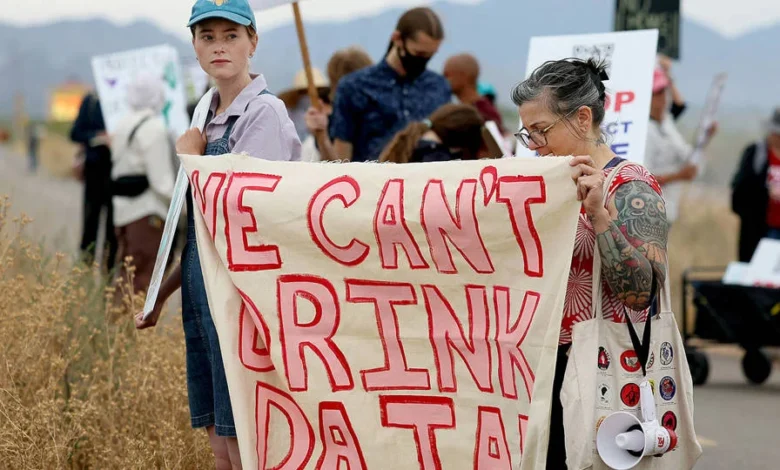
However, the local reception has grown increasingly hostile. Unlike manufacturing plants of the past, modern data centers bring very few permanent jobs to the communities that host them once construction is completed. Instead, residents are left to contend with severe negative externalities: staggering energy consumption that strains local power grids and threatens to drive up utility bills for households, massive water usage required for cooling systems, round-the-clock industrial noise from massive cooling fans, and the transformation of pastoral landscapes into monolithic windowless warehouses.
Public policy data underscores the scale of this infrastructure boom. Industry reports indicate that capital expenditures on data center construction in the United States surpassed $50 billion annually by 2024 and are projected to double by the end of the decade. Concurrently, public opposition has surged. Local zoning boards, once accustomed to rubber-stamping commercial developments in exchange for promised tax revenues, now face hostile town hall meetings packed with residents demanding moratoriums.
Chronology of Competing Anxieties
To understand how these two disparate fears have come to dominate the contemporary American landscape, it is helpful to examine their parallel trajectories over the past decade:
- 2015–2016: The political mainstreaming of border security and anti-immigration rhetoric takes center stage in American politics with Donald Trump’s presidential campaign, elevating demographic anxieties to a central pillar of the conservative platform.
- 2018–2020: As cloud computing matures, tech companies quietly acquire vast tracts of land near major metropolitan fiber-optic hubs, sparking early, localized pushback from environmental groups and suburban homeowners regarding noise and land use.
- 2021–2022: Post-pandemic supply chain shifts and the remote-work boom accelerate the reliance on digital infrastructure, prompting a massive wave of data center groundbreakings across secondary and tertiary markets.
- November 2022: The public release of OpenAI’s ChatGPT triggers an unprecedented gold rush for artificial intelligence infrastructure, exponentially increasing the demand for high-density data centers.
- 2023–2024: Anti-immigrant political platforms harden across Western nations, culminating in strict legislative proposals and border enforcement debates, while concurrently, rural communities in states like Virginia, Oregon, and Georgia form organized coalitions to block new server farm approvals.
- 2025–2026: The two anxieties converge in the public consciousness as defining symptoms of economic displacement—one driven by human migration, the other by automation and technological centralization.
Economic Insecurities: Value Versus Obsolescence
While both movements are fueled by a deep-seated fear of losing control over one’s community and future, the psychological profile of each anxiety reveals a fundamental divergence in how individuals view their intrinsic worth within the modern capitalist system.
The fear of demographic replacement, distilled to its core, is rooted in a zero-sum view of culture and political power. Proponents of this view believe that their demographic group is being pushed aside, but the underlying premise relies on the idea that they should be the rightful owners of the land, culture, and economic benefits of the nation. It is an exclusionary politics of entitlement and grievance, yet it inherently asserts that the native population possesses a unique, irreplaceable value that is actively being stolen.
Conversely, the resistance to data centers stems from a paralyzing premonition of complete irrelevance. When a community fights against a massive server farm, the underlying panic is not that outsiders will outvote them or change their cultural traditions, but that human labor, local resources, and human agency are being entirely sidelined by an opaque, technocratic elite. The data center does not care about the local population; it does not buy goods from local main streets, send children to local schools, or participate in civic life. It consumes massive amounts of electricity and water while housing algorithms designed to automate human thought and labor.
In this scenario, local residents do not feel valued or besieged; they feel discarded. The fear is that their land, their natural resources, and eventually their livelihoods are worth nothing to the corporate titans directing the AI revolution.
Official Responses and Policy Implications
Governments at the local, state, and federal levels are struggling to formulate coherent responses to these divergent crises, often caught between competing economic imperatives and populist pressures.
Regarding immigration, federal lawmakers remain deeply polarized. Hardline factions advocate for sweeping deportations, militarized border enforcement, and restrictive asylum policies to appease constituents gripped by demographic fears. Meanwhile, business lobbies and economists emphasize the necessity of immigrant labor to sustain aging domestic workforces and prevent labor shortages in agriculture, construction, and healthcare. This stalemate has left immigration policy mired in cyclical political warfare without long-term structural reform.
On the technological front, municipal and state governments are beginning to grapple with the realities of the digital buildout. Several states have introduced legislation aimed at reining in the environmental impact of data centers. For instance, lawmakers in Virginia and Georgia have proposed bills requiring server operators to disclose their exact water and power consumption, mandate minimum distances from residential zones, and fund local grid upgrades rather than passing those costs onto residential ratepayers.
Industry representatives, however, argue that stringent regulations risk crippling American competitiveness in the global artificial intelligence race, warning that if domestic energy grids cannot support the necessary infrastructure, leadership in tech innovation will inevitably shift to geopolitical rivals such as China.
Conclusion
The simultaneous rise of anti-immigrant nationalism and anti-tech infrastructure grassroots movements highlights a fractured national psyche. Whether confronting the perceived human influx of globalization or the silent, humming expansion of the artificial intelligence apparatus, millions of citizens feel adrift in a changing economy that appears indifferent to their well-being.
Ultimately, these two fears tell contrasting stories about human worth in the twenty-first century. One fights to preserve a privileged identity against perceived human rivals, while the other struggles to retain human dignity in the face of mechanized obsolescence. Until policymakers address the underlying economic precarity driving both phenomena—stagnant working-class wages, regional economic decay, and a lack of control over technological and demographic transformations—these anxieties will continue to shape the political and social landscape of the modern world.