The Questions that Change Everything: Kris Longmore Breaks Down the Realities of Solo Quantitative Trading in a Comprehensive 72-Minute Retrospective

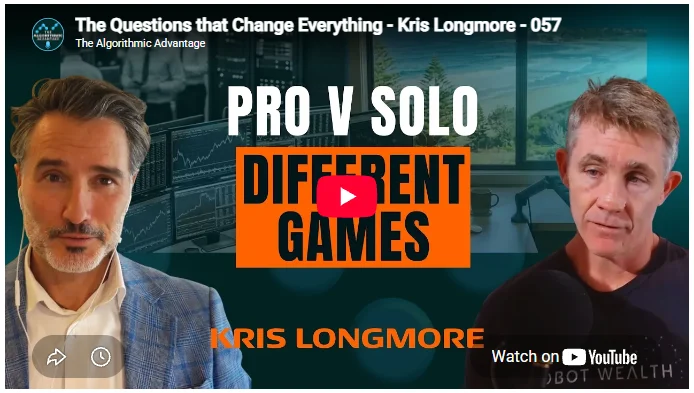
The modern landscape of financial trading has undergone a profound democratization over the past decade, shifting from an exclusive domain dominated by institutional prop firms and high-frequency trading (HFT) monoliths to an arena increasingly populated by independent, solo practitioners. Recently, quantitative researcher and seasoned trader Kris Longmore sat down with Simon, host of the prominent industry program The Algorithmic Advantage, for a wide-ranging, 72-minute retrospective on the realities of algorithmic trading. The resulting conversation—titled "The Questions that Change Everything"—offers an unfiltered look into the evolution of a retail-to-institutional-to-independent trading career, providing crucial insights for aspiring quants, part-time speculators, and seasoned market participants alike.
Rather than relying on heavily scripted talking points or sanitized industry talking heads, the unvarnished discussion traversed Longmore’s trajectory from a curious amateur attending regional developer meetups to a partner at a professional proprietary trading firm, and finally to his current status as an independent solo operator. The dialogue serves as a rare, end-to-end masterclass on the philosophical and practical constraints governing modern quantitative finance outside the traditional institutional fortress.
The Genesis of an Edge: From Sydney Meetups to Institutional Realities
The foundational narrative of Longmore’s career traces back to a quantitative traders’ meetup in Sydney, Australia, during an era when educational platforms like Quantopian regularly hosted community workshops and local proprietary trading firms actively scouted emerging regional talent. At the time, Longmore had developed a sophisticated machine learning framework intended for algorithmic backtesting—a technological feat that, in the early days of retail machine learning applications to finance, he believed would command immediate professional respect.
During the event, Longmore pitched his backtesting infrastructure to a senior researcher from a prominent local prop firm, expecting validation. Instead, the practitioner offered a sobering, reality-check inquiry that fundamentally reoriented Longmore’s intellectual framework: "Look mate, that’s really cool, but what’s your edge?"
At the time, Longmore possessed no answer. He had never even conceptualized the question in those terms. That single, blunt inquiry catalyzed a career-defining trajectory that eventually saw him join the very same proprietary firm as a researcher and partner.
When discussing this transition with The Algorithmic Advantage, Simon pressed Longmore on how much of the institutional prop shop’s operational framework he ultimately retained when he left to establish his own independent trading entity. According to Longmore, the elements that successfully migrate are cultural rather than structural or tactical. He emphasizes the immense value of institutional paranoia—the rigorous weekly peer-review rituals where nascent trading ideas are systematically dismantled, and the intellectual rigor required to ruthlessly kill underperforming hypotheses before they consume capital.
Conversely, the actual execution mechanics of institutional trading are entirely non-transferable to a home office environment. Low-latency statistical arbitrage across global futures markets demands co-located server infrastructure, direct exchange memberships, specialized clearing arrangements, and a multidisciplinary engineering team dedicated exclusively to execution pathways. Recognizing that a solo practitioner cannot economically compete in the high-frequency or co-location domains forces a vital strategic pivot: defining precisely which games an independent operator is mathematically and logistically equipped to win.
The Macroeconomic and Psychological Dangers of Full-Time Solo Trading
One of the most provocative and fiercely debated segments of the interview centers on the ubiquitous ambition among retail traders to quit their day jobs and trade full-time. Drawing on more than a decade of observation, including his extensive engagement with independent operators through the RW Pro community, Longmore issued a cautionary perspective that challenges conventional retail trading mythology: the vast majority of aspiring traders should maintain their primary employment indefinitely.
The economic rationale underpinning this advice relies on the inherent volatility of trading income. P&L generation for independent systematic traders is characteristically lumpy; revenue streams are non-linear, and profitability in any given month remains fundamentally unpredictable until the settlement period concludes. When an individual relies on their trading account to service fixed liabilities—such as mortgages, utility bills, and basic living expenses—the psychological pressure induces severe behavioral pathologies. Under financial duress, traders routinely commit classic portfolio management errors: they systematically oversize positions, accept suboptimal trade setups they would otherwise reject, and abandon established risk parameters out of desperation. Longmore noted that he has repeatedly witnessed this dynamic transform exceptionally intelligent individuals into chronically unprofitable market participants.
Furthermore, the mechanics of drawing a living wage directly from a trading account introduce structural handicaps that severely impair long-term portfolio growth. Extracting consistent monthly capital withdrawals from a modest trading pool functions mathematically like an investment strategy burdened by an indefinitely negative Sharpe ratio. Compounding remains the singular, most powerful asset available to a solo trader, and its compounding engine operates exclusively on capital that is left undisturbed. Longmore revealed that even after more than a decade of sustained profitability, he purposefully maintains diversified external income streams, both to insulate his trading capital from drawdown pressure and to maintain professional diversification.
Demographic data from professional indie trading communities largely corroborates this thesis. Within specialized cohorts like RW Pro, an estimated ninety percent of active participants maintain external professional commitments. The ten percent operating on a full-time basis are overwhelmingly comprised of successful, exited technology founders or established entrepreneurs who possess substantial financial reserves and do not rely on monthly trading distributions for survival. Longmore argues that this structural distribution should serve as the normative benchmark for independent quants, refuting the notion that retaining a day job represents a professional compromise or a personal failure.
Breadth Before Polish: The Mathematical Imperative of Portfolio Expansion
In addressing quantitative portfolio construction, Simon introduced the Fundamental Law of Active Management—a cornerstone quantitative finance principle originated by Richard Grinold. The law posits that a portfolio manager’s expected information ratio (risk-adjusted excess return) is a function of their forecasting skill multiplied by the square root of breadth, where breadth represents the number of independent trading bets executed per year.
Because square root functions experience their steepest rates of growth at the lowest integers, the marginal benefit of expanding a quantitative portfolio from two independent strategies to three is exceptionally high, whereas the incremental return generated by spending weeks or months micro-optimizing and polishing an already functional single strategy is comparatively negligible.
Longmore points out that independent traders systematically violate this mathematical reality. Upon developing their maiden profitable trading strategy, practitioners frequently succumb to the cognitive bias of familiarity, spending consecutive weekends bolting on complex optimization overlays, dynamic stop-loss mechanisms, and machine learning enhancements to the system they understand best. Grinold’s law, however, dictates that those same weekend hours are far more efficiently allocated toward researching and deploying strategies two, three, and four. The mandate for rigorous parameter polish and curve-fitting mitigation becomes relevant much later in an operation’s lifecycle, once the marginal returns on expanding breadth begin to plateau.
This mathematical constraint also explains why systematic, rules-based trading is the only viable methodology for an individual operator seeking to run a diversified operation. Attempting to manually monitor and execute seven or eight distinct trading edges concurrently via discretionary tape-reading is a cognitive impossibility that inevitably leads to execution fatigue and capital erosion.
Industry Implications and the Rise of the Independent Quant
The dialogue between Longmore and The Algorithmic Advantage arrives at a pivotal juncture for the retail and independent quantitative finance sectors. As brokerages lower API barriers, alternative data sets become increasingly accessible to non-institutional buyers, and cloud-computing infrastructure democratizes quantitative backtesting, more individuals than ever are attempting to build systematic trading operations from home.
However, the prevailing discourse in retail trading media has historically overemphasized technical execution—such as mastering Python syntax, optimizing neural networks, or securing ultra-low-latency data feeds—while largely ignoring the macro-level risk management, capital allocation psychology, and strategic prioritization highlighted by Longmore. By emphasizing that an independent trader’s primary competitive advantage lies not in competing with institutional co-location facilities, but in exploiting awkward, noisy, and mediocre market inefficiencies that institutional funds are structurally too large to harvest, the interview provides a pragmatic blueprint for survival.
As Simon continues his dedicated series on part-time algorithmic trading via The Algorithmic Advantage, and as Longmore expands upon these foundational concepts through his ongoing written series on Edge Alchemy, the broader financial community is gaining access to an increasingly transparent framework for indie quant operations. For market participants navigating the transition from curious hobbyist to disciplined systematic operator, the retrospective stands as an indispensable roadmap—proving that sustainable trading success is achieved not by chasing institutional perfection, but by mastering the specific, unglamorous realities of operating alone.