US Manufacturing Activity Expands Faster Than Expected in October as ISM PMI Rises to 55.5, Extending Growth Streak to Ten Months

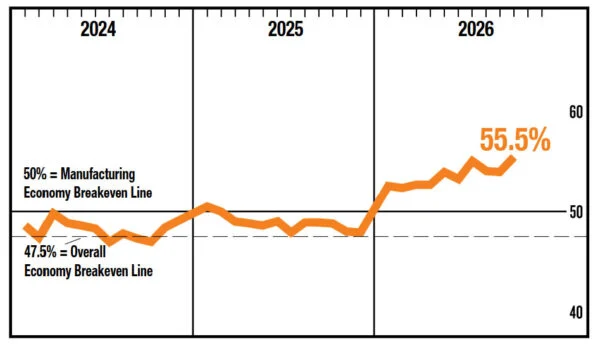
United States manufacturing activity demonstrated continued resilience and accelerated momentum in October, surpassing market expectations and extending the sector’s ongoing expansion phase to ten consecutive months. According to data released by the Institute for Supply Management (ISM), the headline Manufacturing Purchasing Managers’ Index (PMI) rose from 54.5 in September to 55.5 in October. Economists surveyed ahead of the release had anticipated a more modest uptick to 54.7. The steady climb highlights robust operational output across American factories, even as underlying economic crosscurrents—ranging from lingering supply chain friction to persistent input cost pressures—continue to challenge industrial stakeholders.
The latest figures underscore a manufacturing landscape driven heavily by surging production outputs and inventory replenishment, rather than a sharp acceleration in new consumer or commercial demand. All five core sub-indexes that directly feed into the headline PMI remained firmly in expansion territory—readings above the crucial 50.0 threshold—signaling broad-based positive conditions across the sector. However, a closer examination of the individual components reveals a nuanced economic picture characterized by robust factory activity running slightly ahead of incoming orders.
Production Surges to Highest Level Since Late 2021
The most pronounced acceleration in the October report came from the production sub-index, which jumped sharply from 56.7 to 59.0. This represents the strongest reading for domestic manufacturing output since November 2021, reflecting an aggressive push by factories to fulfill backlogs and restock depleted warehouses. Manufacturers across multiple key sectors ramped up shifts and factory utilization rates to meet delivery commitments.
In contrast, incoming demand grew at a more subdued pace. The New Orders Index inched upward from 55.3 to 55.5, marking its tenth consecutive month of expansion. While the steady growth in new orders confirms a solid baseline of customer demand, the relatively narrow gain compared to the dramatic leap in production suggests that October’s headline PMI strength was primarily a function of manufacturing execution and inventory accumulation rather than an explosive wave of new market demand.
Inventories returned to expansionary ground after a brief contraction phase, with the inventory index climbing from 48.6 to 51.4. This shift indicates that businesses are actively working to build up stocks of raw materials and finished goods to buffer against potential future supply disruptions. Meanwhile, international trade metrics showed encouraging resilience: new export orders inched up from 50.9 to 51.2, while import activity expanded more noticeably, with the import index rising from 51.0 to 52.9, pointing to healthy cross-border trade flows supporting domestic production lines.
Labor Market and Supply Chain Dynamics

Employment trends within the manufacturing sector presented a picture of stabilization and slight moderation. The Employment Index edged downward from 52.7 to 52.4. While the reading remains comfortably in growth territory—indicating net job creation within factories—the marginal pullback suggests that hiring managers are exercising caution amid broader labor market adjustments and wage considerations. Industrial companies continue to report selective labor shortages, particularly for specialized technical roles, which may be constraining more aggressive workforce expansion.
Simultaneously, order backlogs increased at a slower pace in October. The Backlog of Orders Index fell from 56.4 to 54.6, signaling that manufacturers are successfully eating into their piles of pending orders thanks to the accelerated production output. Customer inventories remained unchanged at a lean 41.6, continuing to signal that downstream supply chains are not overstocked, which bodes well for future manufacturing orders if consumer and corporate spending hold steady.
Supply chain pressures, though slightly more manageable than during the height of the post-pandemic logistical crises, remain a factor for procurement managers. The Supplier Deliveries Index ticked up from 59.0 to 59.1, indicating that vendor delivery times lengthened marginally. Shortages persisted across several critical industrial inputs, keeping supply chains tight and forcing purchasing agents to remain vigilant.
Input Price Pressures Ease but Remain Elevated
On the inflation front, the October report offered some welcome relief, though cost burdens remain substantial. The Prices Paid Index—a key gauge of the inflation pressures facing industrial producers—dropped significantly from 77.9 to 75.2, coming in below the consensus forecast of 77.5.
Despite the notable sequential decline, a reading of 75.2 still indicates widespread, robust price increases for manufacturing inputs. Survey respondents highlighted ongoing cost escalations across vital commodities and components, notably energy, industrial metals, and electronic components. The persistent elevation in input costs underscores the reality that while the rate of inflation may be moderating from its peak levels, producers are still absorbing considerable expenses that are ultimately passed down the supply chain or squeezed out of operating margins.
Chronology of Recent Manufacturing Trends
The trajectory of the US manufacturing sector over the past year has been defined by steady, cautious recovery punctuated by distinct cyclical pressures:
- Early to Mid 2026: The ISM Manufacturing PMI hovered in modest expansion territory, consistently staying above the 50.0 threshold as factories navigated variable demand and fluctuating commodity prices.
- August 2026: Industrial metrics began to show renewed vigor, driven by strategic inventory building and resilient export orders.
- September 2026: The PMI registered at 54.5, supported by steady new orders (55.3) and strong production figures (56.7), setting the stage for the autumn pickup.
- October 2026: The index accelerated to 55.5, fueled by a sharp rise in the production index to 59.0 and a return to inventory expansion (51.4), despite persistent input cost pressures indicated by a Prices Paid reading of 75.2.
Summary of October 2026 ISM Manufacturing Data
| Indicator | September | Expected | October |
|---|---|---|---|
| ISM Manufacturing PMI | 54.5 | 54.7 | 55.5 |
| New Orders | 55.3 | — | 55.5 |
| Production | 56.7 | — | 59.0 |
| Employment | 52.7 | — | 52.4 |
| Supplier Deliveries | 59.0 | — | 59.1 |
| Inventories | 48.6 | — | 51.4 |
| Prices Paid | 77.9 | 77.5 | 75.2 |
| Backlog of Orders | 56.4 | — | 54.6 |
| Customers’ Inventories | 41.6 | — | 41.6 |
| New Export Orders | 50.9 | — | 51.2 |
| Imports | 51.0 | — | 52.9 |
Economic Implications and Market Outlook
The stronger-than-expected October ISM manufacturing report carries several important implications for macroeconomic policy and financial markets. First and foremost, it demonstrates that the industrial core of the US economy maintains solid momentum, defying concerns of a broader economic slowdown or industrial contraction. The ten-month expansion streak illustrates that capital expenditures and factory operations are adjusting effectively to current financial and trade environments.
However, the divergence between surging production (59.0) and more moderate new order growth (55.5) warrants careful monitoring by analysts. When production significantly outpaces new incoming demand for an extended period, it risks resulting in overproduction or excessive inventory accumulation if downstream consumption fails to catch up. For now, the return of inventories to expansion territory (51.4) appears to be a calculated and healthy replenishment strategy rather than an unwanted buildup of unsold goods, especially given that customer inventories remain remarkably lean at 41.6.
From a monetary policy perspective, the persistence of elevated input prices—highlighted by the Prices Paid Index holding firm at 75.2—reinforces the cautious stance likely to be maintained by the Federal Reserve. While the easing from September’s 77.9 reading is a positive sign, the broad-based increases in energy, metal, and electronic component costs prove that underlying industrial inflation pressures have not been fully extinguished. Central bankers will likely factor these sticky cost components into their ongoing assessment of price stability and interest rate trajectories.
As the final quarter of the year unfolds, the performance of the US manufacturing sector will depend heavily on whether incoming consumer and business demand can accelerate to match the robust output capacity currently being demonstrated on factory floors. With global trade metrics showing signs of steady life and domestic supply chains adapting to lingering constraints, American manufacturing heads into the closing months of 2026 on a stable, albeit watchful, footing.