USD/JPY Technical Outlook: Bearish Consolidation Persists Near 152.87 Amid Broader Correction Phase

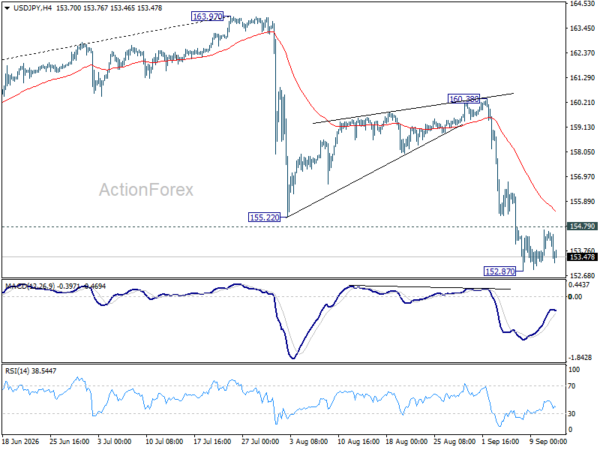
The United States Dollar to Japanese Yen (USD/JPY) currency pair remains under persistent downward pressure, testing the 152.87 threshold following a pronounced downward slide last week. After reaching this local low, price action has transitioned into a subdued, sideways consolidation pattern. Market participants are closely monitoring upcoming macroeconomic data releases and technical boundaries to determine whether the currency pair will resume its descent toward deeper Fibonacci retracement levels or stage a temporary corrective rebound.
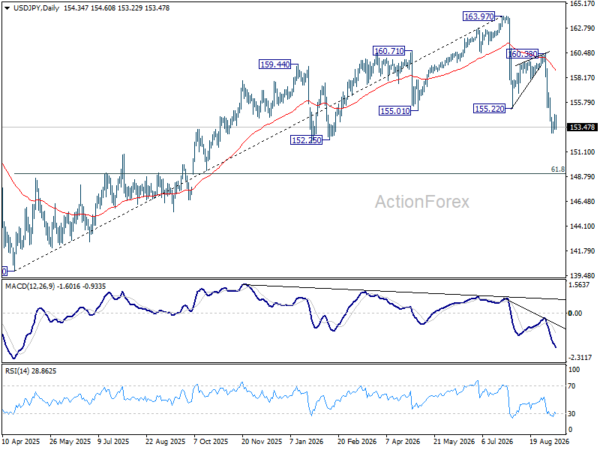
Technical indicators suggest that the initial trading bias for the week remains neutral to mildly bearish. As long as the minor resistance level at 154.79 holds firm, further downside continuation is favored by technical analysts. A decisive break below the 152.87 mark would invalidate the current consolidation range, extending the broader sell-off that originated from the 163.79 medium-term peak. Such a move would expose the next major downside objective at the 149.07 Fibonacci retracement level. Conversely, a breakthrough above the 154.79 minor resistance would signal a potential short-term bottoming formation, likely sparking a stronger corrective rebound toward the 55 4-hour Exponential Moving Average (EMA), currently positioned at 155.51, with potential to push even higher.
Medium-Term Market Structure and Retracement Projections
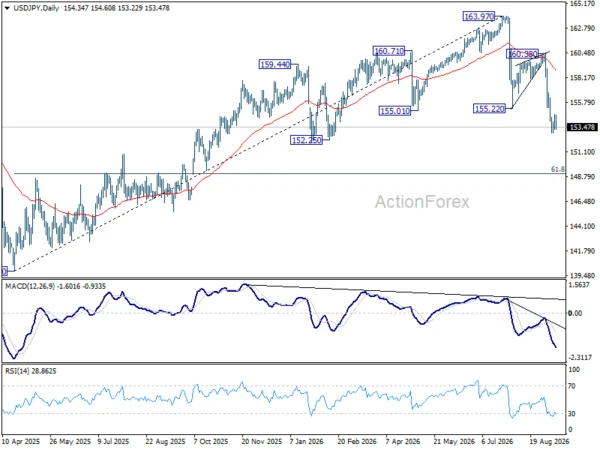
Analyzing the broader market structure reveals that the current downward trajectory from the 163.97 medium-term top functions primarily as a corrective phase against the preceding major upward trend originating from the 139.87 swing low. Market strategists emphasize that this corrective pullback is uncovering significant underlying liquidity shifts. Should selling pressure intensify and drive the pair below the critical 149.07 marker—representing the 61.8% retracement of the 139.87 to 163.97 bullish impulse—the probability of a larger structural bearish reversal increases significantly. In such a scenario, the primary downside target would shift toward the foundational support level at 139.87.
To maintain any structural integrity for a potential recovery, the pair must respect the broader ceiling defined by the 160.38 resistance level. As long as this threshold caps any interim bullish attempts, overall market risk remains heavily skewed to the downside.
Long-Term Macroeconomic Context and Historical Trajectory
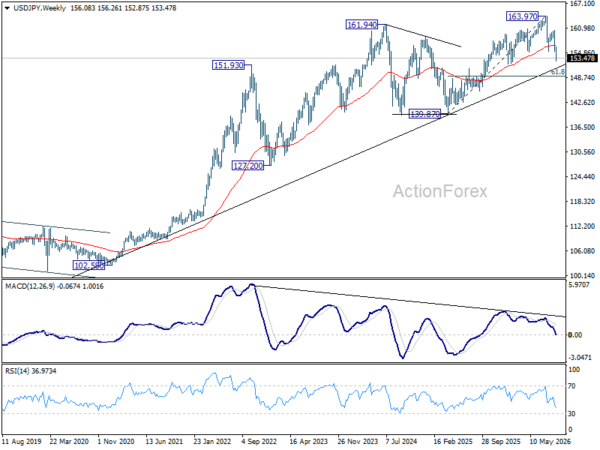
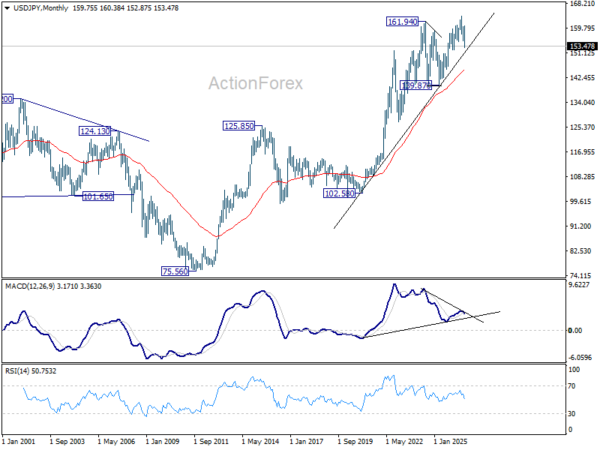
Despite the notable volatility and the intensity of the recent correction from yearly highs, the multi-decade macroeconomic outlook for USD/JPY maintains a structurally bullish bias. Historical technical frameworks indicate that the foundational uptrend originating from the historic 2011 low of 75.56 remains intact. Market analysts point out that as long as the crucial long-term support level at 139.87 remains unbroken, the broader upward cycle is expected to resume once the current corrective phase from the 163.97 peak reaches exhaustion.
This long-term perspective is underscored by the divergence in monetary policy expectations between the United States Federal Reserve and the Bank of Japan (BoJ). While the Federal Reserve navigates an economic landscape characterized by persistent inflation monitoring and subsequent interest rate adjustments, the Bank of Japan continues to manage a delicate normalization process following decades of ultra-loose monetary policy and negative interest rate regimes. These fundamental central bank dynamics continue to drive capital flows, influencing long-term structural valuations across global foreign exchange markets.
Chronology of Recent Price Action
The recent downward movement in the USD/JPY pair is part of a broader sequence of volatility observed throughout the third quarter. The chronology of the recent market shifts highlights key inflection points:
- Early Third Quarter: The currency pair established a significant medium-term peak near the 163.79 to 163.97 range, driven by persistent interest rate differentials and speculative positioning.
- Mid-Quarter Correction Phase: Heightened market sensitivity to potential currency intervention measures by Japanese authorities, coupled with shifting expectations surrounding US macroeconomic data, triggered a sustained downward correction.
- Recent Sessions: The pair experienced an accelerated decline toward the 152.87 level last week before stabilizing into a narrow, sideways trading range as market participants weighed upcoming central bank communications.
Analyst Perspectives and Market Implications
Currency strategists and institutional analysts note that the current technical configuration reflects a market at a crossroads. The transition from aggressive impulsive moves to localized consolidation highlights growing caution among institutional traders.
From a practical trading perspective, market participants are advised to monitor key pivot points closely. A sustained hold below the 154.79 resistance keeps the bearish momentum alive, prioritizing downside targets toward 149.07. On the other hand, failure to break lower accompanied by a sudden spike above moving average benchmarks could invite short-covering rallies.
As global foreign exchange markets continue to digest incoming labor market reports, inflation metrics, and central bank signaling, the USD/JPY pair remains a primary barometer for global risk sentiment and carry-trade unwinding dynamics. Traders and investors alike will be watching closely to see whether the current consolidation yields a continuation of the corrective pullback or sets the stage for a re-engagement with long-term trend lines.