TJX Companies Faces Market Recalibration as Premium Retailer Experiences 20 Percent Valuation Correction


The retail sector has long viewed The TJX Companies, parent organization to T.J. Maxx, Marshalls, and HomeGoods, as a bellwether for consumer sentiment and operational efficiency. However, the company’s recent performance on the public markets has shifted from a period of sustained growth to one of significant volatility. Following an impressive multi-year rally that saw the company establish itself as a dominant force within the S&P 500, shares have undergone a 20% decline from their recent peaks. This contraction has prompted a broader reassessment among analysts and institutional investors regarding the sustainability of the company’s premium valuation in an era of persistent macroeconomic uncertainty.
A Chronicle of Retail Dominance and Recent Headwinds
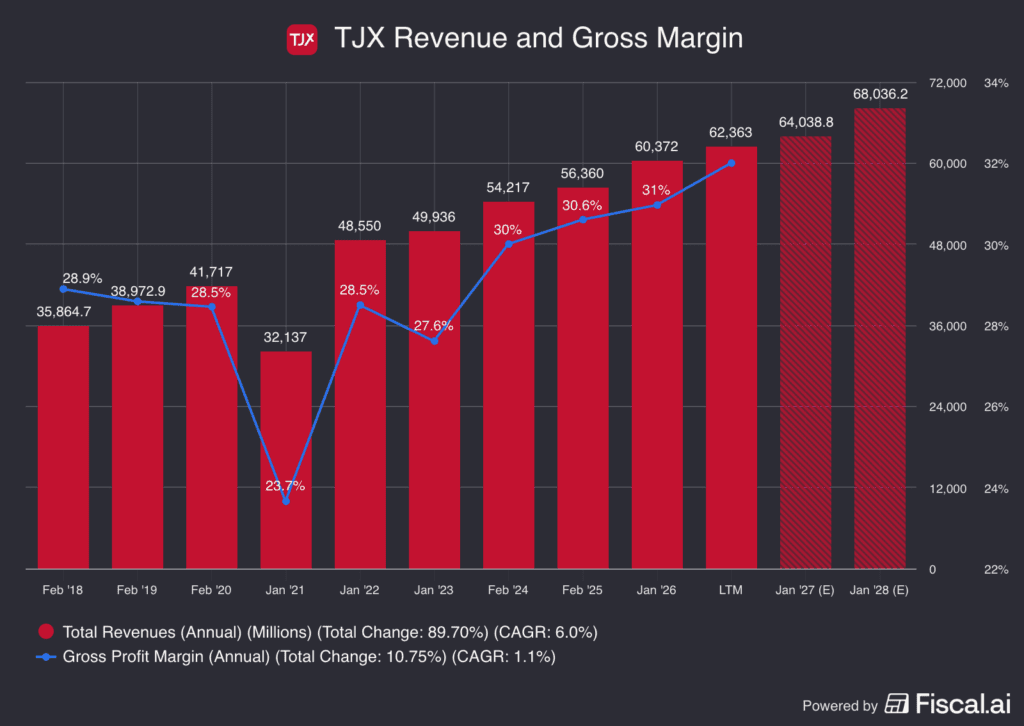
To understand the current market position of TJX, one must analyze its trajectory over the last five years. Throughout this period, the retailer has achieved a nearly 100% appreciation in share price, cementing its status as the fourth-best-performing retailer in the S&P 500. The company’s business model—centered on an "off-price" strategy that attracts value-conscious consumers while maintaining high inventory turnover—has historically insulated it from the typical cyclicality that plagues traditional department stores.
The recent downward pressure began to manifest following the company’s August earnings release. While the firm reported results that technically surpassed analyst expectations for both revenue and earnings, the market response was distinctly negative. The core point of friction was the company’s forward guidance. TJX raised its full-year earnings outlook to a range of $5.15 to $5.20 per share; however, this forecast failed to satisfy the market, which had baked in expectations of $5.23 per share.
Furthermore, the performance of the Marmaxx division—the company’s largest revenue driver, encompassing T.J. Maxx, Marshalls, and Sierra in the United States—reported a 1% increase in same-store sales. This figure significantly missed the consensus estimate of 2.8%. In a market where high-growth valuations are predicated on perfection, this delta between expectation and reality served as a catalyst for a rapid repricing of the stock.
Analyzing the Valuation Gap
The historical valuation of TJX has shifted dramatically over the past decade. Between 2017 and 2022, the company consistently traded at a price-to-earnings (P/E) multiple of approximately 17 times. During this window, that level acted as a reliable support floor, even amidst the systemic shocks of the COVID-19 pandemic and subsequent supply chain crises.

In the post-pandemic recovery, investor enthusiasm pushed this multiple toward 32 times earnings. This "rich" valuation was supported by three consecutive years of margin expansion and consistent revenue growth. However, such a premium multiple left little room for error. The recent contraction has brought the forward P/E ratio down to just under 25 times. While this represents a ~22% correction from peak multiples, market participants are now engaged in a debate: does this represent an attractive entry point for a high-quality retailer, or is the market in the early stages of reverting toward its historical, more conservative valuation mean?
Macroeconomic Pressures and Consumer Sentiment
The broader environment for retail has become increasingly complex. Recent economic data indicates that headline Consumer Price Index (CPI) figures have consistently outpaced annual wage growth for four consecutive months. This disparity directly impacts discretionary spending power, as consumers prioritize essential goods over the apparel and home decor products that comprise the bulk of TJX’s inventory.
When consumers face sustained inflationary pressure, the "off-price" value proposition of TJX is theoretically an advantage, as the retailer offers goods at significant discounts compared to traditional retail. Yet, the recent softening in Marmaxx sales suggests that even value-focused shoppers may be tightening their belts more severely than anticipated. If this trend persists beyond a single quarter, it could indicate a deeper structural shift in consumer behavior rather than a temporary lull in demand.
Projections and Analyst Consensus
Market analysts continue to monitor the company’s trajectory closely. According to Bloomberg, the current consensus price target for TJX stock sits at approximately $172 per share. This target implies a potential upside of roughly 27.6% from current price levels, suggesting that many analysts remain bullish on the company’s long-term operational integrity despite the recent volatility.
However, the path to that target is contingent upon several factors. Analysts are watching the company’s ability to manage inventory levels effectively—a hallmark of the TJX success story—as well as its ability to navigate wage pressures and transportation costs. If the company can demonstrate that the recent sales miss was an anomaly tied to short-term inventory imbalances rather than a decline in consumer appetite, the current price levels may eventually be viewed as a technical floor.
Corporate Strategy and Operational Execution
TJX has built its reputation on a decentralized buying model that allows its buyers to capitalize on "opportunistic" inventory acquisitions. By purchasing excess inventory from manufacturers at low prices, the company provides a unique treasure-hunt experience for its customers. This model has proven resilient across various economic cycles.
The company’s management has historically maintained a cautious approach to guidance, often setting expectations that they are confident they can exceed. The recent decision to provide guidance that fell short of the $5.23 target, while arguably prudent from a corporate risk-management perspective, sent a signal of caution to the markets. Whether this was an intentional recalibration of market expectations or a genuine reflection of internal forecasting remains a point of speculation.
Implications for the Broader Retail Landscape
The implications of the TJX pullback extend beyond the company itself. As one of the largest and most successful retailers in the U.S., the performance of TJX often acts as a proxy for the health of the retail industry. A prolonged correction in its stock price suggests that even high-performing retailers are not immune to the cooling effects of a high-inflation, high-interest-rate environment.
For investors, the current situation highlights the inherent dangers of buying into companies when their valuation multiples reach historic highs. Even if the underlying business remains robust, the "multiple compression" that follows a slight earnings miss can lead to significant short-term capital loss. Investors must now weigh the company’s track record of excellence against the current, more challenging macroeconomic headwinds.
Risks and Future Considerations
Looking ahead, several key risks persist. First, the potential for a more pronounced economic downturn remains, which could further dampen discretionary spending. Second, company-specific execution will be under a microscope in the coming quarters. Any further deceleration in same-store sales growth at the Marmaxx division will likely lead to downward revisions in price targets.
Furthermore, the valuation remains a point of contention. With the P/E ratio still elevated compared to its pre-2022 historical average, it is unclear where the ultimate support level lies. If the broader market experiences a correction, high-multiple stocks like TJX could face further downward pressure, regardless of the company’s internal operational strengths.
Conclusion
The current volatility surrounding The TJX Companies serves as a case study in market expectations. While the retailer maintains a strong competitive moat and a history of effective operational management, the market’s reaction to its recent earnings release underscores the unforgiving nature of high-valuation stocks. Bulls will continue to point to the long-term growth story and the inherent value proposition of the business model, while bears will highlight the ongoing pressure on the consumer and the risk that the company’s period of outperformance may be hitting a natural ceiling. As investors look toward the next two quarters of the fiscal year, the company’s ability to meet its revised earnings targets will be the primary determinant of whether this 20% decline is a buying opportunity or a signal of a structural shift in the company’s market status.