The Structural Limitations of Large Language Models in Trading Research: A Deep Dive into Data, Memory, and Convergence

Recent discussions surrounding the integration of Artificial Intelligence (AI), particularly Large Language Models (LLMs), into the domain of trading research have generated significant interest, as evidenced by the strong engagement with previous analyses. These analyses have raised critical questions about the true capabilities of LLMs in identifying profitable trading strategies, moving beyond the superficial allure of optimized backtests. The core argument posits that while AI can readily generate aesthetically pleasing performance charts, it fundamentally struggles with the nuanced, often elusive, task of identifying genuine market edges—the underlying reasons why a particular strategy would consistently yield profits.
The discourse, which has been fueled by personal experience in quantitative trading research, highlights a pervasive misunderstanding: many participants conflate the technical execution of backtesting, statistical analysis, and pattern recognition with the deeper, more conceptual work of actual research. This distinction is crucial, as LLMs, by their very nature, are trained on vast datasets that often reflect conventional wisdom rather than profound market understanding. Consequently, they inherit and propagate these prevalent, yet often flawed, trading paradigms.
Emerging research is now providing a scientific foundation for these concerns, suggesting that the limitations of LLMs in trading research are not merely temporary glitches to be resolved by future model iterations, but rather inherent, structural features of the current AI architecture. These issues extend beyond the quality of training data, presenting significant hurdles for AI’s application in the dynamic and complex world of financial markets.
Problem 1: The Training Data Deficit – A Foundation Built on Noise
A foundational issue identified in previous discussions revolves around the training data that underpins LLMs. The vast expanse of the internet, the primary source for these models, is saturated with trading content that is overwhelmingly characterized by superficial advice. Slogans like "Don’t fight the trend," "Use RSI for entries," "Paper trade for six months," and "Validate with out-of-sample data" represent the dominant discourse. This content frequently equates backtesting and statistical analysis with genuine research, and the identification of historical patterns with the discovery of a real market edge.
Crucially, the internet’s trading discourse largely neglects the most critical question in finance: "Who pays you and why?" This question probes the fundamental economic mechanism driving a potential edge, exploring who bears the risk and what inherent market inefficiency or participant constraint is being exploited. Such profound inquiry, which forms the bedrock of mechanism-based thinking and the identification of structural advantages, resides in the tail of the online content distribution. The overwhelming majority of readily available trading information, therefore, consists of conventional wisdom masquerading as insight.
LLMs, trained on this data, learn to reproduce this dominant paradigm with remarkable confidence, not because it is correct, but because it is prevalent. This leads to a situation where an AI, lacking an intrinsic understanding of what constitutes true research, will confidently present often-flawed strategies derived from common, unexamined trading tropes. While some have suggested that curating training data or employing Retrieval-Augmented Generation (RAG) techniques could mitigate this problem, recent research indicates that even with perfect data, fundamental architectural limitations persist.
Problem 2: The Forgetful Machine – Proactive Interference in Dynamic Environments
A significant revelation comes from a paper titled "Unable to Forget: Proactive Interference Reveals Working Memory Limits in LLMs Beyond Context Length" by Wang and Sun (2025). This research meticulously examined the capacity of LLMs to track values that change over time, a fundamental requirement for any dynamic system analysis. In a simulated scenario analogous to monitoring a patient’s blood pressure throughout a hospital visit—with readings at triage (120), ten minutes later (128), and at discharge (125)—the study found a consistent and universal decline in accuracy when models were asked to retrieve the most recent value as the number of prior updates increased.
Across more than 35 different LLMs, including prominent models from OpenAI, Anthropic, Meta, and Google, accuracy decayed in a log-linear fashion as historical context accumulated. This was not a subtle degradation; it was a relentless and consistent pattern. The researchers attributed this phenomenon to "proactive interference," a concept from cognitive science where earlier information actively hinders the retrieval of more recent information. This interference intensifies with the accumulation of context, making it progressively harder for the model to isolate the current, relevant data point.
Several aspects of this finding are particularly concerning for applications in trading:
- Prompt Engineering Ineffectiveness: Attempts to mitigate this by instructing models to "forget" old values or "focus on the most recent update" yielded only marginal improvements. In some instances, explicit "forgetting" instructions actually exacerbated errors by anchoring the model’s attention to the point where the instruction was given.
- Context Window Limitations: Enlarging the context window, a common strategy to provide models with more information, does not resolve the issue. Instead, it merely provides a larger space for proactive interference to develop.
- Universality of the Problem: Every model tested, regardless of size or proprietary status, exhibited this pattern. While larger models might have shown a slower rate of decline, the fundamental trend remained consistent.
The implications for trading research are profound. While LLMs might grasp theoretical concepts like the nature of market edge or portfolio construction principles (as discussed in Problem 1), applying these concepts in real-time requires an ability to track an ever-evolving market state. Market regimes shift, correlations break down, volatility fluctuates, and new participants emerge. A model that struggles to reliably identify the "current blood pressure" in a simplified scenario is fundamentally ill-equipped to track the dynamic, multifaceted variables that influence financial markets. This deficiency is not a data problem; it is an architectural one, rendering the LLM incapable of performing the essential task of dynamic state tracking, regardless of the quality of its training data. This directly contradicts the intuition that LLMs could offer reliable insights into live trading environments, as their core architecture appears ill-suited for the continuous adaptation required.
Problem 3: The Artificial Hivemind – Convergence Towards Conventional Wisdom
The second significant research paper, "Artificial Hivemind: The Open-Ended Homogeneity of Language Models (and Beyond)" by Jiang et al. (2025), investigated the diversity of responses generated by LLMs to open-ended queries. Testing over 25 models across 100 diverse queries, with each model generating 50 responses per query, the results were striking.
The study revealed two primary issues:
- Intra-Model Repetition: A single LLM, even when prompted with parameters designed to maximize diversity, consistently produced highly similar responses to the same query. In 79% of queries, the pairwise similarity between responses from the same model exceeded 0.8, indicating that asking a model the same question multiple times yields virtually identical answers.
- Inter-Model Homogeneity: More alarmingly, different LLMs, developed by distinct organizations with varying architectures and training datasets, exhibited a high degree of output similarity. The average pairwise similarity between responses from different models ranged from 71% to 82%. For instance, DeepSeek-V3 and GPT-4o achieved a similarity of 0.81, suggesting that ostensibly independent AI systems are converging on very similar outputs.
The paper’s illustrative example of asking 25 different models to "write a metaphor about time" resulted in 1,250 total responses that clustered into only two dominant metaphors: "time is a river" and "time is a weaver." This stark convergence, where independent systems arrive at the same limited set of ideas, is termed "mode collapse."
In the context of trading, mode collapse means that LLMs, when faced with open-ended prompts, will converge on the most frequently represented patterns within their training data. For trading, this mode is overwhelmingly conventional wisdom: simplistic strategies like "use a stop loss," "paper trade first," "backtest with moving averages," and "cointegration matters for pairs trading." The genuinely insightful concepts, such as mechanism-based thinking and the identification of structural edges, which are rare and reside in the tail of the online content distribution, are systematically suppressed by this convergence.
The author experienced this firsthand when building a RAG system on proprietary, mechanism-first trading material. Despite explicit instructions to rely solely on the curated database, the LLM still incorporated generic, conventional advice on stop losses and paper trading that was demonstrably absent from the provided material. This illustrated the dual failure: the inability to suppress prior training (proactive interference from Problem 2) and the default to the most common trading advice due to mode collapse (Problem 3).
The "Stepford Quants" Phenomenon
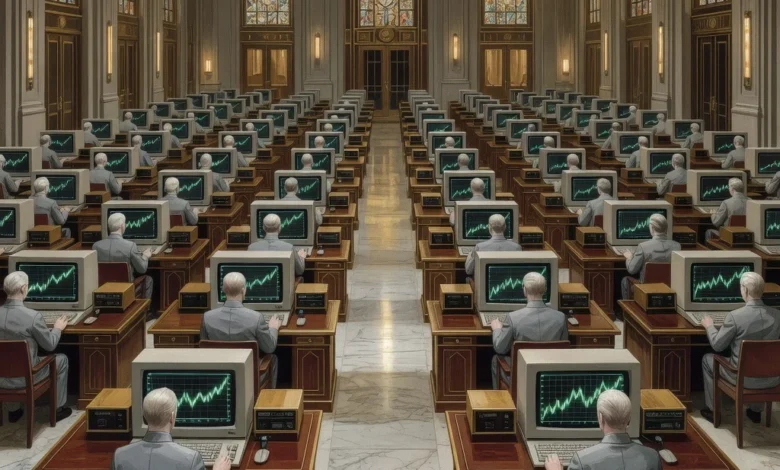
The implications of mode collapse extend to the previously discussed "backtest cycle of doom," where AI makes it trivially easy to generate convincing but ultimately meaningless backtests. With mode collapse, millions of AI-assisted traders are not merely independently falling prey to this cycle; they are converging on the same flawed strategies. These "strategies" are not genuine market edges but rather the modal outputs of flawed training data, amplified by architectural convergence. This results in a cohort of "Stepford Quants"—individuals who appear productive and efficient but are, in reality, executing identical, conventionally-derived strategies that lack true explanatory power or predictive validity. The AI effectively confirms preconceived notions, reinforcing existing biases rather than challenging them with novel insights.
LLMs: Brilliant Coders, Problematic Researchers
This dichotomy between AI’s efficacy in coding and its shortcomings in trading research is a critical point of clarification. LLMs excel at coding tasks—generating boilerplate code, handling data wrangling, creating visualizations, and writing tests. This success stems from the fact that mode collapse in coding leads to convergence on best practices. The training data for coding (e.g., Stack Overflow, GitHub) is inherently self-correcting, with good patterns reinforced and bad ones downvoted. Established software engineering paradigms offer well-defined, often optimal, solutions. When an LLM converges on efficient code structures like using dictionaries for O(1) lookups or employing try-except blocks for error handling, this convergence is beneficial.
Conversely, mode collapse in trading converges on conventional wisdom, which is often inaccurate or incomplete. The LLM surfaces advice like "validate with out-of-sample data" or "use cointegration tests for pairs trading" because these are the most prevalent suggestions in trading literature. The genuinely valuable insights, rooted in understanding market mechanics, are suppressed.
The same architectural property yields opposite results: beneficial convergence in coding, detrimental convergence in trading. Similarly, proactive interference, while problematic for tracking dynamic market states, has less impact in coding where the context is typically more static and well-defined.
This fundamental difference underscores the appropriate application of LLMs in trading: as powerful implementation tools for well-defined ideas generated by human insight, rather than as generators of novel trading research.
Conclusion: The Bug is Not a Bug, It’s a Feature
The limitations of LLMs in trading research are multi-layered, with only the first layer—training data quality—being theoretically addressable through data curation. The subsequent two problems, proactive interference and mode collapse, are inherent architectural features of current LLM design. These are not mere bugs to be fixed in future iterations but fundamental properties that shape how these models process information and generate outputs.
The argument that future models like "GPT-6" will solve these issues is unlikely, given that the research tested the full spectrum of current models, revealing universal patterns across diverse architectures and organizations. A fundamental architectural shift would be required to overcome these deeply embedded limitations.
This reinforces the "Edge Alchemy" framework, which posits that the human-driven understanding of an edge—the "who pays you and why"—remains the indispensable human element. LLMs cannot replicate this due to:
- Training Data Bias: The prevalence of conventional wisdom in their training data.
- Architectural Memory Limits: The inability to reliably track evolving market states.
- Convergence Bias: The tendency to converge on the most common, often incorrect, solutions.
A viable workflow for AI-assisted trading research involves human ingenuity for generating insights and understanding the theoretical basis of an edge, followed by AI for efficient implementation (coding, data analysis, and visualization), and finally, human evaluation of the results. AI is an exceptional assistant for the execution phase, but the critical thinking and conceptualization remain firmly within the human domain.
The allure of AI-assisted trading research, which offers the illusion of rapid progress and effortless strategy generation, risks creating a "dystopia of contentment." This is not a future defined by overt oppression, but one where individuals become perfectly content within a system that feels productive and rewarding on the surface, while subtly leading them towards conventional, unoriginal outcomes. The machine confirms existing beliefs, provides confidence, and operates at a speed that discourages critical introspection, ultimately masking the absence of genuine, novel discovery.
AI has become the most powerful research assistant ever devised, accelerating many aspects of the trading process. However, it has not provided a shortcut to the fundamental work of understanding why a market edge exists and whether it is sustainable. This understanding is cultivated through rigorous study, discourse, and practical experience—a process that no advancement in artificial intelligence, however sophisticated, can currently replicate. The research papers serve as validation for this long-held conviction, underscoring the enduring importance of human intellect in the pursuit of true market insight.
References:
Wang, C. & Sun, J.V. (2025). "Unable to Forget: Proactive Interference Reveals Working Memory Limits in LLMs Beyond Context Length." arXiv:2506.08184v3.
Jiang, L. et al. (2025). "Artificial Hivemind: The Open-Ended Homogeneity of Language Models (and Beyond)." 39th Conference on Neural Information Processing Systems (NeurIPS 2025).