Leveraging Large Language Models for Risk-Managed Algorithmic Trading Strategies

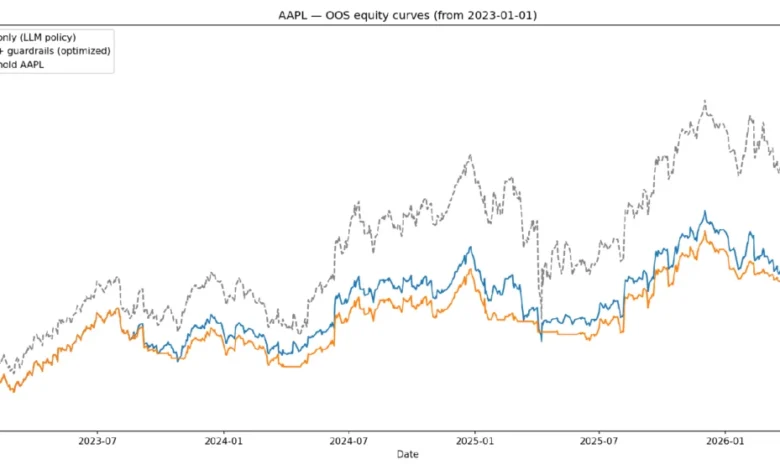
The landscape of algorithmic trading is undergoing a paradigm shift as quantitative analysts move away from using Large Language Models (LLMs) as predictive engines for market direction and toward their application as sophisticated risk management tools. Recent research and practical implementations, spearheaded by practitioners such as José Carlos Gonzáles Tanaka, suggest that while LLMs struggle to consistently predict next-day returns for liquid assets like Apple Inc. (AAPL)—a task that remains notoriously difficult due to market efficiency—they excel at qualitative assessment and regime-based decision-making. By reframing the LLM’s role from a forecaster to a risk-aware capital allocator, traders are discovering new ways to navigate volatile market environments.
The fundamental challenge in modern algorithmic trading remains the predictability of asset returns. According to industry analysis by Ernest Chan [2024], no statistical, machine-learning, or language-based model has demonstrated a reliable edge in forecasting the daily price direction of large-cap stocks. Instead, the focus of quantitative research has pivoted toward volatility assessment and the classification of market states. By utilizing LLMs to interpret historical performance metrics—such as mean returns, standard deviations, and Sharpe-like scores across various market regimes—traders can implement policy tables that dictate position sizing rather than market timing.
The Mechanism of Regime-Aware Risk Management
The strategy in question operates on a monthly walk-forward loop, ensuring that the policy table remains current with shifting market conditions. Each month, the LLM analyzes historical data to determine appropriate exposure levels, which are restricted to a long-only framework. This approach avoids the risks associated with short selling and leverage, focusing instead on calibrated exposure between 50% and 100% of the portfolio.
This methodology relies on three distinct layers of control:
- The LLM Policy Layer: An LLM, specifically DeepSeek in recent iterations, evaluates market states categorized by features such as momentum, volatility, and technical indicators. It outputs a policy decision based on the historical risk-reward profile of those states.
- Volatility Targeting: To ensure risk consistency, the strategy adjusts position sizes based on realized volatility. If market volatility rises, the system automatically scales down exposure to maintain a target risk profile, effectively acting as an automated stabilizer.
- Hard Guardrails: To mitigate catastrophic tail risks, the system employs automated stops based on volatility spikes and drawdown thresholds. These guardrails operate independently of the LLM’s qualitative judgment, providing a crucial safety net during flash crashes or macro-driven liquidity events.
Addressing the Guardrail Deadlock
A critical technical hurdle discovered during the development of this strategy is the "guardrail deadlock." In standard algorithmic implementations, if a drawdown-based stop trigger forces a strategy to move to a cash-only position, the portfolio’s equity becomes frozen. Because the strategy is no longer participating in the market, the drawdown metric never improves, causing the algorithm to remain trapped in a perpetual state of inactivity.
To resolve this, developers have introduced a re-entry mechanism. After a predetermined period of 10 trading days, the strategy forces a partial re-entry, regardless of the drawdown status. This ensures that the algorithm remains responsive to long-term market drift and prevents the strategy from being sidelined during periods of extended market recovery.
Chronology of Data and Implementation
The implementation of this framework requires a rigorous approach to data integrity. Since 2023, the model has been tested using an out-of-sample (OOS) validation process, ensuring that no future information leaks into the historical training data.
- Feature Engineering: The system utilizes seven primary signals derived from OHLCV (Open, High, Low, Close, Volume) data. By discretizing these continuous signals into buckets, the system creates 12 distinct "market states" that are easily interpretable by the LLM.
- Monthly Re-optimization: Both the LLM policy table and the hard guardrail thresholds are re-optimized on a monthly basis. This ensures that the strategy adapts to structural changes in the market, such as the post-COVID volatility environment compared to the low-volatility conditions of the mid-2010s.
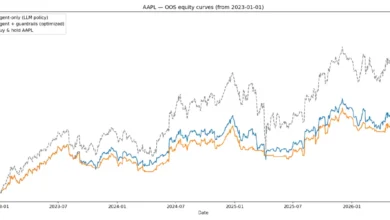
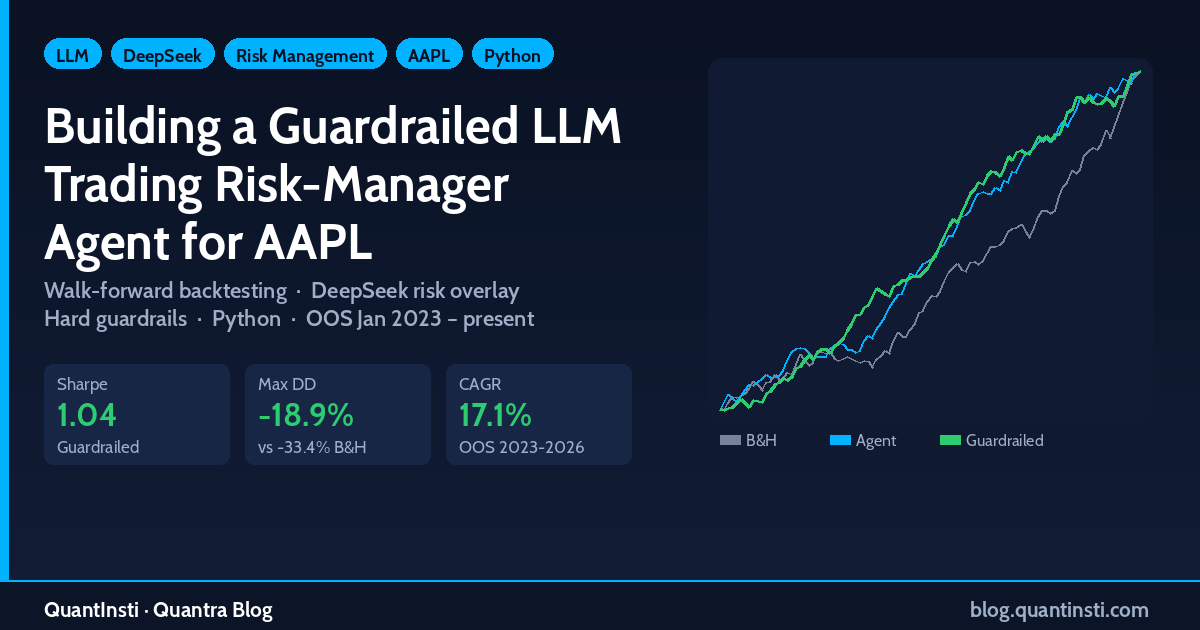
- Backtesting Results: Data from January 2023 through early 2026 indicates that while the strategy may not always surpass the total Compound Annual Growth Rate (CAGR) of a passive buy-and-hold approach, it provides a superior risk-adjusted return. Specifically, the implementation of guardrails has been shown to reduce maximum drawdown from approximately -22% to -18%, offering a more stable equity curve for risk-averse investors.
Institutional Implications and Future Directions
The implications for this type of "Agentic AI" trading are significant. By shifting the LLM’s focus toward regime classification and risk management, firms can potentially reduce the noise that often plagues machine-learning-based trading models. The strategy’s ability to "think" about the market mood rather than just processing raw price signals represents a maturation of the intersection between Natural Language Processing (NLP) and quantitative finance.
However, the strategy is not without its limitations. Critics note that the reliance on historical statistical distributions means the model may still be susceptible to "Black Swan" events that lack historical precedent. Furthermore, the performance of the LLM is heavily dependent on the quality of the "system prompt" and the clarity of the input data. To refine the strategy further, researchers are currently exploring several enhancements:
- Multi-Horizon Momentum: Incorporating 5-day and 63-day cumulative returns to help the LLM distinguish between early-stage and late-stage market trends.
- Macro-Regime Filters: Integrating broader market indicators, such as the S&P 500’s position relative to its 200-day moving average, to provide context during broad market corrections.
- Earnings Blackout Protocols: Automatically moving to a flat position ahead of quarterly earnings releases to mitigate gap-risk events, which are often unpredictable by standard technical indicators.
Expert Analysis and Conclusion
Industry analysts suggest that the true value of LLMs in finance lies in their capacity for nuanced decision-making in ambiguous states—cases where historical statistics are contradictory and traditional rule-based thresholds would flip erratically. By providing a "softer" logic layer, the LLM acts as an experienced portfolio manager who understands the difference between a minor market hiccup and a structural trend reversal.
For those looking to adopt these methods, the recommendation remains consistent: treat the model as a framework for research rather than a turnkey solution. The ability to cache LLM responses allows for cost-effective experimentation, with the cost of running such a backtest currently estimated at less than $0.10 in API usage fees. As the technology evolves, the integration of multiple models—such as comparing DeepSeek with Claude or GPT-4o—may provide a higher degree of consensus-based decision-making, further reducing the risks associated with model-specific hallucinations or errors.
Ultimately, the development of this strategy demonstrates that the path to better algorithmic performance may not lie in bigger, faster models, but in the smarter application of existing ones. By automating the human-like ability to manage risk and adjust to changing market regimes, algorithmic traders are effectively creating a more resilient and disciplined approach to market participation. While the buy-and-hold strategy remains a strong competitor in bull markets, the risk-managed agentic approach provides a compelling alternative for those prioritizing volatility control and drawdown mitigation in an increasingly complex financial landscape.
Related posts: