Fiduciary-Grade AI: Navigating the Intersection of Generative Technology and Regulatory Compliance in Professional Services

The global financial and legal sectors are currently navigating a fundamental shift in technological adoption, moving away from the experimental phase of generative artificial intelligence toward a paradigm defined by "fiduciary-grade" requirements. Unlike the consumer tech sector, where a 95% accuracy rate might be considered a breakthrough, regulated industries such as banking, tax, audit, and law operate under a "zero-tolerance" mandate for error. In these high-stakes environments, a minor hallucination or a slight data leak is not merely a technical glitch; it is a compliance failure that carries profound regulatory, financial, and reputational consequences.
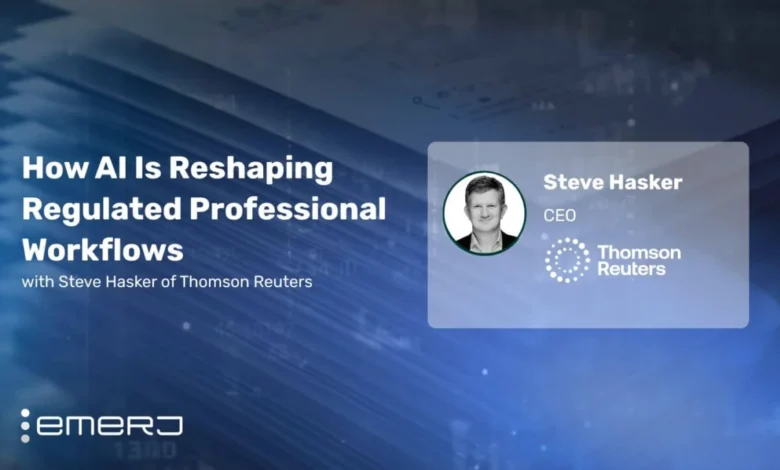
As the integration of Large Language Models (LLMs) moves into core business functions, the tension between the probabilistic nature of AI and the deterministic requirements of regulation has become a central focus for C-suite executives. This transition was recently explored in depth by Daniel Faggella, CEO and Head of Research at Emerj, during a discussion with Steve Hasker, CEO of Thomson Reuters, on the "AI in Financial Services" podcast. The conversation underscored a critical reality: for AI to be viable in regulated professions, it must move beyond general-purpose utility and adopt the same standards of precision and accountability expected of licensed human professionals.
The Economic and Operational Reality of Compliance
To understand why the bar for AI is set so high, one must look at the existing burden of regulatory compliance. Research published by the National Bureau of Economic Research (NBER) indicates that the average United States firm spends between 1.3% and 3.3% of its total wage bill on regulatory compliance. This burden is not distributed evenly; it varies sharply by industry and firm size, with financial institutions often sitting at the higher end of that spectrum. In the years following the 2008 financial crisis, the volume of regulatory changes increased exponentially, forcing firms to hire armies of compliance officers and legal experts just to keep pace with reporting requirements.
Against this backdrop, the promise of AI-driven efficiency is alluring. However, the risks are equally significant. A study conducted by Stanford University researchers tested general-purpose language models against verifiable legal questions and found hallucination rates ranging from 58% to 88%. For a General Counsel or a Chief Financial Officer, these figures are catastrophic. They underscore why off-the-shelf, consumer-grade AI remains fundamentally unfit for high-stakes professional work without the implementation of purpose-built safeguards and authoritative data grounding.
Establishing Fiduciary-Grade Accuracy Standards
The concept of "fiduciary-grade" AI, as discussed by Steve Hasker, refers to a standard of correctness that matches the expectations placed on licensed professionals. In fields like tax and audit, the output of an AI system must be more than just "plausible"—it must be verifiable, consistent, and grounded in the latest statutory language.
Hasker notes that regulated functions depend on a level of precision that probabilistic models do not naturally guarantee. General AI models work by predicting the next most likely token in a sequence, a process that is inherently creative rather than factual. To bridge this gap, professional-grade AI must utilize Retrieval-Augmented Generation (RAG) and other grounding techniques that force the model to cite specific, authoritative sources.
The implementation of these standards shapes where AI can be deployed first. Institutions are prioritizing tasks involving structured documents and repeatable review steps. By focusing on areas with well-defined correctness criteria, firms can safely adopt AI to support professionals in reducing manual workloads while staying within the boundaries of regulated practice. The goal is not to replace human judgment but to provide a "pre-verified" starting point that accelerates the path to a final decision.
The Automation of Labor-Intensive Regulatory Workflows
One of the most immediate applications for AI in the financial sector is the preparation of regulatory filings. Financial institutions routinely manage millions of pages of disclosures, audit inputs, and supporting documentation. This process is currently characterized by high labor costs and significant compliance risk.
Hasker describes a future where content-driven AI applications fundamentally automate the investigative burden of filing preparation. By training models on authoritative legal and financial content, institutions can shift professional time from manual document handling to higher-value analysis. However, the accountability structure remains unchanged. Even if an AI assists in drafting a 10-K filing or a tax return, the final sign-off responsibility remains with the CFO or the licensed accountant.
Practical considerations for evaluating AI in these workflows include:
- Source Verifiability: Can the AI provide a direct link to the specific regulation or internal document used to generate an answer?
- Consistency: Does the model provide the same answer to the same regulatory query across different sessions?
- Auditability: Is there a clear digital trail showing how the AI arrived at its conclusion, allowing for human review of the logic?
Data Sovereignty and the Protection of Sensitive Information
Beyond the accuracy of the output, the security of the input is a primary hurdle for AI adoption. The National Institute of Standards and Technology (NIST) AI Risk Management Framework identifies privacy concerns and data leakage as core risk categories. For a bank or a law firm, the idea that client data or proprietary transaction records could be used to train a public model is an existential threat.
Hasker emphasizes that regulated institutions require ironclad guarantees that their sensitive data remains isolated. Many commercial AI systems are built on a "feedback loop" model where user interactions are used to refine future versions of the model. In a fiduciary context, this is unacceptable.
To meet these requirements, vendors are increasingly offering "private instance" models where the data never leaves the institution’s secure environment and is never used to train the provider’s underlying model. This "data sovereignty" is the foundation upon which trust is built. Without it, the productivity benefits of AI are outweighed by the risk of violating client confidentiality or regulatory privacy mandates such as GDPR or CCPA.
Explicit Sign-Off and the Preservation of Human Accountability
Perhaps the most significant insight from the discussion on regulated AI is that technology does not absolve leadership of responsibility. In fact, AI makes the need for explicit sign-off more critical. Throughout the conversation, Hasker highlighted the roles of the General Counsel, CFO, and CEO as the ultimate arbiters of truth.
The adoption of AI requires a formalization of boundaries. Institutions must determine which tasks are "machine-supported" and which decisions are "human-led." In a regulated environment, the responsibility for a legal opinion or a financial submission cannot be delegated to an algorithm. If an AI generates a draft, a human professional must still "own" the result through a formal approval process.
This "expert-in-the-loop" model ensures that while the speed of work increases, the standard of care does not diminish. It also provides a clear framework for liability. By maintaining a clear distinction between machine-generated drafting and human-certified decision-making, firms can navigate the legal complexities of AI-assisted work.
Chronology and Context: The Evolution of Professional Information Services
The shift toward fiduciary-grade AI is part of a broader evolution in the information services industry. Thomson Reuters, led by Hasker, has transitioned from a traditional media and data provider to a "content-driven technology company." This transition mirrors the needs of their clients, who no longer just need access to information, but need tools that can interpret and act on that information.
The timeline of this shift has accelerated since the public release of ChatGPT in late 2022. While the initial reaction in the legal and financial sectors was one of caution—and in some cases, outright bans—the current phase is characterized by strategic investment. Major firms are now moving from general experimentation to pilot programs involving specialized tools like "CoCounsel" and other legal-specific AI assistants.
Implications for the Future of Regulated Professions
The long-term impact of AI on regulated industries will likely be felt in the restructuring of the professional workforce. As AI takes over the "investigative burden" and the manual drafting of documents, the value of junior professionals may shift from information gathering to critical review.
Furthermore, the "billable hour" model in law and accounting may face pressure as AI significantly reduces the time required for standard tasks. This could lead to a shift toward value-based pricing, where firms are compensated for the quality of their judgment and the degree of risk they manage, rather than the time spent on manual labor.
In conclusion, the path to AI adoption in regulated industries is paved with rigorous standards for accuracy, security, and accountability. As Steve Hasker’s insights suggest, the institutions that succeed will be those that view AI not as a replacement for professional expertise, but as a high-precision tool that requires authoritative grounding and human oversight. The era of "fiduciary-grade" AI has arrived, and it is set to redefine the boundaries of professional services in the 21st century.