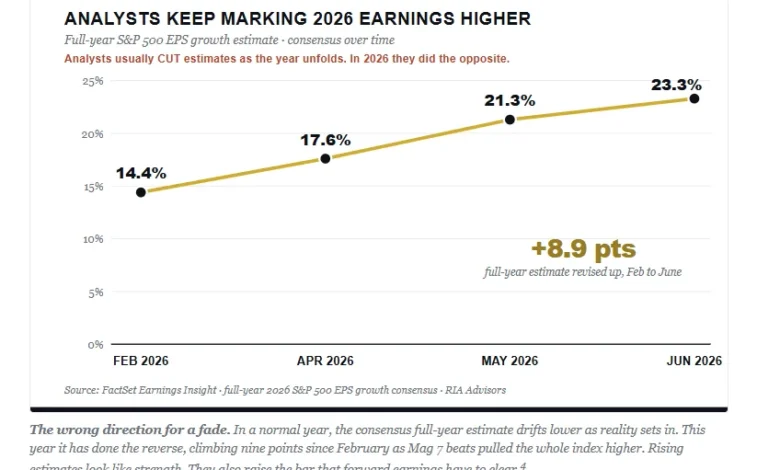
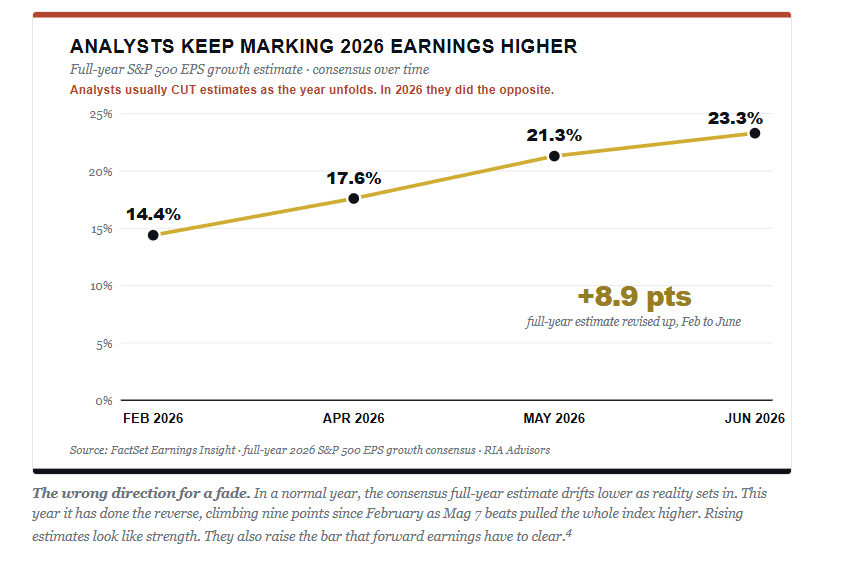
The second-quarter earnings season of 2026 has defied historical precedents, revealing a market landscape where traditional analyst behavior has been turned upside down. Typically, Wall Street analysts begin a calendar year with optimistic forecasts, gradually trimming their expectations as macroeconomic realities set in. However, in 2026, the consensus for S&P 500 earnings growth has undergone a series of upward revisions, climbing from an initial estimate of 14% in February to over 23% by mid-summer. While these figures suggest a robust corporate environment, a deeper investigation into the underlying accounting reveals that a significant portion of this growth is the result of a temporary timing mismatch between revenue recognition and capital expenditure depreciation. This phenomenon, often referred to as the "Golden Window," is currently acting as a massive tailwind for corporate earnings, but it carries a latent risk that could transform into a significant headwind as the "bill" for artificial intelligence (AI) infrastructure finally arrives on the income statement.
The Accounting Divergence: Sellers Versus Buyers
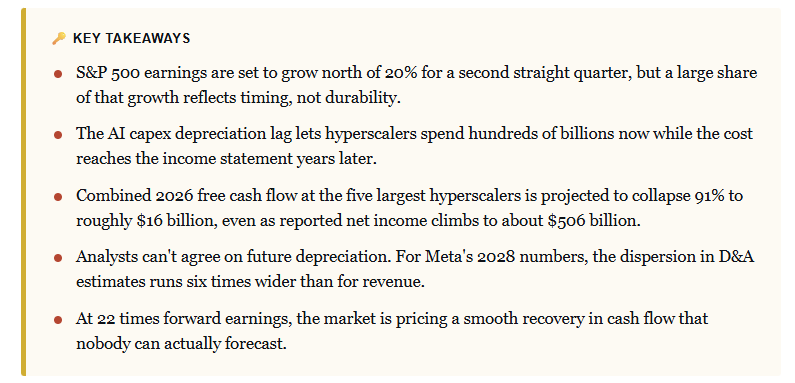
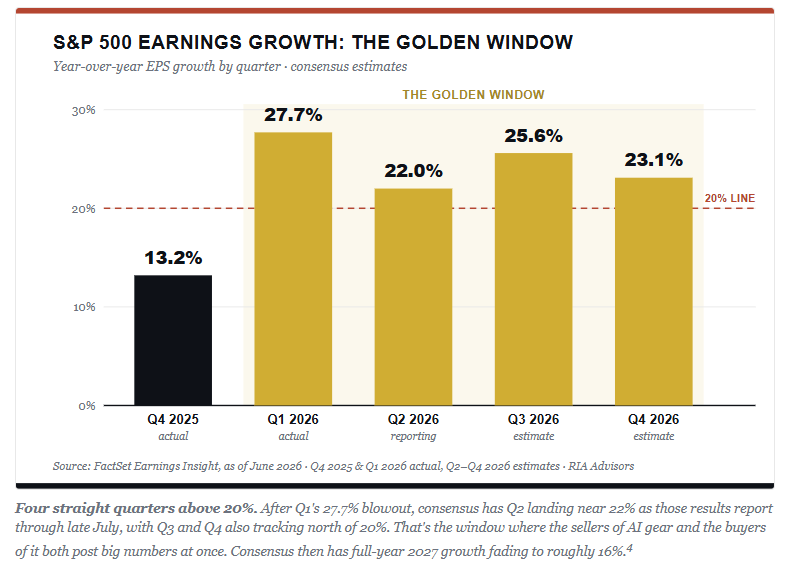
The current earnings narrative is almost entirely dominated by the semiconductor industry and the providers of AI infrastructure. The strength of the S&P 500, which is on track to grow earnings by more than 20% for the second consecutive quarter, is heavily weighted toward these sectors. However, the accounting mechanics of the AI buildout create a disparity between the companies selling the technology and those purchasing it.

When a semiconductor giant like Nvidia or an infrastructure provider sells high-end AI chips or networking equipment, the accounting rules allow them to book the revenue and the associated profit almost immediately upon delivery. Conversely, the "hyperscalers"—the massive technology firms such as Microsoft, Alphabet, Amazon, and Meta that are purchasing this hardware—do not record the full cost of these multi-billion-dollar investments as an immediate expense. Instead, they classify these purchases as capital assets on their balance sheets. The cost of these assets is then spread out over several years through the process of depreciation.
This creates a period where the seller’s earnings jump instantly, while the buyer’s costs are recognized in "slow motion." During this interval, both the seller and the buyer appear highly profitable simultaneously. Todd Castagno, an equity analyst at Morgan Stanley, describes this as a "golden window where everybody looks good." This simultaneous strength convinces investors that the current cycle is durable, whereas it may actually be a byproduct of accrual accounting timing.
Chronology of the AI Capital Expenditure Surge
To understand the scale of the impending depreciation risk, one must look at the timeline of capital spending among the industry’s largest players. The five primary hyperscalers—Alphabet, Amazon, Meta, Microsoft, and Oracle—have engaged in an unprecedented arms race to secure AI dominance.
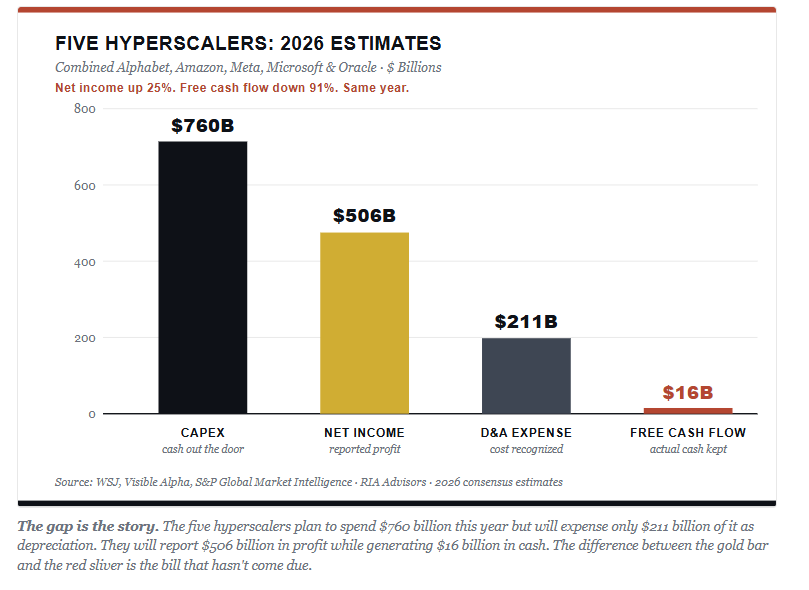
In 2025, these five entities combined for approximately $412 billion in capital expenditures (capex), a figure that was already considered historic. However, 2026 has seen a massive acceleration. Current estimates suggest that total capex for these firms will reach roughly $760 billion by the end of the year. This represents an 84% year-over-year increase in spending.
Despite this $760 billion cash outlay, the combined depreciation and amortization (D&A) that these companies expect to recognize against their earnings in 2026 is only about $211 billion. This leaves a staggering $549 billion in un-depreciated assets sitting on corporate balance sheets. These costs are not being ignored; they are simply waiting. As data centers currently under construction are completed and the hardware inside them is activated, the depreciation clock will begin to tick, applying downward pressure on future net income.
The Disconnect Between Net Income and Free Cash Flow
The most transparent way to observe the "accounting accident" is through the widening gap between reported net income and free cash flow. In a healthy, mature business cycle, these two metrics tend to move in relative tandem. In the current AI-driven environment, they have diverged to an extreme degree.
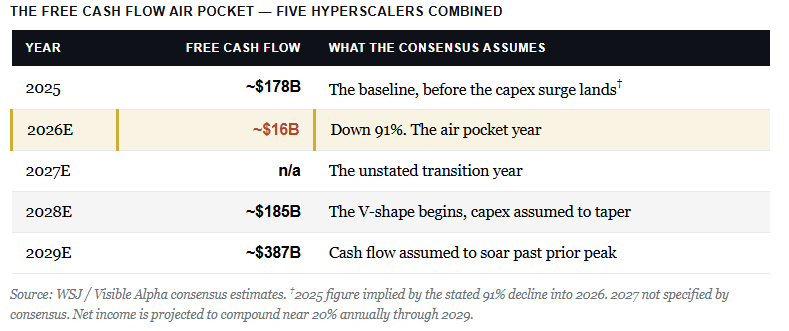
For the full year of 2026, the combined net income for the five major hyperscalers is projected to rise by 25%, reaching approximately $506 billion. At the same time, their combined free cash flow—the actual cash remaining after operating expenses and capital expenditures—is projected to plummet by 91% to just $16 billion.
This creates a paradoxical situation where a group of companies can report half a trillion dollars in profit while generating almost no actual cash. While this is entirely within the bounds of Generally Accepted Accounting Principles (GAAP), it highlights the "liquidity air pocket" created by the AI buildout. Investors are currently valuing these companies based on their reported earnings multiples, effectively ignoring the fact that the cash used to generate those earnings has already left the building.
Analytical Uncertainty and the Depreciation Model Gap
A significant concern for market stability is the lack of consensus among financial analysts regarding future depreciation costs. While Wall Street maintains a relatively tight grip on revenue forecasts, their ability to model the "cost of running the machines" is remarkably low.
Taking Meta (formerly Facebook) as a case study for 2028 projections, the standard deviation of revenue forecasts among major analysts is only 4% of the average. This suggests a high degree of agreement on how much Meta will sell. However, the standard deviation for depreciation and amortization forecasts for the same year is 24%—six times wider than the revenue variance.
This uncertainty stems from several factors:
- Model Shifts: Many of these technology firms have only recently transitioned from asset-light software models to capital-heavy infrastructure models. There is little historical data to inform long-term depreciation cycles for AI-specific hardware.
- Useful Life Assumptions: Companies have significant discretion in determining the "useful life" of their equipment. If a company decides its AI servers will last six years instead of four, it can instantly boost its reported annual earnings by reducing the yearly depreciation expense.
- Off-Balance-Sheet Financing: An increasing portion of the AI buildout is being financed through complex structures that may keep some depreciation costs hidden from initial view.
David Zion of Zion Research Group has warned that consensus depreciation estimates could be "systematically understated," suggesting that the future "bill" for today’s growth may be even larger than currently anticipated.
The Bull Case: The V-Shaped Recovery Assumption
Optimists and proponents of the current market valuation argue that the depreciation wave will be absorbed by a massive surge in revenue. This "bull case" relies on a specific sequence of events: a taper in capital spending followed by a "V-shaped" recovery in free cash flow.
The consensus model assumes that after the 84% jump in capex in 2026, the annual increase in spending will collapse to single digits—rising to $820 billion in 2027 and $930 billion in 2028. If spending growth slows while AI-driven revenue continues to compound at 20% annually, free cash flow would theoretically snap back, recovering from $16 billion in 2026 to $185 billion in 2028 and $387 billion by 2029.
Under this scenario, today’s high price-to-earnings (P/E) multiples would appear reasonable in hindsight. However, this model assumes a level of spending discipline that the technology industry has yet to demonstrate. Each time analysts have projected a slowdown in AI spending over the past 18 months, the companies themselves have guided those numbers higher in subsequent quarters. The 2026 capex consensus alone rose by $160 billion between November 2025 and February 2026.

Broader Market Implications and Portfolio Risks
The risks associated with AI capex depreciation are not confined to the "Magnificent Seven" or the hyperscalers; they permeate the entire S&P 500 index. Currently, the index trades at approximately 22 times forward earnings, a valuation significantly above its long-term historical average. If these forward earnings are being artificially inflated by deferred depreciation costs, the "true" multiple—based on fully loaded expenses—is likely much higher.
Furthermore, there is a stark contrast between the AI leaders and the rest of the market. When AI infrastructure names are removed from the S&P 500, the remaining 470-plus companies have actually seen their 2026 earnings estimates revised downward over the past 17 months. This indicates that the broader economy may be softer than the headline index numbers suggest, with the entire market’s performance resting on a concentrated group of stocks with potentially "low-quality" earnings.
For institutional and retail investors, this environment necessitates a strategy of caution. Professional money managers are increasingly holding AI infrastructure positions at model weight rather than allowing price appreciation to create overexposure. This approach recognizes that when a position’s valuation reaches historic highs at the same time its earnings quality becomes murkier, the risk-reward profile shifts unfavorably.
Conclusion: The Closing of the Golden Window
The AI capex depreciation wave is a mathematical certainty; the only variables are its magnitude and the timing of its impact. The "Golden Window" has allowed for a period of exceptional reported profitability, but as the infrastructure buildout matures, the deferred costs will inevitably hit the income statements of the world’s largest companies.
The current market is pricing in a "perfect landing" where revenue growth seamlessly offsets the rising tide of depreciation. However, history and Rule #9 of Bob Farrell’s investing tenets suggest that when all experts and forecasts agree on a specific positive outcome, the reality often differs. If a single major hyperscaler guides for higher-than-expected depreciation or if AI revenue growth shows the slightest sign of deceleration, the window of optimism could close rapidly. Investors who recognize the underlying accounting disconnect today may be better positioned for the volatility that will likely accompany the eventual arrival of the AI bill.