Chain of Thought vs. Tree of Thoughts: Which is Best for AI Agents?

Large language models (LLMs) are fundamentally designed to predict the next token in a sequence based on statistical probabilities derived from vast datasets. While this architecture enables impressive fluency, it inherently struggles with complex reasoning that requires long-term planning or the evaluation of multiple variables. Because models traditionally generate responses in a single, linear pass, they often exhibit a phenomenon known as "hallucination," where the model produces an output that appears logically sound but is factually or mathematically incorrect. To mitigate these failures, developers have introduced sophisticated reasoning frameworks—specifically Chain of Thought (CoT) and Tree of Thoughts (ToT)—that shift the paradigm from immediate generation to structured, deliberative processing.
The Evolution of Reasoning Frameworks
The evolution of machine reasoning began in earnest around 2022, when researchers first identified that forcing models to output intermediate reasoning steps significantly improved performance on standardized benchmarks. Before this, models were often evaluated on their "zero-shot" performance—the ability to answer a question immediately. However, data from early testing (notably on the GSM8K math dataset) revealed that prompting a model with a simple phrase like "Let’s think step by step" could increase accuracy from roughly 18% to 57%.
This discovery laid the groundwork for Chain of Thought. By 2023, the industry moved toward more complex architectures, culminating in the formal introduction of Tree of Thoughts, a framework designed to allow models to explore multiple potential solutions simultaneously, mimicking human problem-solving in high-stakes environments.
Chain of Thought: The Linear Foundation
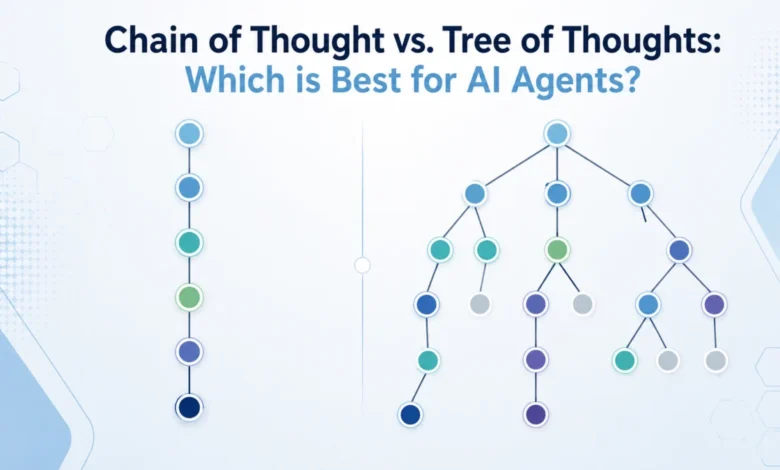
Chain of Thought (CoT) functions as the primary reasoning layer for most modern AI applications. Its mechanism is straightforward: it decomposes a complex problem into a sequence of smaller, manageable sub-problems. By forcing the LLM to write out its "scratchpad" of logic before stating the final answer, the model is less likely to jump to a premature conclusion.
The primary strength of CoT is its efficiency. Because it follows a single, linear trajectory, it requires minimal computational overhead. In enterprise AI agents, CoT is frequently employed for tasks such as sentiment analysis, data extraction, and basic code completion. For instance, if an agent is tasked with summarizing a legal contract, it will first identify the key clauses, then synthesize those clauses, and finally draft the summary. The linear nature of this process is an asset for auditing, as developers can easily trace where a model’s logic may have deviated.
However, the linearity of CoT is also its most significant liability. If the model makes a logical error at the third step of a ten-step process, that error cascades through the remaining seven steps. Because standard CoT does not include a "look-back" or verification mechanism, the final answer—while grammatically perfect—will be fundamentally flawed. This is a critical limitation for agents tasked with multi-stage planning, such as those used in autonomous software testing or complex supply chain logistics.
Tree of Thoughts: Introducing Non-Linear Deliberation
To address the failures of linear reasoning, researchers introduced Tree of Thoughts (ToT). Unlike CoT, which travels down a single path, ToT treats reasoning as a search problem. At each junction of a task, the model generates multiple candidate "thoughts" or potential next steps. It then employs a secondary evaluation mechanism—often a "critic" model or a self-scoring function—to rank these branches.
The process resembles the search algorithms used in game-playing AIs like AlphaZero. The agent explores the "tree" of possibilities, prunes branches that lead to dead ends or illogical conclusions, and backtracks to previous states if a selected path proves ineffective. This ability to backtrack is transformative for AI agents. In scenarios such as complex software architecture design, an agent can "propose" an implementation strategy, "test" it against constraints, and if the constraints are violated, abandon the strategy entirely in favor of an alternative branch.
The data surrounding ToT performance is compelling. In experiments involving the "Game of 24," a mathematical puzzle that requires finding a sequence of operations to reach the number 24, standard LLMs achieve success rates of approximately 7%. When applying Chain of Thought, that rate rises to 45%. With the implementation of Tree of Thoughts, success rates have been documented to exceed 70%. These gains, however, come at a substantial cost.
The Economic and Operational Trade-offs
The transition from CoT to ToT is not merely a technical choice; it is a financial and operational one. Because ToT requires the model to generate and evaluate multiple paths, the number of "tokens" consumed per request can increase by an order of magnitude. If a Chain of Thought prompt requires 500 tokens, a full Tree of Thoughts traversal might require 5,000 or more, depending on the breadth of the tree and the depth of the search.
For businesses deploying AI agents at scale, this creates a distinct hierarchy of utility:
- Low-Latency/Low-Cost (CoT): Ideal for customer support chatbots, routine email drafting, and simple data processing.
- High-Complexity/High-Value (ToT): Reserved for strategic planning, scientific research, and complex system troubleshooting where the cost of a "wrong" decision outweighs the increased compute budget.
Implications for AI Agent Development
The current industry trend is moving toward "Hybrid Reasoning Agents." Developers are increasingly building orchestration layers that assess the difficulty of an incoming task before selecting the reasoning framework. An AI agent, upon receiving a user prompt, might first perform a "triage" step. If the query is identified as a simple information request, it routes to a CoT process. If the query requires a multi-step solution with high ambiguity, the agent elevates the request to a ToT process.
This modular approach is becoming the gold standard for enterprise-grade AI. As companies move beyond simple chat interfaces toward "Agentic Workflows"—where AI agents possess the autonomy to use tools, browse the web, and execute code—the reliability offered by ToT becomes non-negotiable.
Broader Impact and Future Outlook
The shift toward these reasoning frameworks highlights a broader trend in artificial intelligence: the transition from "probabilistic guessing" to "deliberative reasoning." While current LLMs are still limited by their training data, the application of structural frameworks like CoT and ToT allows them to operate within a logical sandbox that effectively simulates higher-order cognition.
Looking forward, the integration of these frameworks will likely be handled at the model architecture level rather than the prompting level. We can anticipate "reasoning-native" models that perform internal, hidden searches—similar to how deep-learning models now perform internal data normalization. For now, however, the ability for human developers to orchestrate these frameworks remains a key competitive advantage in the development of robust, reliable, and intelligent AI agents. The choice between Chain of Thought and Tree of Thoughts is ultimately a reflection of the task at hand: the former provides the speed and efficiency required for the routine, while the latter provides the depth and error-correction necessary for the truly difficult.