USD/JPY Consolidates Near Key Resistance as Fed Rate Cut Expectations Cool and BoJ Policy Divergence Persists

The USD/JPY currency pair is currently consolidating following a recent wave of gains, heavily underpinned by persistent macroeconomic yield differentials between the United States and Japan. Financial markets have steadily scaled back aggressive expectations regarding imminent Federal Reserve interest rate cuts, providing a robust floor for the greenback. At the same time, the Bank of Japan maintains an overwhelmingly accommodative monetary stance despite phasing out rigid yield curve control mechanisms, ensuring that the carry trade remains a favored strategy among institutional and retail investors alike.
Macroeconomic Drivers and Yield Differentials
The primary catalyst anchoring the USD/JPY pair at elevated levels remains the stark contrast between US and Japanese bond yields. US Treasury yields continue to trade substantially higher than those offered on Japanese government bonds (JGBs). This enduring interest rate gap makes borrowing in Japanese yen to fund investments in higher-yielding US dollar-denominated assets an attractive and profitable venture for market participants.
This yield advantage has been further reinforced by shifting expectations surrounding US monetary policy. Earlier in the economic cycle, market consensus leaned heavily toward aggressive monetary easing by the Federal Reserve. However, a string of stronger-than-expected macroeconomic reports, coupled with sticky and persistent services inflation, has forced traders to recalibrate their timelines. Futures markets now point toward a significantly slower and shallower path of rate cuts throughout the remainder of the year. This narrative of a "higher for longer" Fed rate environment directly bolsters the valuation of the US dollar against most of its major global counterparts.
Adding a layer of fiscal stability to the US landscape, recent political developments in Washington have also influenced market sentiment. A freshly negotiated legislative agreement between President Donald Trump and the US Senate successfully averted a potential government shutdown. By removing a significant source of short-term fiscal uncertainty, the legislative compromise has provided currency bulls with additional breathing room to maintain long positions without the immediate threat of domestic political disruption.
The Bank of Japan Stance and Intervention Risks
On the opposing side of the currency cross, the Bank of Japan (BoJ) continues to navigate a delicate normalization process. While the central bank has officially dismantled its strict framework of yield curve control and abandoned negative interest rates, broader monetary policy remains profoundly accommodative. Short-term Japanese interest rates hover near zero, keeping real yields in Japan exceptionally low and unappealing to global investors. Consequently, structural conditions continue to make it challenging for the Japanese yen to mount a sustainable, long-term rally.
Despite these headwinds, the threat of verbal and physical intervention by Japanese monetary authorities remains a persistent sword of Damocles for yen bears. Officials at the Ministry of Finance and the BoJ have repeatedly reiterated their vigilance, warning that they stand ready to take decisive action if speculative pressures cause the currency to experience disorderly or excessive declines.
Historically, sharp rallies in the USD/JPY pair that breach crucial psychological thresholds have frequently triggered official intervention. While these market-shering maneuvers typically induce abrupt, short-term pullbacks and volatility spikes, financial analysts widely note that intervention alone rarely alters the underlying macroeconomic trend. Unless the fundamental policy divergence between the Federal Reserve and the Bank of Japan narrows substantially, official warnings can only serve as temporary speed bumps for the currency pair.

Market Positioning and Sensitivity to Sentiment
Beyond interest rates and central bank policies, market positioning plays a critical role in the ongoing dynamics of USD/JPY. A vast majority of market participants maintain substantial net-long positions in the US dollar through various carry trade structures. This heavy concentration of positioning introduces a degree of structural vulnerability; any sudden shift in global risk sentiment can rapidly amplify price movements.
A sudden drop in US Treasury yields, unexpected corrections in global equity markets, or escalating fears of an economic recession could quickly prompt leveraged investors to unwind and pare back their long USD/JPY exposure. Such an event would likely trigger a sharp, albeit potentially temporary, flight to safety that benefits the Japanese currency. Conversely, sustained economic resilience in the United States and stable risk appetite will likely encourage traders to maintain their carry trade allocations.
Looking forward, currency traders are closely monitoring incoming US economic data, particularly the Producer Price Index (PPI) release. The figures are expected to heavily influence near-term sentiment regarding wholesale inflation trends. Upside risks to the USD/JPY pair will persist if domestic yields resume their upward trajectory and Federal Reserve officials reinforce messages of prolonged monetary restriction. On the other hand, downside risks remain prominent should incoming data reveal a faster-than-expected cooling of the US economy, a more rapid deceleration in inflation, or any explicit indication that the Bank of Japan is preparing to accelerate its policy normalization timeline.
USD/JPY Technical Price Analysis: W Pattern Formation
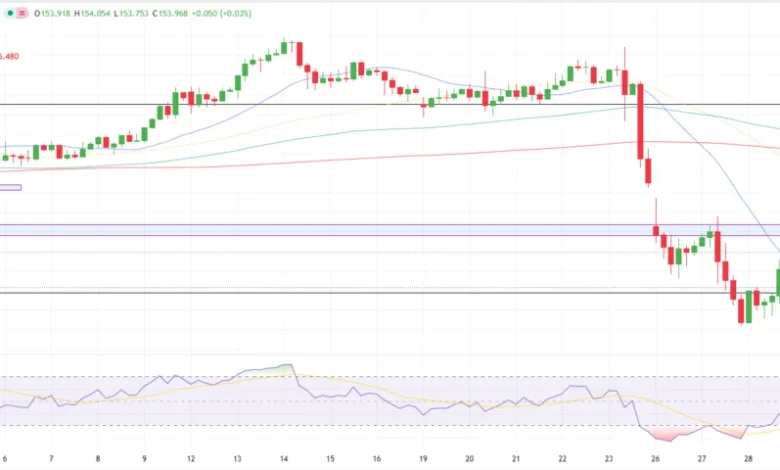
From a technical perspective, the 4-hour chart for the USD/JPY pair displays clear indications of a bullish reversal, highlighted by the formation of a classic "W Pattern." Following a period of consolidation, the exchange rate has successfully climbed above its 20-period moving average, signaling an incoming shift in near-term momentum.
Simultaneously, the Relative Strength Index (RSI) has recovered to the neutral 50.0 threshold, reflecting a temporary equilibrium between buyers and sellers. However, a significant central demand zone, broken during previous sessions and now situated around the 154.50 level, presents a formidable technical hurdle that buyers must decisively overcome to confirm further upside continuation.
USD/JPY 4-Hour Technical Levels Overview:
--------------------------------------------------
Immediate Resistance / Hurdle : 154.50 (Broken Demand Zone)
Secondary Resistance          : 155.60 (100-period Moving Average)
Immediate Support             : 152.70 (Thursday's Lows)
Secondary Support             : 152.00 (Weekly Lows)
Should buying pressure intensify and yield a sustained breakout above the 154.50 barrier, the pair could quickly gather additional market traction. Such a move would likely clear the path toward testing the 100-period moving average positioned near 155.60. A successful test of this level would effectively allow the market to fill the notable bearish price gap that formed at the very beginning of the trading week.
Conversely, failure to breach the 154.50 resistance zone could invite renewed selling pressure. In the event of a downside correction, immediate support is expected to emerge around Thursday’s swing lows near the 152.70 mark. A deeper retracement would expose the broader weekly lows situated around the psychological 152.00 level, where medium-term buyers are anticipated to step back into the market. As the fundamental and technical factors collide, market participants remain on high alert for upcoming economic catalysts that could dictate the next major directional breakout for the world’s most heavily traded yen cross.
Related posts: