EUR/USD Navigates Choppy Waters: Key Levels Dictate the Path Forward Amidst Shifting Economic Sentiments

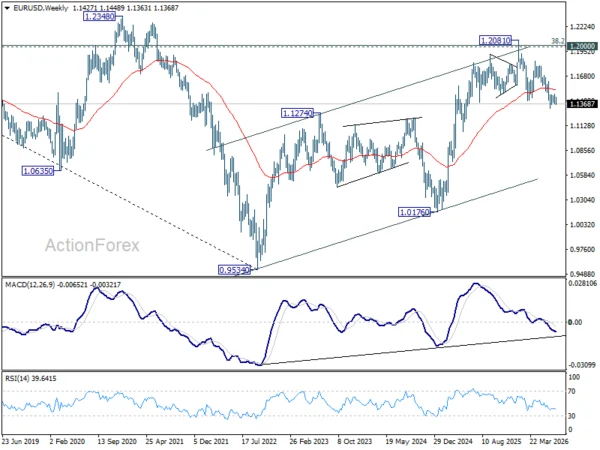
The Euro to US Dollar (EUR/USD) exchange rate has found itself in a prolonged period of consolidation, trading within a tight range above the 1.1323 mark throughout the past week. This sideways movement suggests a lack of clear direction, and the technical outlook for the pair remains largely unchanged as traders and analysts scrutinize key support and resistance levels for clues to the next significant price move. The prevailing sentiment leans towards a neutral stance in the immediate short term, but the underlying technical structure indicates a bearish bias with the 1.1499 level, previously a support, now acting as a formidable resistance.
Short-Term Technical Outlook: A Tightrope Walk Above 1.1323
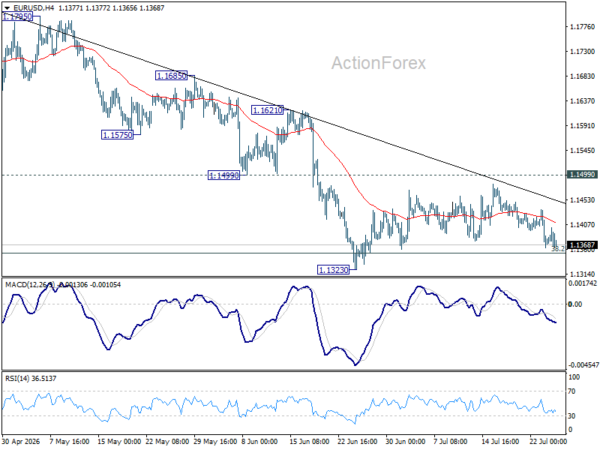
The past week’s price action for EUR/USD has been characterized by a lack of decisive momentum, with the pair largely confined to a narrow trading band. This consolidation above the 1.1323 support level indicates a temporary equilibrium between buyers and sellers, a common precursor to a more significant price swing. Analysts at ActionForex.com highlight that the initial bias for the current week remains neutral, reflecting this indecisiveness in the market.
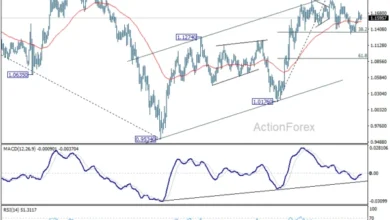
However, the broader technical picture suggests that this neutrality might be a brief interlude before a potential downward move. The bearish outlook is underscored by the resilience of the 1.1499 level, which has transitioned from a supportive floor to a ceiling for the Euro. A decisive breach below the 1.1323 support level would likely reignite the bearish trend that began from the 1.2081 high. This downward trajectory could see the EUR/USD pair plummeting towards the 100% projection level at 1.1175, calculated from the price swings between 1.2081 and 1.1408, extending from the 1.1848 point.
Conversely, a strong upward momentum that sees the EUR/USD decisively break through the 1.1499 resistance level would significantly alter the short-term bias, shifting it back towards the upside. Such a move would likely target the 1.1621 resistance level, suggesting a potential recovery in the Euro’s fortunes.
Mid-Term Technical Landscape: The Significance of 1.1353 and 1.1499
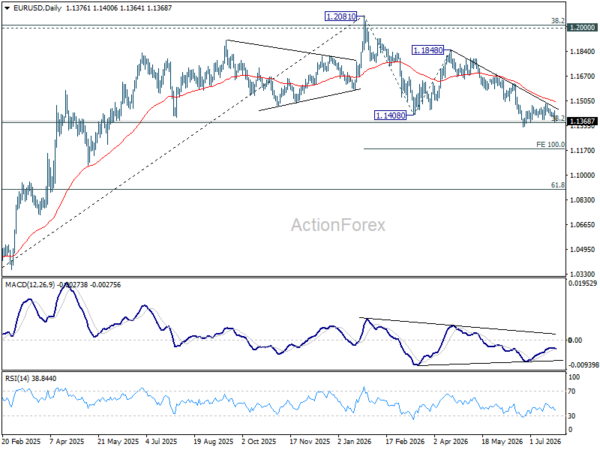
Zooming out to the medium-term perspective, the focus intensifies on the 38.2% Fibonacci retracement of the significant move from 1.0176 to 1.2081, which sits at approximately 1.1353. This level has emerged as a critical pivot point, and a decisive break below it could revive the case for a medium-term bearish trend reversal. This potential reversal would be particularly potent if it follows a rejection from the significant 1.2000 key cluster resistance level, a level that has historically acted as a strong psychological and technical barrier.
Should the EUR/USD pair succumb to selling pressure and break below 1.1353, the next significant downside target would be the 61.8% Fibonacci retracement, situated at 1.0904. This would signal a more substantial correction or a deeper bearish trend.
However, the outlook is not exclusively bearish. A robust rebound from the 1.1353 support, coupled with a subsequent decisive break above the 1.1621 resistance, would serve to retain medium-term bullishness for the Euro. This scenario would suggest that the recent consolidation is merely a pause before a renewed upward trend.
Long-Term Perspective: The Crucial 1.2000 Barrier
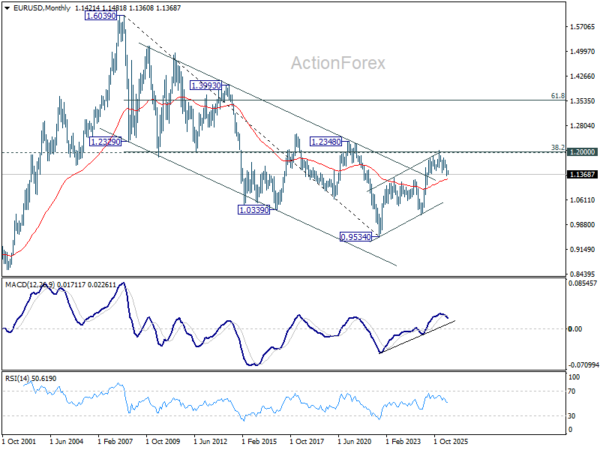
The long-term outlook for EUR/USD hinges critically on the price action around the 1.2000 psychological level, which is closely aligned with the 38.2% Fibonacci retracement of the extensive move from 1.6039 (the 2008 high) to 0.9534. This level, around 1.2019, represents a pivotal point that could determine the continuation of a multi-decade downtrend or signal a significant long-term bullish trend reversal.
A sustained rejection by this 1.2000/1.2019 resistance zone would reinforce the prevailing multi-decade downtrend that originated from the 2008 peak. In such a scenario, the long-term outlook would remain neutral at best, implying a period of uncertainty and potentially further sideways trading or a continuation of the existing bearish momentum.
Conversely, a decisive and sustained break above the 1.2000/1.2019 level would be a powerful signal of a long-term bullish trend reversal. This would open the door for further upside potential, with the next significant target being the 61.8% Fibonacci retracement, located at 1.3554. Such a breakout would indicate a fundamental shift in market sentiment and could usher in a new era of Euro strength against the US Dollar.
Context and Supporting Data: The Economic Backdrop
The current technical stalemate in EUR/USD is occurring against a backdrop of evolving economic landscapes in both the Eurozone and the United States. Recent economic indicators from both regions have presented a mixed picture, contributing to market uncertainty.
In the Eurozone, inflation data has remained a key concern for the European Central Bank (ECB). While headline inflation has shown signs of moderating from its peaks, core inflation, which excludes volatile energy and food prices, has proven to be more persistent. This has led to ongoing debate about the future path of monetary policy, with market participants closely watching for signals from ECB officials regarding potential interest rate hikes or pauses. Employment figures in the Eurozone have shown resilience, offering some support to the economy, but manufacturing indices have indicated a slowdown in industrial activity, reflecting global supply chain pressures and weakening demand.
The United States, on the other hand, has demonstrated more robust economic growth, albeit with its own set of challenges. The Federal Reserve has been actively engaged in tightening monetary policy to combat inflation, with a series of interest rate hikes aimed at cooling the economy. While inflation has begun to ease from its highs, the Federal Reserve has signaled its commitment to bringing it back to its target. The labor market in the US has remained surprisingly strong, with low unemployment rates and steady job creation, providing a solid foundation for consumer spending. However, concerns about a potential recession linger, fueled by aggressive monetary tightening and geopolitical uncertainties.
Timeline and Chronology of Key Events
The current technical configuration of EUR/USD is the culmination of several months of price action, influenced by a series of economic events and policy decisions.
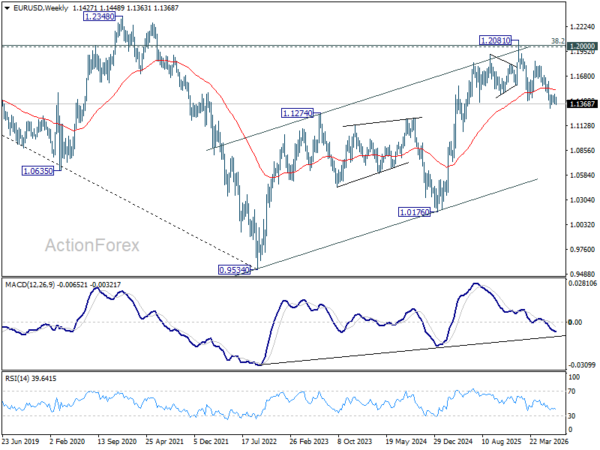
- Late 2021 – Early 2022: The EUR/USD pair experienced a significant decline from its 2021 highs, driven by factors such as the aggressive monetary policy stance of the Federal Reserve and ongoing geopolitical tensions. The 1.2081 high marked a significant turning point, initiating a sustained downward trend.
- Mid-2022: The Euro found some support around the 1.0176 level, forming a potential base for a rebound. This period saw the formation of the Fibonacci retracement levels that are now critical for analysis.
- Late 2022 – Early 2023: The pair began to recover from its lows, exhibiting a period of upward momentum that tested various resistance levels. The 1.1353 and 1.1499 levels emerged as key battlegrounds during this phase.
- Recent Weeks (leading up to current analysis): EUR/USD entered a consolidation phase, trading predominantly above 1.1323, indicating a period of indecision and a lack of clear direction as market participants await further economic catalysts or technical breaks.
Broader Impact and Implications
The trajectory of the EUR/USD exchange rate has far-reaching implications for global trade, investment flows, and economic stability.
- For Businesses: A stronger Euro makes European exports more expensive for US buyers and imports cheaper for European consumers. Conversely, a weaker Euro has the opposite effect. This can impact corporate earnings, import/export costs, and overall trade balances for companies operating internationally.
- For Investors: Fluctuations in EUR/USD affect the value of investments denominated in either currency. For example, US investors holding Euro-denominated assets will see their returns increase if the Euro strengthens and decrease if it weakens. Similarly, European investors holding US Dollar assets are subject to the inverse relationship.
- For Central Banks: The ECB and the Federal Reserve monitor exchange rates closely as they can influence inflation, economic growth, and the effectiveness of monetary policy. A significant and sustained move in EUR/USD could prompt adjustments to interest rate policies or other policy tools.
- Global Economic Sentiment: The EUR/USD is one of the most actively traded currency pairs in the world, and its movements are often seen as a barometer of global economic health and risk appetite. A sharp decline in EUR/USD could signal increased risk aversion, while a strong upward trend might indicate growing confidence in the global economy.
Analysis of Implications and Potential Scenarios
The current technical deadlock in EUR/USD suggests that the market is at a critical juncture. The coming weeks and months will likely be characterized by heightened volatility as traders and investors weigh the conflicting economic signals and technical indicators.
Scenario 1: Bearish Breakout
If EUR/USD breaks decisively below 1.1323, it would confirm the bearish bias and likely trigger a sell-off towards 1.1175 and potentially lower. This scenario could be fueled by disappointing economic data from the Eurozone, a more hawkish stance from the Federal Reserve, or escalating geopolitical risks. Such a move would signal a significant risk-off sentiment in the global markets.
Scenario 2: Bullish Reversal
A strong and sustained break above 1.1499, followed by a push through 1.1621, would signal a shift towards a more bullish outlook for the Euro. This could be driven by better-than-expected economic performance in the Eurozone, a dovish pivot from the Federal Reserve, or a resolution of geopolitical uncertainties. This scenario would indicate renewed confidence in the Euro and potentially a revival of risk appetite.
Scenario 3: Continued Consolidation
The market could also remain in a prolonged consolidation phase, with EUR/USD oscillating between the key support and resistance levels. This would indicate a lack of conviction from market participants and a prolonged period of indecision, influenced by a balance of positive and negative economic news.
Conclusion
The EUR/USD exchange rate is currently at a crucial technical crossroads. While short-term sentiment remains neutral, the underlying bearish bias is evident in the key resistance levels. The interplay between economic developments in the Eurozone and the United States, coupled with the critical technical levels of 1.1323, 1.1353, 1.1499, and the pivotal 1.2000/1.2019 zone, will dictate the future direction of this major currency pair. Traders and investors will be closely watching for any decisive breaks that could signal the start of a new trend, whether it be a resumption of the bearish trend, a medium-term bullish recovery, or a long-term bullish reversal. The coming period promises to be a dynamic one for EUR/USD, with significant implications for global financial markets.