Uniswap Token Pullback Tests $5.83 Support Following Rapid Surge Despite $160 Million Annualized Burn Rate and New v4 StablePair Hook Integration

The native governance token of the decentralized finance (DeFi) ecosystem Uniswap, UNI, has experienced a notable correction following a powerful three-week rally that saw its valuation double from mid-August lows. Trading currently around $6.26, the digital asset is testing critical technical support levels as market participants weigh structural protocol enhancements—such as an ongoing token burn mechanism and the recently deployed Uniswap v4 StablePair Hook—against short-term profit-taking and shifting macroeconomic sentiment.
While the broader uptrend structure remains intact, the recent 11% pullback highlights the divergence between high-frequency trading metrics and immediate token price action. Market analysts are closely monitoring the $5.79 to $5.83 zone, where a confluence of Fibonacci retracement levels and moving averages will likely dictate the short-term trajectory of the token.
Background Context and Chronology of the Rally
The events leading up to the current technical retracement began in mid-August 2026, when UNI found a local swing low near $3.15. Propelled by surging onchain activity and a broader market revival in the decentralized exchange (DEX) sector, the token embarked on a steep vertical ascent. In approximately three weeks, UNI climbed roughly 138%, peaking at $7.49 in early September.
Such rapid appreciation historically invites profit-taking, particularly when buying pressure begins to taper off. Rather than signaling a fundamental trend reversal, market behavior over the past week points to a natural and healthy retracement of an overextended move. The token’s relative strength index (RSI), which had reached overbought territory above 80 during the peak, has cooled to a much more sustainable 60.78. This reading indicates that while bullish momentum has moderated, it remains comfortably above the 50 neutral midline, supported by relatively light volume on down days compared to the heavy volume that fueled the initial surge.
Technical Analysis and Key Price Levels
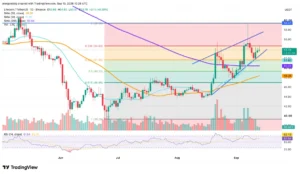
Technical strategists mapping the correction are utilizing Fibonacci retracement levels drawn from the $3.15 swing low to the $7.49 high. The shallow 0.236 Fibonacci level at $6.47 has already been breached, transforming from former support into near-term overhead resistance. Price action is now gravitating toward the 0.382 Fibonacci retracement level located at $5.83.
This $5.83 threshold holds heightened technical significance because it overlaps directly with the 20-day simple moving average (SMA), situated at $5.79. In technical analysis, the convergence of a major Fibonacci retracement level and a key moving average often forms a formidable demand zone that attracts algorithmic buyers and swing traders.
Should this primary support band fail to hold under sustained selling pressure, deeper support zones await. The 0.5 Fibonacci level sits at $5.32, followed by the 50-day simple moving average near $4.64. Conversely, if bulls successfully defend the $5.79–$5.83 band, the path opens for another challenge of the $6.47 resistance level and, ultimately, a retest of the $7.49 multi-month high. From a macro-structural perspective, the daily chart continues to display bullish characteristics: UNI trades comfortably above its 20-day, 50-day, and 200-day moving averages, with shorter-term averages properly stacked above longer-term indicators.
The Dynamics of Protocol Volume and the Token Burn Mechanism
A persistent point of discussion among cryptocurrency analysts has been the historical disconnect between Uniswap’s colossal protocol usage and the direct valuation of the UNI token. Trading volume is fundamentally a protocol-level metric that reflects aggregate activity passing through liquidity pools. Traditionally, this activity directly compensated liquidity providers via trading fees rather than accruing value to UNI holders.
This dynamic shifted significantly following the implementation of a decentralized governance fee switch in December 2025. Under the current protocol framework, a designated fraction of every swap fee funds an automated onchain mechanism that consistently purchases UNI tokens from the open market and permanently destroys them.

Recent data underscores the profound scale of this supply-side intervention. Uniswap processed over $70 billion in trading volume over a single recent monthly period—outpacing the combined volume of the next three largest decentralized exchanges. At these record turnover rates, the token burn mechanism is currently operating at an annualized pace of approximately $160 million.
Despite this aggressive supply reduction, UNI experienced an 11% retracement over a seven-day period. Market observers attribute this divergence to differing operational timeframes. Supply burns execute steadily over weeks and months, whereas market sentiment, trader positioning, and speculative capital fluctuate in a matter of days. A digital asset that doubles in value within three weeks naturally requires a period of consolidation, independent of the long-term deflationary tailwinds provided by the burn protocol.
Innovation in Liquidity Management: The StablePair Hook
In tandem with supply-side tokenomics, Uniswap Labs continues to roll out structural protocol upgrades designed to optimize market efficiency and capture economic value. On September 11, the development team officially launched the StablePair Hook, a dynamic-fee hook engineered specifically for stablecoin trading pairs under the Uniswap v4 architecture.
DeFi markets heavily rely on stablecoin liquidity. Official protocol data indicates that stable-to-stablecoin swaps alone generated $43.4 billion in the second quarter of the year, cementing Uniswap’s dominance as the primary venue for stable asset exchange. However, traditional automated market makers with fixed fee structures often inadvertently transfer a significant portion of value to high-frequency arbitrage bots when stablecoin prices drift slightly from their intended pegs.
The StablePair Hook revolutionizes this process by replacing static fees with dynamic parameters that adapt to individual trades. Within a tight pricing band, the hook maintains a minimal, set spread. When swaps push prices further outside normal deviations, the mechanism utilizes a unique Dutch auction format where the fee starts high and progressively decreases block-by-block until an arbitrageur or trader fills the order. Crucially, the resulting price difference is retained directly within the liquidity pool rather than leaking to external bots.
By preserving revenue within the pools, the StablePair Hook enhances yields for liquidity providers. Deeper, more profitable liquidity pools naturally attract higher trading volumes, reinforcing the foundational flywheel that drives the protocol’s multi-billion-dollar turnover and, by extension, the annualized token burn rate. The StablePair Hook joins a growing roster of v4 integrations—including DualPool, Permissioned Pools, and LitePSM—designed to future-proof the protocol’s infrastructure.
Implications and Future Outlook for UNI Holders
As the cryptocurrency market digests both the technical pullback and ongoing protocol innovations, attention remains fixed on two core catalysts that will determine UNI’s trajectory through the remainder of the year.
First, the immediate health of the market depends on the resilience of the $5.79 to $5.83 support band. A successful defense of this technical zone will validate the prevailing bullish market structure, offering market participants a stable base from which to target higher resistance markers. A decisive breakdown below this zone, accompanied by expanding bearish volume, would expose deeper support floors near the $5.32 and $4.64 regions.
Second, the fundamental valuation thesis increasingly hinges on the compounding efficacy of the $160 million annualized burn rate. As protocol volume continues to scale, the steady reduction of circulating supply acts as a macroeconomic cushion against broader market volatility. The success of Uniswap v4 upgrades, such as the StablePair Hook, will play a decisive role in maintaining high protocol volume and defending market share against competing decentralized platforms. For UNI holders, the central question is no longer whether high onchain usage translates to token utility, but rather how rapidly the relentless supply drain will absorb near-term speculative positioning and propel the asset toward its next major leg upward.