Grayscale Seeks SEC Approval to Convert Litecoin Trust Into a Spot ETF Amid Rising Prices and Technical Resistance

Grayscale Investments has officially accelerated its push to reshape the institutional cryptocurrency landscape by filing Amendment No. 1 to its Form S-3 registration statement with the United States Securities and Exchange Commission (SEC). Submitted on September 11, the filing asks federal regulators to greenlight the conversion of the firm’s existing Litecoin Trust into a spot exchange-traded fund (ETF). Once the registration statement takes effect and final regulatory reviews clear, the investment vehicle will trade on NYSE Arca under the ticker symbol LTCN and will be officially rebranded as the Grayscale Litecoin Trust ETF.
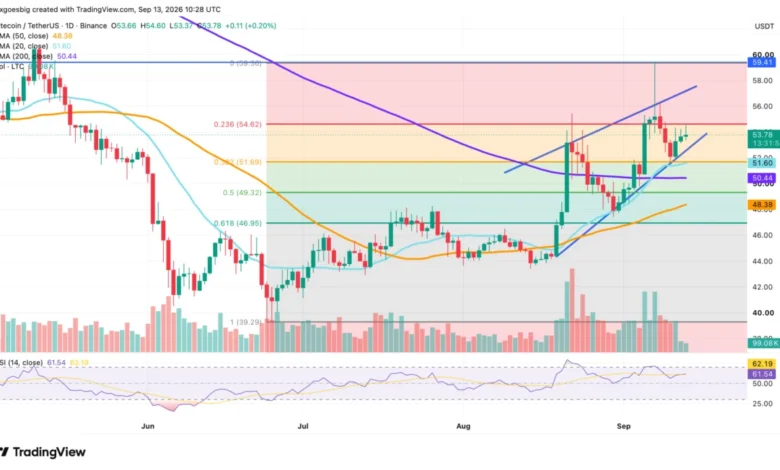
This regulatory milestone arrives during a pivotal week for Litecoin (LTC). Changing hands near $53.62, the asset has successfully recovered approximately 75% of its sharp summer sell-off. The introduction of Grayscale’s regulatory catalyst injects fresh momentum into a chart that had already carved out higher lows, setting the stage for a critical test of key technical resistance levels as the broader digital asset market watches closely.
Understanding the Mechanics: Closing a Market Gap Rather Than Opening New Territory
While the Grayscale Litecoin Trust already trades publicly over-the-counter on the OTCQX market, its over-the-counter status often introduces structural inefficiencies. Shares in OTC trusts frequently trade at significant premiums or discounts relative to the actual net asset value (NAV) of the underlying Litecoin held inside the vehicle. The primary objective of converting the trust into a spot ETF is to eliminate this persistent valuation gap.
Unlike traditional trusts, a spot ETF incorporates robust creation and redemption mechanisms. Authorized participants are granted the ability to swap shares directly for the underlying digital asset, creating an arbitrage loop that permanently pins the market price of the shares tightly to their net asset value. Grayscale has previously executed this exact playbook with immense success across its flagship digital asset vehicles, including its spot Bitcoin, Ethereum, and Zcash products.
However, the September 11 filing does not represent an immediate finish line. NYSE Arca initially lodged its corresponding 19b-4 rule change application for the listing back on January 24, 2025. That separate application must also secure formal SEC sign-off before a single share can officially trade under the new ETF structure. Both an effective Form S-3 registration and a cleared 19b-4 filing must be formally in place before launch. Prominent Bloomberg ETF analysts Eric Balchunas and James Seyffart have assessed the ultimate approval odds near 100%, attributing their optimism to the SEC’s newer generic listing standards, which strip away much of the historical regulatory discretion that once delayed crypto-related investment vehicles.
The Precedent Set by Canary Capital and the Reality of Market Demand
Grayscale’s entry into the Litecoin ETF arena is not entirely groundbreaking. The United States market welcomed its first spot Litecoin ETF on October 28, 2025, when Canary Capital successfully listed LTCC on Nasdaq. That historical debut, however, was notably subdued. Issuers’ flow data revealed that the product recorded roughly $1 million in first-day trading volume and zero net inflows during its opening session—a stark contrast to the billions of dollars that flooded into Bitcoin and Ethereum spot ETFs upon their respective launches.

This historical context reframes Grayscale’s strategic maneuver. Rather than racing to capture an overwhelming wave of pent-up retail or institutional demand that Canary somehow missed, Grayscale is executing a mechanical upgrade. The primary utility of LTCN’s conversion is structural: wrapping an existing pool of trust assets into a cleaner, more efficient vehicle and resolving the persistent premium or discount discrepancies that have frustrated long-term trust holders.
Technical Analysis: Moving Averages and Fibonacci Levels Align at $54.62
From a charting perspective, Litecoin’s daily trend has exhibited a steady recovery over a six-week period. Following a punishing 34% drawdown from its June high of $59.36 down to a late-August trough near $39.29, LTC bulls steadily built higher lows, reclaiming both the foundational base and a critical cluster of moving averages. At the current spot price of $53.62, buyers have retraced approximately 72% of the summer decline.
Market technicians are paying close attention to the positioning of moving averages, which currently offer a clean bullish alignment. The price sits comfortably above the 20-day simple moving average ($51.60), the 200-day simple moving average ($50.44), and the 50-day simple moving average ($48.38). The 20-day moving average acts directly beneath the spot price as a reliable moving floor.
The broader retracement structure is further reinforced by several independent technical markers converging tightly around key price zones:
- $54.62 (Ceiling / Trigger): A critical confluence representing the 0.236 Fibonacci retracement level, a major swing high, and the top of the prevailing rising channel. Three distinct technical tools converge on this single price point.
- $53.62 (Spot Price): The asset remains coiled directly between defended support levels and a triple-confirmed overhead ceiling.
- $51.60 (First Support): The 20-day simple moving average sits directly on the 0.382 Fibonacci retracement level ($51.69), forming a fortified local floor.
- $49.32 (Second Support): The 0.5 Fibonacci level overlaps neatly with the 200-day simple moving average zone ($50.44).
- $46.95 (Invalidation Level): A decisive daily close below the 0.618 Fibonacci retracement would signal a complete failure of the current recovery attempt.
Momentum indicators provide additional nuance. The Relative Strength Index (RSI) stands at 61.57, leaving ample room before reaching the traditional 70 overbought threshold. This suggests that upside momentum remains healthy rather than exhausted. However, market participants note that volume remains a persistent vulnerability. While the August 22 breakout and early-September price thrusts were accompanied by heavy institutional buying, the recent grind toward $54 has been supported by lighter turnover—averaging roughly 90,890 units. Historical trading patterns dictate that breakouts driven by fading participation frequently struggle during subsequent retests.
Whale Participation and Derivatives Metrics
On-chain data offers a cautionary perspective regarding large-scale capital involvement. According to insights shared by Alphractal analyst Joao Wedson, the total number of Litecoin addresses holding balances between $1 million and $10 million, as well as those holding in excess of $10 million, has retreated to levels not witnessed since the depths of the 2022 market cycle bottom.
This metric highlights a significant shift in whale participation, demonstrating that high-net-worth investors and large-scale entities are considerably less represented in current market structures. Derivatives markets reflect a similar cooling trend. Total open interest for Litecoin stood at $385.14 million as of September 13, resting near the lower boundary of a multi-year range that previously exceeded $1.1 billion during the speculative rallies of previous years. Together, thin whale participation and subdued open interest point to an asset class that has temporarily fallen out of favor with speculative crowds.

Bullish and Bearish Scenarios
With Litecoin compressed between critical technical barriers, analysts have outlined two primary directional paths:
The Bullish Case: A confirmed daily close above the $54.62 resistance level accompanied by expanding trading volume would validate the rising channel breakout. This scenario opens a relatively clear path toward the June swing high at $59.36, representing a potential 9% to 10% upside move from the breakout trigger. This remains the higher-probability trajectory as long as moving averages maintain their current bullish alignment.
The Bearish Case: Conversely, a definitive rejection at the $54.62 ceiling, followed by a breakdown below the $51.60 support level, would likely drive the asset lower toward the $49.32 to $50.44 consolidation zone. A daily close falling beneath the $46.95 invalidation mark would push Litecoin back into its broader summer trading range, effectively returning market control to the bears.
Broader Industry Implications and the Road to the 2027 Halving
The ongoing exchange-traded fund race operates on a regulatory timeline independent of daily chart movements, yet it holds the potential to significantly impact market liquidity. An eventual SEC approval would systematically reprice LTCN toward its net asset value through mechanical arbitrage, successfully transitioning Grayscale’s established trust assets into a transparent, publicly listed wrapper without inherently generating fresh, organic retail demand on its own.
Ultimately, the most pressing question surrounding the conversion is not legal, but behavioral: Will legacy trust holders maintain their positions through the corporate conversion, or will they choose to liquidate or rotate out once they are finally granted the ability to trade at net asset value? Furthermore, market participants will be watching to see whether new institutional capital favors the ETF wrapper over direct asset custody.
Looming in the background of these structural developments is Litecoin’s next scheduled halving event, projected for July 27, 2027. The upcoming halving will reduce the network’s block reward from 6.25 LTC down to 3.125 LTC, structurally tightening the issuance of new supply. As regulatory frameworks evolve and institutional products mature, this fundamental supply constraint serves as the overarching clock against which the current wave of Litecoin ETF applications and market recoveries is ultimately being measured.