Bridging the Compute Chasm: How Physical AI Is Redefining Industrial Infrastructure, Safety, and Power Management

The intersection of artificial intelligence and physical operations is facing a profound structural bottleneck, one driven not by a lack of algorithmic ambition, but by a severe deficit in compute maturity. While the digital economy has spent decades refining cloud infrastructures and large language model frameworks, industrial sectors are increasingly attempting to run real-time, safety-critical control workloads on severely constrained edge computing architectures. This architectural mismatch has created what industry analysts term a "compute-maturity lag," leaving high-stakes environments such as manufacturing, logistics, and transportation grappling with the complexities of physical AI.
Data recently published by the Organisation for Economic Co-operation and Development (OECD) regarding AI adoption across G7 economies highlights this stark industrial discrepancy. Information and Communication Technology (ICT) firms have surged ahead, reaching nearly 45 percent AI adoption. Conversely, legacy physical sectors such as manufacturing and transportation languish below the 10 percent adoption threshold. While this metrics gap does not solely quantify the underlying hardware problem, compute scarcity remains a primary structural contributor. Physical-operations AI is fundamentally constrained by limited edge processing power, stringent real-time latency thresholds, and unforgiving safety parameters that leave little room for computational error.
Layered on top of this foundational gap, high execution risks continue to deter enterprise investment. Research from the RAND Corporation indicates that more than 80 percent of artificial intelligence projects fail—double the failure rate typically observed in traditional information technology initiatives. Furthermore, only 14 percent of organizations surveyed consider themselves fully prepared to integrate AI into their core operations, even as executive leadership maintains high expectations for business impact and operational transformation.
Simultaneously, Stanford University’s AI Index documents a widening chasm between frontier-model capabilities in laboratory settings and actual robotic performance in the physical world. This discrepancy is largely attributed to deployable robotics hardware constraints, including on-device power budgets, latency ceilings, and compute boundaries, alongside persistent challenges regarding data scarcity, algorithmic robustness, and real-world generalization.
Compounding these technological hurdles are unprecedented infrastructure and energy constraints. According to reports from the U.S. Department of Energy, electricity load from data centers has tripled over the past decade and faces projections to double or triple again by 2028. As power demand surges to accommodate intensive AI workloads, organizations pursuing AI-driven physical automation must navigate a narrowing corridor of resource availability.
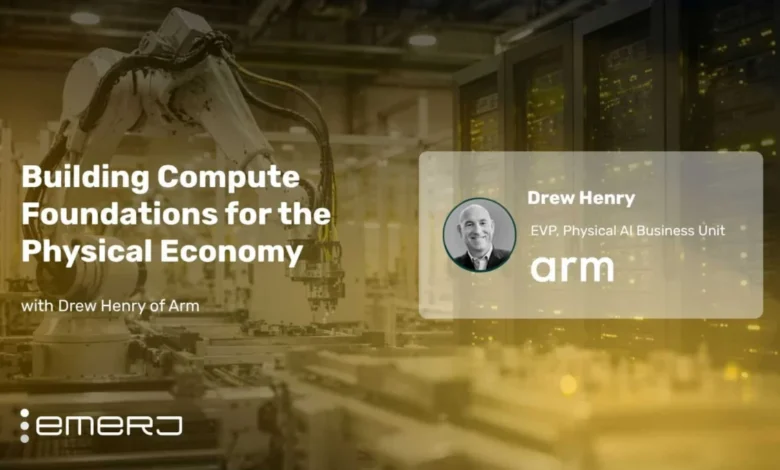
Addressing these systemic challenges requires a fundamental reassessment of how industrial sectors approach risk, capital allocation, and chip design. Recently, Daniel Faggella, CEO of Emerj, sat down with Drew Henry, Executive Vice President of the Physical AI Business Unit at Arm, to dissect the transition of artificial intelligence from digital environments to physical industrial systems. Arm, renowned for designing the fundamental compute architectures utilized across mobile ecosystems, cloud data centers, and increasingly robotic networks, provides a unique vantage point on this industrial evolution.
The Evolution from Automation to Intelligent Control
For decades, industrial leaders in logistics, manufacturing, and supply chain management have relied on automated machinery to execute repetitive physical tasks. However, Henry draws a critical distinction between traditional automation and true AI-driven operational control. Automation implies that a system executes a rigid sequence of actions pre-determined by human engineers. In contrast, intelligent control delegates decision-making authority to an adaptive AI model operating in real time.
When applied to physical environments, the margin for error narrows dramatically. In digital contexts, an inaccurate output from a conversational chatbot results in a textual hallucination. In a factory or automated fulfillment center, an erroneous decision by an AI system can halt production lines, damage costly capital assets, or trigger serious safety incidents.
"When an LLM hallucinates, that’s a bad answer," Henry noted during the discussion. "When an AI system makes the wrong call on a manufacturing or logistics line, that’s lines down. You’ve got to be incredibly confident in exactly what the outcomes are going to be. It can’t just be something you guess is going to happen—it’s got to be assured that it’s going to happen."
This heightened requirement for operational assurance forces infrastructure teams to rethink procurement standards. A model demonstrating 95 percent accuracy may suffice for an e-commerce recommendation engine, but it represents an unacceptable liability in a safety-critical physical loop. Consequently, industrial leaders are beginning to demand rigorous boundaries and deterministic guarantees before connecting machine learning outputs directly to physical actuators and machinery. Companies operating at the cutting edge—such as Amazon, widely recognized for deploying advanced robotics throughout its fulfillment network—continually push semiconductor and infrastructure partners toward their most modern compute roadmaps rather than settling for legacy systems.
De-Risking Capital Allocation Through Advanced Simulation
Beyond operational safety, the integration of physical AI introduces significant capital-allocation dilemmas. Investments in heavy industrial machinery, reconfigured factory floors, and customized robotics hardware involve massive upfront capital expenditures that are exceptionally difficult and expensive to reverse once deployed.
To mitigate these risks, leading industrial enterprises are increasingly turning to digital twins—high-fidelity virtual replicas of physical operations. These simulated environments allow organizations to test, validate, and optimize AI-driven operational changes in a virtual space before committing physical capital.
"If I’m going to get a computing system that’s optimized for the way I operate, I better have a pretty good view of how I operate," Henry explained, emphasizing the necessity of accurate digital representation. "We’re seeing ratios that are thousands, if not tens of thousands to millions to one, where you’re running simulations of different ways you might do it, before you turn it into a physical representation of how it gets done."
This methodology addresses the complex interaction between two distinct operational layers: the foundational physical automation tier responsible for moving goods or operating machinery, and the higher-level optimization tier powered by neural-network predictions. By leveraging digital twins, engineering teams can run millions of virtual test cycles to validate that optimization algorithms translate safely and effectively to the physical layer, achieving a volume of stress-testing that would be impossible to execute safely against physical infrastructure.
Re-Engineering Chip Architectures Around Power Efficiency
Perhaps the most disruptive realization for modern infrastructure leaders is the shift in primary operational constraints. For the past twenty years, scaling compute capacity was largely treated as an additive exercise—adding more processors to achieve greater throughput, a dynamic heavily influenced by the traditional scaling paradigms of the late 20th century. Today, that assumption has broken down entirely under the weight of severe energy limitations.
"A huge manufacturing line or an AI cloud data center is as power-constrained as a mobile phone is, which is a really crazy thing to think about," Henry observed.
This reality is corroborated by broader macroeconomic and industry data. Projections from the International Energy Agency (IEA) indicate that global data center electricity consumption surged significantly, with power demands continuing to climb even as grid bottlenecks prompt a frantic search for alternative energy solutions. Because electricity availability, rather than raw processor availability, now acts as the ultimate ceiling on industrial compute deployment, hardware design philosophies are shifting rapidly.
The semiconductor industry is moving away from generic, general-purpose computing architectures toward highly specialized, workload-specific accelerators. For infrastructure leaders, this demands a reversal of traditional technology adoption cycles. Instead of acquiring advanced AI capabilities first and searching for an operational problem to solve, successful organizations are starting from specific operational bottlenecks—such as optimizing manufacturing throughput relative to market competitors—and subsequently engineering the precise compute architecture required to solve it.
This strategic divergence is already reshaping competitive landscapes across industries. A prime example is the ongoing transition within logistics centers from traditional automated guided vehicles (AGVs) to advanced autonomous mobile robots (AMRs). Enterprises that embraced AMRs early captured compounding efficiency gains, while competitors that delayed adoption find themselves encumbered by legacy systems, facing substantially higher switching costs to modernize their facilities.
Broader Economic Implications and Future Outlook
As physical AI transitions from experimental trials to core operational control, the long-term implications for the global economy are profound. The convergence of edge computing, advanced simulation, and power-efficient semiconductor design will determine which industrial sectors successfully navigate the transition into the physical economy.
Bridging the compute-maturity lag requires close collaboration between semiconductor designers, software developers, and industrial operators. Establishing a shared vocabulary around system boundaries, investing proactively in digital twin simulation capabilities, and prioritizing energy efficiency over brute-force compute scaling will be essential prerequisites for enterprise success.
Ultimately, the organizations that thrive in the era of physical AI will be those that treat compute not merely as an IT resource, but as a core operational utility—carefully balanced against safety assurances, capital constraints, and the hard limits of modern power infrastructure.