In the current financial landscape, American households are displaying a distinct preference for liquidity and capital preservation, even as the inflationary environment erodes the real value of their cash holdings. According to the latest Federal Reserve Z1 Financial Accounts data for the second quarter of 2026, household balances in money market funds (MMFs) have surged to a staggering $5.1 trillion. This represents a $63 billion increase over the previous quarter and a year-over-year climb of $579 billion, or 12.8%. Since the Federal Reserve initiated its aggressive interest rate hiking cycle in the first quarter of 2022, these balances have more than doubled, signaling a profound shift in consumer behavior toward risk-averse, cash-equivalent assets.
The Anatomy of Liquidity: Why Cash Remains King
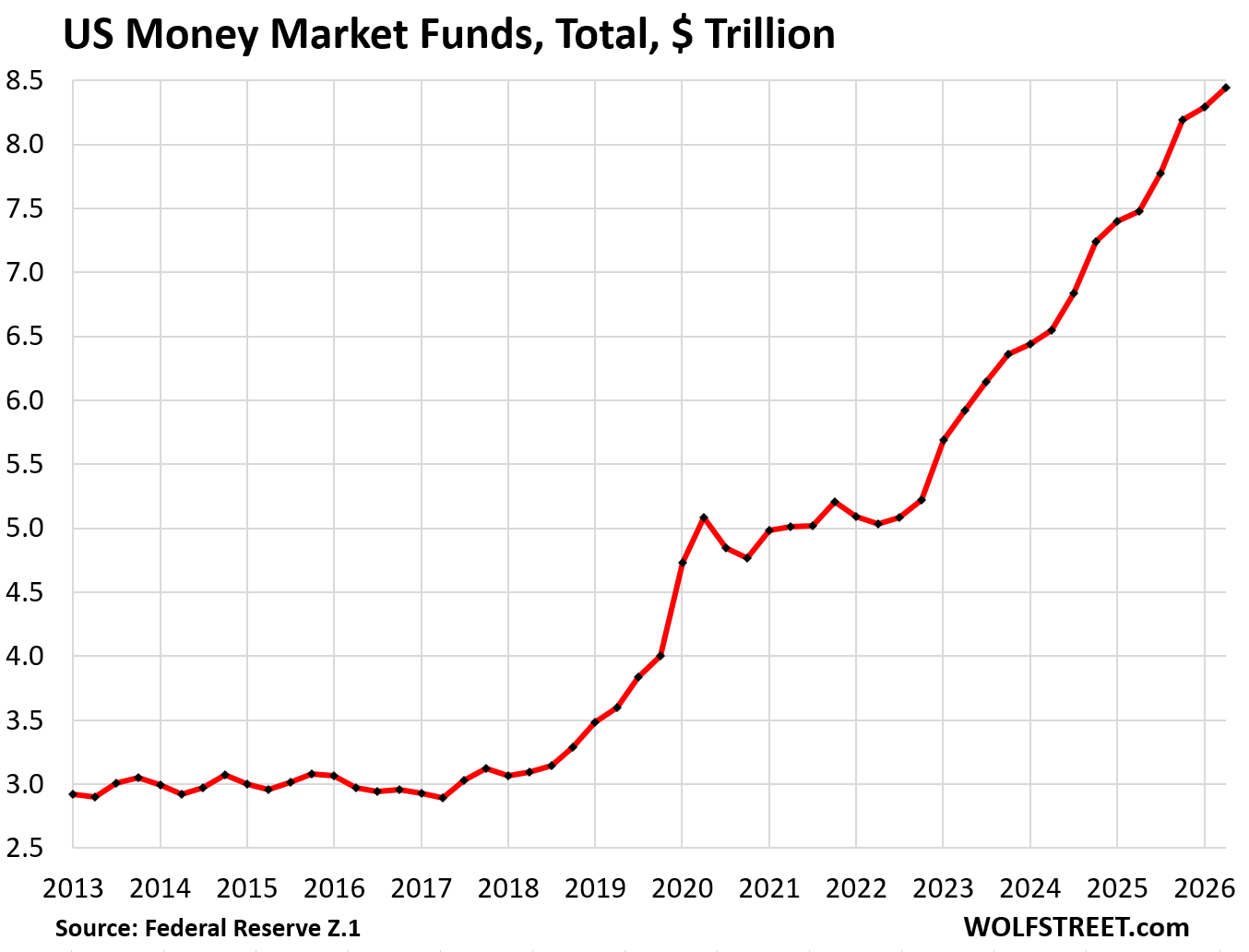
The $5.1 trillion held by households encompasses both retail MMFs—those accessible through standard brokerage accounts—and institutional MMFs held indirectly through retirement vehicles like 401(k) plans and fiduciary accounts. When broadening the lens to include all investors, total MMF balances have reached $8.4 trillion, a year-over-year increase of $960 billion.
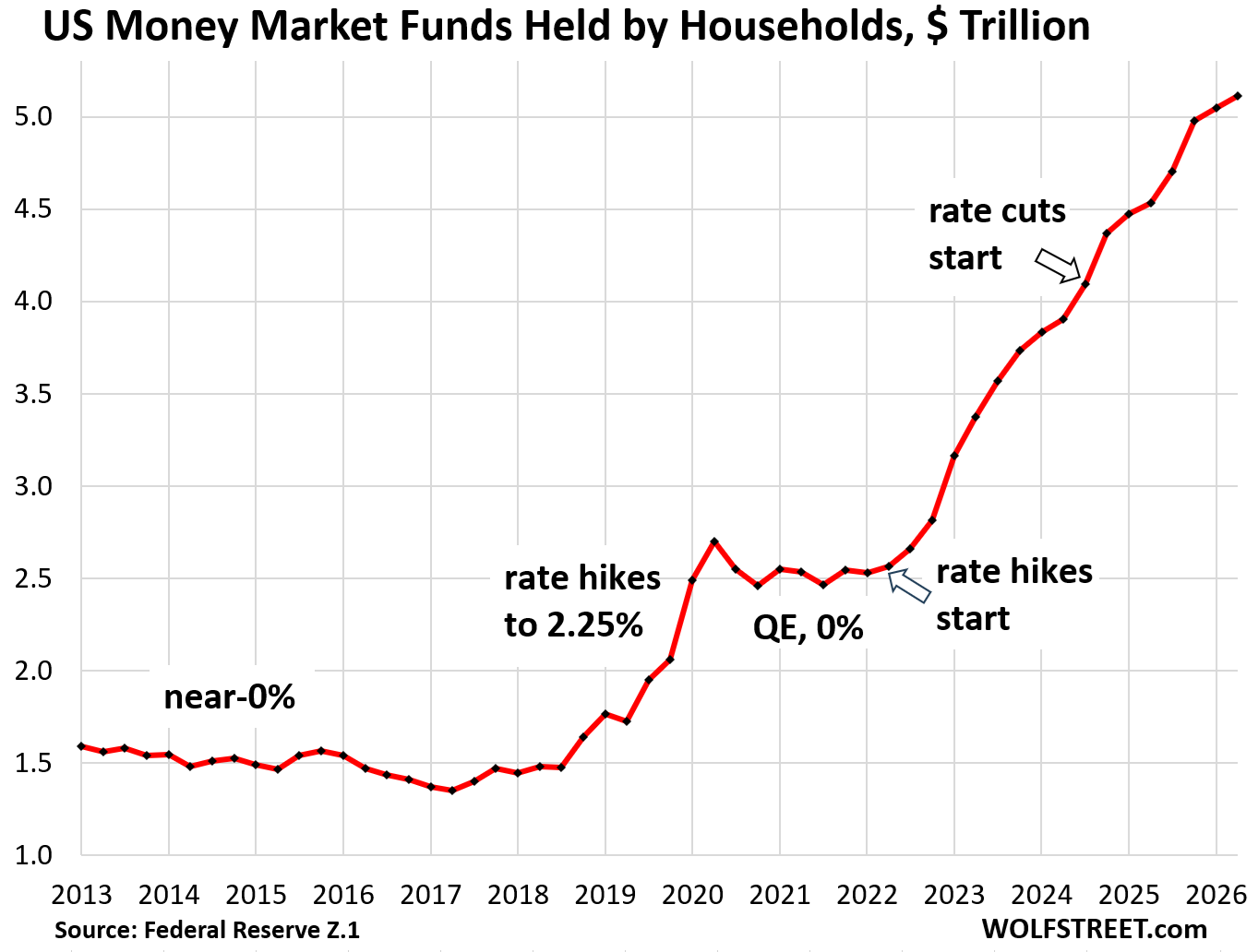
Money market funds operate as low-risk conduits for short-term liquidity, primarily investing in high-quality, short-duration instruments. These include Treasury bills, repurchase agreements (repos), agency securities, and, in some cases, large-denomination bank certificates of deposit (CDs). Because these funds typically maintain a stable net asset value, they serve as a "parking spot" for capital that investors wish to keep accessible while earning a yield that fluctuates alongside Fed policy.
However, the allure of these funds is currently tempered by a cooling yield environment. While yields topped 5% during the first half of 2024, they have since retreated to below 3.75% after fees. This decline has prompted some investors to look toward direct Treasury bill auctions, which offer a competitive alternative without the management fees associated with MMFs. For instance, recent government auctions for 6-month T-bills saw an investment rate of 4.20%, while 3-month bills hovered near 4.07%. As investors balance the convenience of MMFs against the slightly higher raw yields of direct T-bill ownership, the sheer volume of assets remaining in MMFs suggests that ease of access and automatic rollover capabilities continue to outweigh marginal yield differences.
A Chronology of the Interest Rate Cycle
The current appetite for cash-like instruments cannot be decoupled from the Fed’s monetary trajectory. The following timeline outlines the evolution of this shift:
- Q1 2022: The Federal Reserve commences its interest rate hiking cycle to combat rising post-pandemic inflation. Money market balances begin a sustained upward trajectory as the "risk-free" rate becomes meaningful for the first time in over a decade.
- September 2024: The Fed initiates a shift toward rate cuts. Following this pivot, bank CD rates begin to moderate, and the growth rate of large-denomination time deposits slows significantly.
- First Half 2024: Money market yields reach their peak, briefly exceeding 5%, driving record-high retail interest in these vehicles.
- Late 2024–2025: Market volatility and persistent, albeit fluctuating, inflation lead investors to maintain high cash positions as a hedge against market instability.
- Q2 2026: Despite lower yields, MMF balances reach a record $5.1 trillion for households, reflecting a "wait-and-see" approach among retail investors.
The Inflationary Drag: Real vs. Nominal Returns
The primary challenge facing the modern investor is the persistence of inflation, which continues to challenge the "risk-free" return paradigm. Recent data indicates that the Consumer Price Index (CPI) rose 3.4% year-over-year in August 2026, while the Fed’s preferred gauge, the Personal Consumption Expenditures (PCE) price index, registered a 3.7% increase in July.
When nominal yields on MMFs and CDs fall into the 3.5% to 4% range, the "real" return—after accounting for inflation—is effectively zero or negative. This creates a psychological and financial dilemma for households. While they are insulated from the capital losses inherent in volatile asset classes like equities or real estate, they are simultaneously losing purchasing power.
Economists point out that this is a classic "interplay" of risk and inflation. The investor is essentially paying a "volatility tax" by choosing safety; they avoid the potential 50% drawdowns seen in the Dotcom bust or the 2008 Financial Crisis, but they forgo the long-term capital appreciation that inflation-hedged assets might provide.
Bank Deposits and the CD Landscape
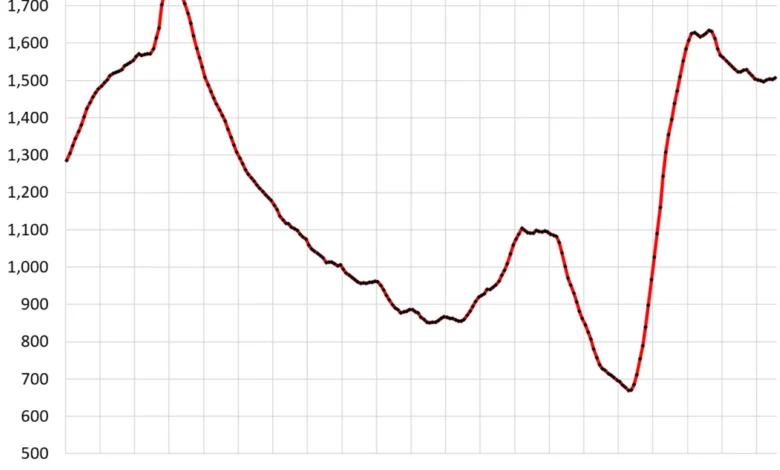
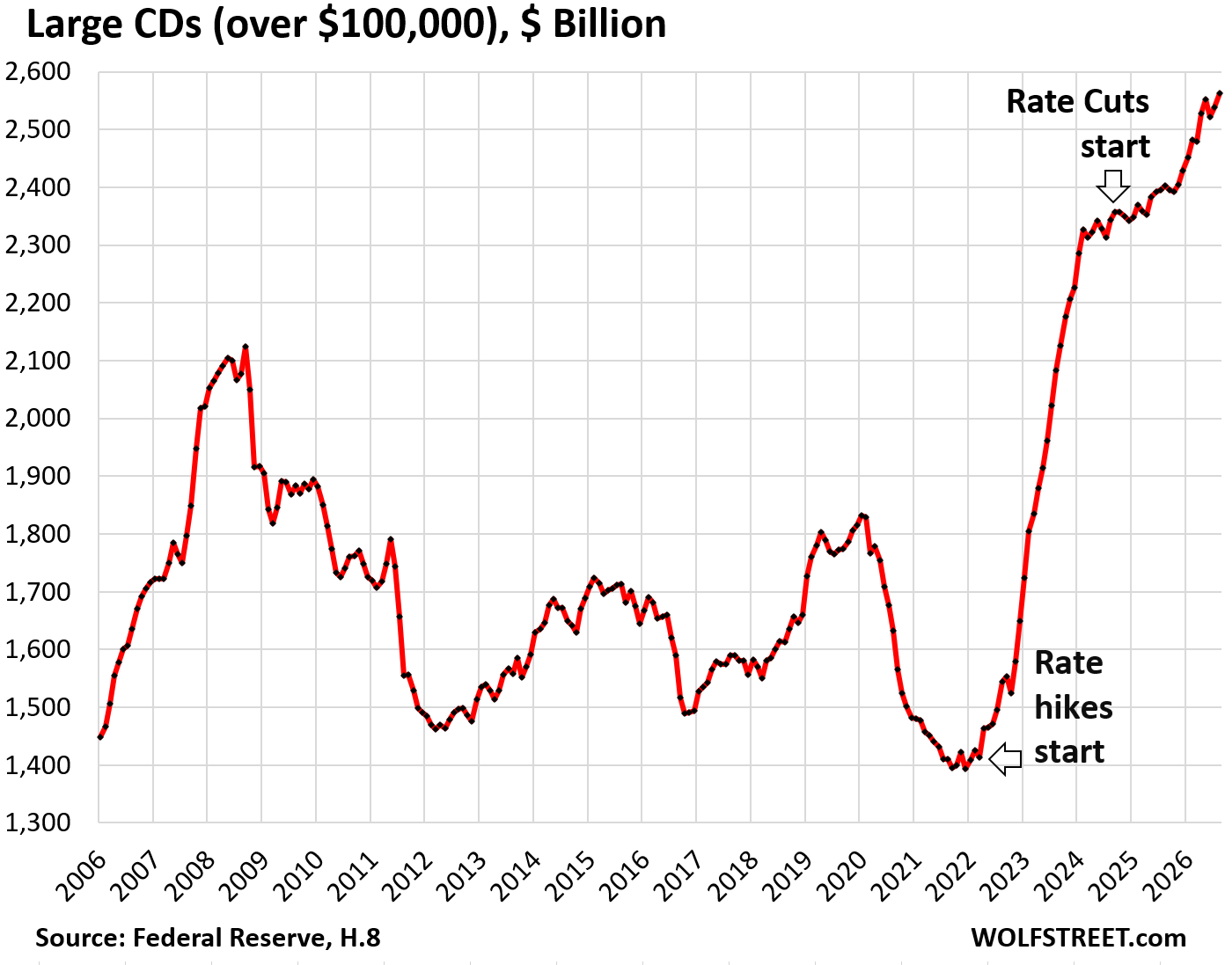
Beyond money market funds, the banking sector has seen a parallel evolution in time-deposit behavior. Large time-deposits (CDs exceeding $100,000) have hit a record $2.56 trillion as of August 2026. This reflects a flight to safety among institutional holders and wealthy individuals who prioritize FDIC insurance and stable, fixed-income returns.
Conversely, small time-deposits—those under $100,000, which are typically favored by retail savers—have exhibited high sensitivity to rate shifts. After peaking in late 2024, these balances contracted by $128 billion as the Fed began lowering rates. However, in the last seven months, these balances have stabilized near $1.5 trillion. This stabilization suggests that retail savers are increasingly locking in available 4% yields on brokered CDs, attempting to secure a predictable return in an uncertain economic environment.
Broader Implications and Market Outlook
The current trend toward cash accumulation has significant implications for the broader economy. First, it suggests that consumers are not yet prepared to deploy excess capital into riskier investments, such as corporate expansion or speculative growth stocks. This "liquidity overhang" provides a massive cushion for the financial system, but it also reflects a lack of confidence in the long-term trajectory of real asset prices.

Second, the disparity between real estate performance and inflation is becoming a growing concern. In the current cycle, national median home prices have struggled to outpace inflation, meaning that for many homeowners, the asset that was once considered the primary vehicle for wealth creation is failing to provide a real return.
Finally, the debate over the Fed’s next move remains a source of market friction. While the bond market continues to price in the possibility of further rate adjustments, the Federal Open Market Committee (FOMC) has shown hesitation. At the July meeting, despite market anticipation of a hike, only three of the twelve voting members supported such a move. This divergence between market expectations and central bank action creates a persistent uncertainty that keeps investors tethered to the safety of short-term, liquid instruments.
Conclusion
The data confirms that in the face of sustained inflation, the American investor has adopted a defensive posture. By prioritizing liquidity through MMFs and FDIC-insured CDs, households are effectively buffering themselves against the prospect of a market sell-off. However, this safety comes at the cost of real growth. As the interplay between inflation and interest rates continues to evolve, the challenge for the average household will remain the same: finding a way to generate returns that outpace the rising cost of living without exposing their hard-earned capital to the extreme volatility that has historically characterized the equity and real estate markets. For now, the preference for "safe" money persists, even if that safety is currently yielding only a marginal return against the persistent pressure of inflation.
Related posts: