The Geopolitical Dilemma of New Delhi: How the Russia-Ukraine War Rewrites India China Dynamics

The protracted conflict in Ukraine has fundamentally altered the geopolitical landscape of Eurasia, transforming Russia from an independent global superpower into the junior partner of an increasingly ascendant China. While this asymmetrical alliance serves Beijing’s overarching economic and strategic ambitions, it presents a profound and escalating strategic dilemma for India. For decades, New Delhi relied heavily on Moscow as a diplomatic shield, a defense supplier, and, crucially, a reliable counterweight to Beijing’s growing hegemony in Asia. Today, that foundational pillar of Indian foreign policy is eroding, forcing policymakers in New Delhi to navigate a volatile triangular relationship where their traditional ally is economically and militarily tethered to their primary regional rival.
At first glance, a surface-level analysis of Asian foreign policy might suggest that India and China share identical approaches toward the war in Ukraine. Both nations have maintained robust diplomatic and economic ties with the Kremlin, capitalized on discounted Russian crude oil exports, and consistently resisted Western-led efforts to diplomatically isolate Moscow through international sanctions. However, a deeper examination reveals a stark strategic divergence. While India has repeatedly signaled its desire for a swift, negotiated cessation of hostilities, Beijing has demonstrated a tacit willingness to see the conflict persist. This divergence is rooted less in their respective bilateral relationships with Moscow and far more in their tense, highly competitive bilateral relationship with each other.
Historical Foundations: The Russia-India-China Triangle
To understand the current crisis in New Delhi’s strategic calculus, one must examine the historical architecture of the post-Cold War Eurasian order. For decades, the "Georgy Primakov doctrine"—named after the former Russian prime minister—envocied a strategic axis between Russia, India, and China (RIC) designed to dilute American unipolarity and foster a multipolar world order.
During the Cold War, the Soviet Union served as India’s most dependable security partner, particularly following the 1971 Indo-Soviet Treaty of Peace, Friendship and Cooperation, which provided New Delhi with a crucial deterrent during the Bangladesh Liberation War. Even after the collapse of the Soviet Union in 1991, Moscow remained the cornerstone of India’s military hardware supply chain, providing over 60 percent of its defense equipment, including advanced fighter jets, naval submarines, and air defense systems like the S-400 Triumf.
Simultaneously, Russia maintained a complex, often turbulent relationship with China. Following the Sino-Soviet split in the late 1950s, relations between Moscow and Beijing were marked by deep ideological and territorial distrust well into the 1980s. Only in the late 1980s and 1990s did bilateral ties begin to normalize, accelerated by a mutual desire to challenge Western dominance and settle long-standing border disputes. However, the fundamental power asymmetry between Moscow and Beijing was historically checked by Russia’s desire to maintain an independent foreign policy and its strong defense and energy partnerships with democratic powers like India and Vietnam.
Chronology of a Shift: From Independence to Asymmetry
The 2014 annexation of Crimea and the subsequent imposition of Western sanctions against Moscow marked a watershed moment, accelerating Russia’s pivot toward Asia and forcing it into a closer economic embrace with China. However, the full-scale invasion of Ukraine in February 2022 drastically accelerated this trajectory, transforming a gradual diplomatic realignment into a structural dependency.
- February 2022: Russia launches its full-scale invasion of Ukraine. Western nations introduce sweeping, unprecedented economic sanctions, cutting Moscow off from global financial systems and European energy markets.
- Spring and Summer 2022: Isolated from Western economies, Russia dramatically reorients its trade arteries eastward. China emerges as the primary consumer of Russian energy, while India rapidly scales up its purchases of discounted Urals crude oil, creating a dual lifeline for the Russian economy.
- Late 2022 through 2023: Trade volumes between Moscow and Beijing skyrocket, surpassing $200 billion ahead of schedule. Beijing supplies dual-use technologies, microelectronics, and industrial machinery to Russia, helping sustain its defense manufacturing sector despite Western export controls.
- 2024–2026: Russia becomes structurally reliant on Chinese financial rails and consumer markets. Beijing exercises considerable leverage over Moscow’s strategic decisions, reducing Russia’s capacity to act as an independent arbiter in Asian geopolitics or to prioritize its historic ties with India when they conflict with Chinese interests.
Economic Realities and Energy Flows
The economic dimensions of this realignment are starkly visible in trade data and energy markets. Prior to 2022, India accounted for a modest share of Russia’s energy exports. Following the implementation of the European Union’s embargo on Russian seaborne crude, India rapidly transformed into one of the largest buyers of Russian oil. By 2023 and 2024, Russian crude accounted for more than 35 percent of India’s total oil imports, saving the South Asian economy billions of dollars in foreign exchange and buffering it against global inflationary shocks.
At the same time, Sino-Russian trade has reached unprecedented heights. China has become the indispensable market for Russian hydrocarbons, coal, and agricultural products. More importantly, Beijing provides the critical industrial inputs and technological components that allow the Russian economy to function under severe sanctions.
This economic dominance translates directly into political leverage. Where Moscow once balanced its relationships between New Delhi and Beijing with relative diplomatic autonomy, today’s Kremlin can no longer afford to alienate Beijing. For India, this economic reality carries a profound strategic risk: if a crisis were to erupt along the disputed Sino-Indian border in the Himalayas, Russia is no longer positioned—nor economically capable—to serve as a neutral mediator or to expedite emergency military spare parts to New Delhi at the expense of its vital lifeline in Beijing.
Diplomatic Postures and International Reactions
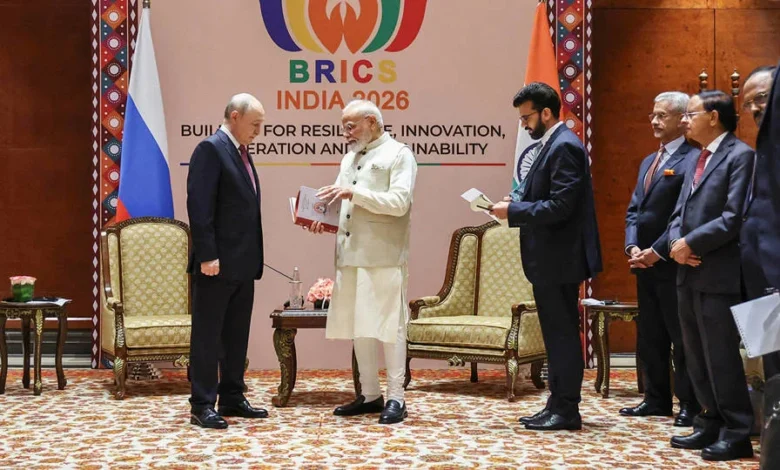
New Delhi’s official diplomatic stance on the war in Ukraine has been defined by strategic autonomy and a refusal to bow to Western pressure. Prime Minister Narendra Modi’s administration has consistently emphasized the principles of the United Nations Charter, respect for territorial integrity, and the urgent necessity of dialogue and diplomacy. During high-profile visits to both Moscow and Kyiv, Indian leadership has reiterated that "this is not an era of war."
Simultaneously, India has participated in multilateral forums while avoiding votes on UN General Assembly resolutions condemning Russian aggression, choosing instead to abstain. This balancing act is designed to preserve India’s access to affordable energy and vital defense supplies while maintaining constructive engagement with the United States and its Indo-Pacific allies through the Quadrilateral Security Dialogue (Quad).
Conversely, Beijing has adopted a posture of "pro-Russian neutrality." While officially calling for peace talks and respecting the sovereignty of all nations, China has consistently blamed NATO’s eastward expansion for provoking the conflict. By providing economic sustenance and diplomatic cover to Moscow at international forums, Beijing has solidified a "no limits" partnership that aligns their geopolitical objectives against Western democratic institutions.
Strategic Implications for India’s Regional Security
The transformation of Russia into Beijing’s junior partner presents a cascading series of national security challenges for India:
- Defense Supply Vulnerability: The Indian military remains heavily dependent on Russian-origin platforms, including Su-30MKI fighter jets, T-90 tanks, and Kilo-class submarines. Prolonged combat operations in Ukraine have drained Russian defense stockpiles and redirected manufacturing capacity toward the domestic front, leading to severe delays in the delivery of critical spare parts and weapon systems to India.
- Erosion of the Regional Counterweight: New Delhi historically valued its ties with Moscow as a diplomatic hedge against a two-front security threat involving both China and Pakistan. With Russia deeply indebted to China for its economic survival, Moscow’s willingness to support India in international disputes involving Beijing—such as the ongoing territorial standoffs along the Line of Actual Control (LAC)—has diminished significantly.
- The Sino-Russian Eurasian Axis: The consolidation of power between Beijing and Moscow creates a formidable continental bloc that stretches across Central Asia, an economically and strategically vital region where India has long sought to expand its influence.
Broader Outlook and Future Prospects
As the war in Ukraine grinds on without a clear resolution, the structural shifts in Eurasian geopolitics are hardening. For India, the challenge lies in managing a rapidly deteriorating strategic environment without abandoning its traditional doctrine of multi-alignment. New Delhi continues to diversify its defense procurement by forging deeper technological and military partnerships with the United States, France, Israel, and domestic defense manufacturers.
However, decoupling entirely from Russia remains neither feasible nor desirable in the near term, given the sheer volume of legacy military hardware currently deployed by the Indian Armed Forces. Ultimately, India’s primary strategic objective is to prevent the Sino-Russian partnership from hardening into an unyielding geopolitical containment wall. Navigating this treacherous diplomatic landscape will require consummate statecraft as New Delhi seeks to safeguard its national sovereignty in a world order where its oldest friend has become economically tethered to its most formidable rival.