The official launch of Circle’s Arc mainnet on September 16, 2026, marks a significant milestone in the evolution of stablecoin-integrated financial infrastructure. As a specialized Ethereum Virtual Machine (EVM) chain, Arc is engineered to prioritize the efficiency of USDC transactions, utilizing the stablecoin as its native gas currency. While the launch provides a high-performance environment for decentralized finance (DeFi) applications, it also introduces immediate technical hurdles for developers: the necessity of accessing, parsing, and indexing complex blockchain data in real-time. Bitquery has emerged as a primary solution for this challenge, offering a robust GraphQL-based API that abstracts the complexities of raw node interaction.
The Strategic Significance of Circle Arc
Circle’s development of Arc is a calculated move to integrate the speed and transparency of blockchain technology directly into the financial services stack. By setting the chain ID to 5042 and mandating USDC for gas fees, the network eliminates the friction of volatile gas tokens, allowing users and developers to predict transaction costs with absolute certainty. This "gas-stable" model is a paradigm shift for institutional users who require predictable overhead for automated trading and settlement systems.
However, the transition from a permissioned framework to a public mainnet requires a shift in how data is retrieved. While developers can interact with the network via standard JSON-RPC endpoints, this method is fundamentally limited. JSON-RPC is designed for atomic, single-node requests—fetching a block, checking a balance, or submitting a signed transaction. It is not architecturally suited for complex analytical tasks, such as tracking cross-chain token flows, aggregating liquidity across decentralized exchanges (DEXs), or performing historical time-series analysis on gas fluctuations.
Bridging the Data Gap: The Role of Bitquery
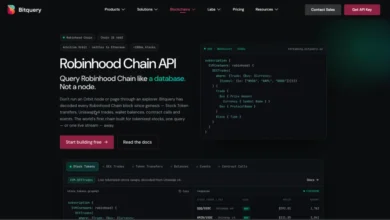
The complexity of reading raw chain data without an indexer is significant. A developer would otherwise need to maintain their own node, implement a custom indexing engine, manage database shards, and handle chain reorgs manually. Bitquery’s Arc API sidesteps this overhead by providing a managed data layer. By utilizing a GraphQL interface, developers can perform surgical data extraction, requesting only the specific fields required for their application, which significantly reduces bandwidth and compute costs.
Our technical review, conducted on the day of the mainnet launch, confirmed that Bitquery’s API architecture is bifurcated into two primary schemas: the "Trading" schema for market-centric data and the "EVM" schema for core network activity. This separation allows for cleaner codebases; developers focusing on front-end price discovery need not sift through low-level bytecode logs, while those building block explorers or security monitoring tools can focus exclusively on the EVM transaction layer.
Chronology and Launch Context
The launch on September 16, 2026, was preceded by a lengthy period of private testing and institutional validation. Circle’s founding validator group, comprised of prominent firms in the payments and digital asset sectors, played a critical role in stress-testing the network’s consensus mechanism. During the launch window, observers noted that while the mainnet was fully operational, some of the supporting infrastructure—such as official RPC documentation—retained artifacts from the network’s earlier, permissioned iteration. This necessitated a cautious approach for developers, who were advised to verify access terms and rate limits against live API output rather than relying solely on legacy documentation.
Technical Implementation and Query Optimization
For developers looking to integrate Arc into their existing workflows, the setup process is streamlined. Authentication is handled via a Bearer token in the request header, ensuring that API access is restricted to authorized server-side environments.
A key advantage of the Bitquery implementation is its ability to handle native versus ERC-20 USDC variants. Because Arc treats USDC as the native asset, it occupies a dual role within the ecosystem. The API allows for the filtering of the ERC-20 contract (address: 0x3600000000000000000000000000000000000000) while also capturing native transfers. Failure to account for this distinction often leads to double-counting in treasury management applications. Advanced users are encouraged to monitor the system ledger address (0xfffffffffffffffffffffffffffffffffffffffe) and exclude it from holder rankings to prevent skewed analytical results.
Analytical Implications of Gas-Stable Networks
The use of USDC for gas fees has immediate implications for the metrics of the network. Because the fee is not denominated in a fluctuating asset like ETH or SOL, Bitquery can provide highly accurate, dollar-denominated fee reports. By aggregating data into hourly buckets, developers can now generate, for the first time, median and average fee charts that are immediately legible to retail users without the need for secondary currency conversion APIs.
This data is crucial for the development of "gas-optimized" smart contracts. With a granular look at effective gas prices and average gas usage per transaction, developers can refine their contract calls to minimize costs, a feature that is expected to drive higher adoption among smaller-scale DeFi users who are sensitive to transaction overhead.
Real-Time Streaming and Subscriptions
Beyond static queries, the requirement for real-time observability is met through GraphQL subscriptions. By transitioning from a standard query structure to a subscription model, applications can receive push notifications for trade executions, liquidity pool updates, and address monitoring.

For high-frequency trading bots or automated arbitrage systems, the latency between an on-chain event and the availability of that data via an API is the difference between profitability and loss. Bitquery’s infrastructure for Arc is designed to minimize this gap, though developers must implement robust error handling, including reconnection logic and block-marker cursors to ensure that no data is lost during temporary network interruptions.
Comparative Analysis: RPC vs. Indexed API
The industry standard for interacting with an EVM chain involves a hybrid approach. The JSON-RPC endpoint remains the primary tool for transaction submission and state-changing operations. It is the conduit for writing to the blockchain. Conversely, the indexed API—such as the one provided by Bitquery—is the preferred tool for read-heavy operations.
| Feature | JSON-RPC (Node) | Indexed API (Bitquery) |
|---|---|---|
| Primary Use Case | Writing transactions, state reads | Analytics, monitoring, reporting |
| Complexity | High (Requires decoding) | Low (Pre-parsed data) |
| Latency | Low (Direct to node) | Low (Streamed) |
| Historical Data | Limited/Difficult | Comprehensive/Indexed |
Broader Impact on the Financial Ecosystem
The successful deployment of Arc and its supporting data infrastructure underscores a broader trend: the "institutionalization" of blockchain data. By moving away from raw, opaque ledger files toward structured, queryable databases, Circle is lowering the barrier to entry for financial institutions. The ability to audit, track, and report on transactions in real-time is a regulatory requirement for many entities looking to enter the digital asset space.
As the Arc ecosystem grows, the role of reliable data providers will become increasingly central. While the current scope of Bitquery’s historical coverage is still evolving, the infrastructure provided on launch day sets a high bar for performance. Developers are advised to continuously monitor the API documentation as the network matures and new features, such as advanced cross-chain bridging or complex governance voting, are integrated into the mainnet.
Final Technical Recommendations
For teams currently building on Arc, the following best practices are recommended:
- Redundancy: Always maintain a direct RPC connection for critical transaction signing while using the indexed API for all secondary analytical needs.
- Sanitization: Ensure that your data pipeline correctly handles the distinction between native USDC and its ERC-20 representation to avoid reporting errors.
- Security: Never embed API keys within front-end client-side code; keep all sensitive credentials within secure, server-side environments.
- Resilience: Design your application with the assumption that network conditions can fluctuate; implement aggressive retry logic and state-tracking for all real-time subscriptions.
In summary, the integration of Bitquery with the Circle Arc mainnet provides the necessary tooling for the next generation of stablecoin finance. By providing a clean, efficient interface for complex blockchain data, it empowers developers to build sophisticated applications that are both performant and transparent, meeting the rigorous standards required for modern financial infrastructure. The launch of Arc, supported by robust data indexing, serves as a proof-of-concept for how specialized, gas-stable networks can bridge the gap between traditional finance and the decentralized future.