Quantitative Analysis of SEC Form 4 Insider Purchase Filings Reveals Short-Term Market Anomalies and Long-Term Uncertainty

The United States Securities and Exchange Commission (SEC) Form 4, a mandatory disclosure for corporate insiders, has long served as a focal point for quantitative researchers seeking to bridge the gap between private corporate knowledge and public market outcomes. By analyzing over 7,400 signal-day events derived from 1.3 million raw transaction rows between January 1, 2022, and June 30, 2026, researchers have identified a statistically significant, albeit modest, short-term performance premium associated with insider purchase disclosures. However, the data also highlights the dangers of over-interpreting these signals, as longer-term abnormal returns frequently regress toward zero, suggesting that the "insider effect" is largely concentrated within the immediate window following public dissemination.
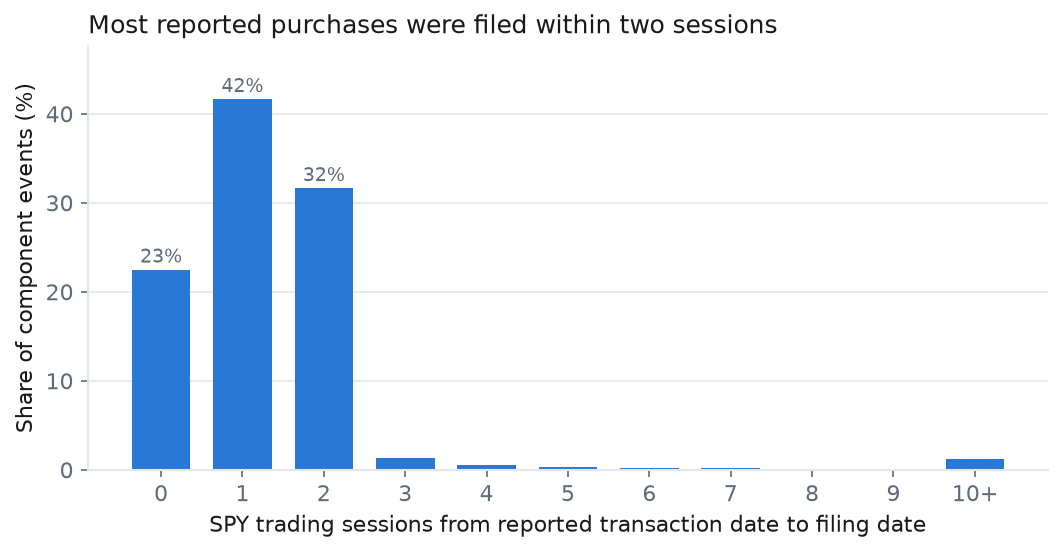
The mechanics of Section 16 reporting require officers, directors, and beneficial owners of more than 10% of a company’s equity to report changes in ownership within two business days of a transaction. This regulatory deadline creates a structured, public dataset that is theoretically ideal for event studies. Yet, the reality of SEC data is far more complex than the simple narrative of a single insider making a single trade. A single filing may contain numerous transaction rows, joint ownership declarations, and various security classes, requiring rigorous data cleaning to isolate meaningful "Code P" (open-market or private purchase) events.
Chronology and Data Refinement
The methodology employed in this study highlights the necessity of a granular "funnel" approach to filtering SEC data. Starting with approximately 1.35 million non-derivative transaction rows, the research narrows the scope by excluding Form 4/A amendments, which can introduce double-counting, and focusing exclusively on original, non-derivative common stock acquisitions. By filtering for C-suite executives—specifically CEOs, CFOs, and Chairs—and removing transactions affirmatively flagged as Rule 10b5-1 plan trades (which are pre-scheduled and therefore less likely to be opportunistic), the sample size is reduced to a more reliable core of 11,957 component events.
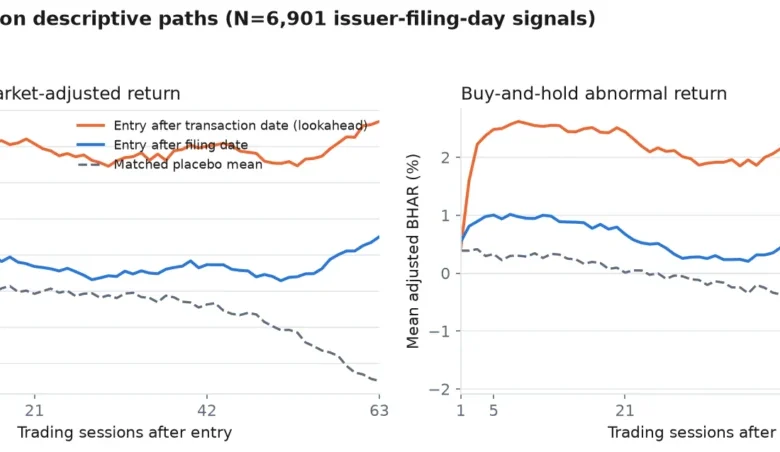
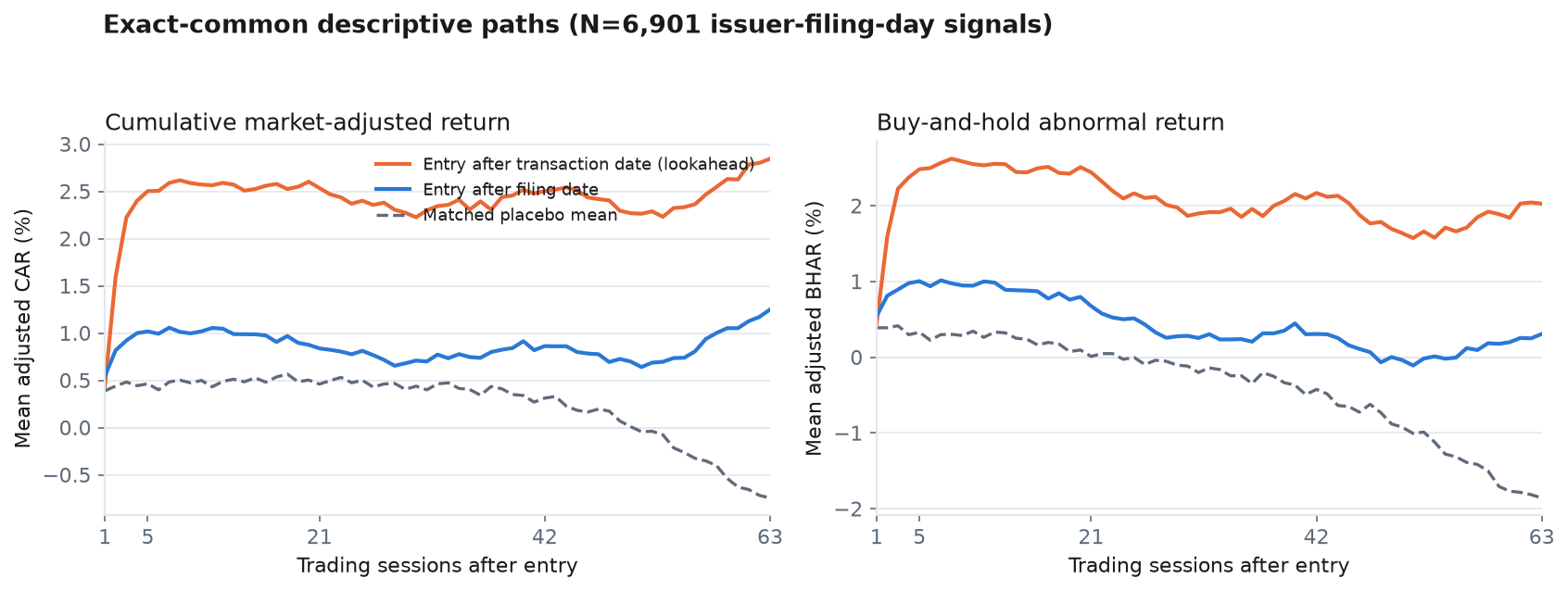
This chronological rigor is vital because of the "lookahead bias" inherent in many historical studies. Researchers found that if an analysis uses the transaction date—the day the insider actually bought the stock—it inevitably incorporates information that was not yet public. By strictly anchoring the study to the filing date, the research ensures that the abnormal returns measured are those accessible to an outside investor at the earliest possible moment of market notification.
Supporting Statistical Evidence
The headline results of the study are deliberately measured. For the first trading session after the filing, the SPY-adjusted mean cumulative abnormal return (CAR) stands at +0.534%. By the fifth session, this figure rises to +1.009%. These results are supported by robust, two-way clustered t-statistics (6.460 and 5.053, respectively), indicating a high degree of statistical significance for these short-term windows.
However, as the time horizon extends to 21 and 63 sessions, the findings lose their statistical potency. At 63 sessions, the confidence intervals for both adjusted CAR and Buy-and-Hold Abnormal Return (BHAR) widen to include zero. In some cases, the 1%-winsorized mean for 63-session BHAR drops to -0.967%, with the median falling to -3.605%. This suggests that while insiders may possess short-term information that the market reacts to upon disclosure, there is no evidence of a persistent, long-term alpha generation strategy for retail or institutional investors following these filings.
The "Market Model" Sensitivity
A critical nuance in this research involves the use of market-model adjustments compared to the primary adjusted estimators. Fitted market models, which account for stock beta and alpha, often produce larger return estimates, sometimes showing a +6.560% return at 63 sessions. Researchers warn that these figures should be viewed with extreme caution. The model often relies on pre-event periods where a high percentage of fitted alphas are negative; subtracting a negative alpha mechanically inflates the cumulative residuals over longer horizons. Consequently, the study treats these as sensitivity checks rather than definitive evidence of long-term outperformance.
Broader Implications for Market Efficiency
The findings have significant implications for the debate on market efficiency and the value of insider signal tracking. The study concludes that while insider purchases are a "noisy" signal, they are not a "free lunch." The liquidity of the targeted stocks is a major hurdle; in nearly 10% of the cases analyzed, the disclosed purchase volume exceeded 100% of the pre-entry median daily dollar volume. This underscores the reality that for many of these securities, a significant institutional or retail position could not be established without causing substantial market impact, thereby eroding any theoretical profit margin.
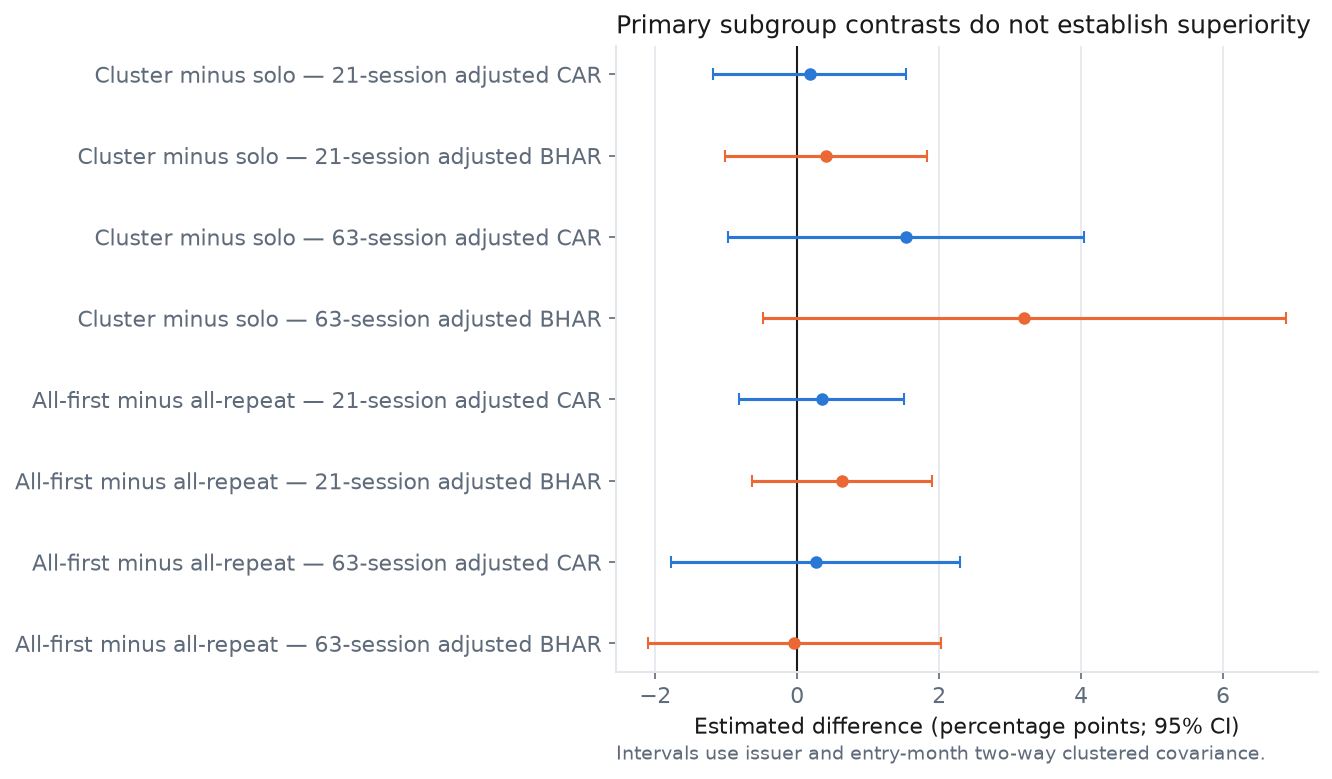
Furthermore, the comparison between "cluster" filings (multiple insiders buying) and "solo" filings, as well as "first-time" versus "repeat" purchasers, shows no significant performance divergence. None of the subgroup contrasts established a clear, repeatable advantage. This implies that the market’s reaction to a Form 4 filing is largely agnostic to the specific profile of the filer, provided the transaction is deemed an "open-market" purchase.
The Role of Regulatory Transparency
The SEC’s recent emphasis on the transparency of Rule 10b5-1 trading plans—specifically the mandate for affirmative checkbox reporting effective April 2023—has been a boon for data integrity. By normalizing these flags, researchers can more accurately distinguish between discretionary trades and those governed by pre-existing contracts. The study’s reliance on the SEC’s "SUBMISSION.tsv" and "NONDERIV_TRANS.tsv" files, combined with a transparently published methodology and reproducible code, sets a high standard for future empirical work.
The author of the study, Mikhail Makeev, emphasizes that this research is not intended to serve as investment advice or a blueprint for a deployable trading strategy. Instead, it serves as a masterclass in financial data engineering. By emphasizing the need to preserve filing timestamps, avoid inferring venue from transaction codes, and treat corporate actions as variables rather than constants, the research provides a framework for others to avoid the common pitfalls that have plagued historical insider-trading studies.
Conclusion and Future Outlook
As financial data becomes more accessible, the temptation to "data mine" for profitable signals grows. This comprehensive analysis serves as a sobering reminder that the most significant returns associated with insider purchases are transient. The rapid dissipation of abnormal returns after the five-session mark suggests that markets incorporate the information disclosed in Form 4 filings with high efficiency. For the average investor, these filings may provide insight into management sentiment or corporate confidence, but they do not, by themselves, represent a reliable mechanism for beating the broader market over an extended duration.
The methodological rigor required to arrive at these conclusions—the cleaning of millions of rows, the matching of filing days to business cycles, and the careful treatment of corporate actions—highlights the evolving state of quantitative research. As the industry continues to refine its tools, the focus is shifting away from the search for "holy grail" signals and toward a more mature understanding of the limitations and conditional nature of public market data. In this landscape, transparency and reproducibility, as demonstrated in this study, are the only ways to ensure that financial analysis remains grounded in reality rather than speculation.