Mastering Triangulated Statistical Arbitrage: A Comprehensive Framework for Independent Traders

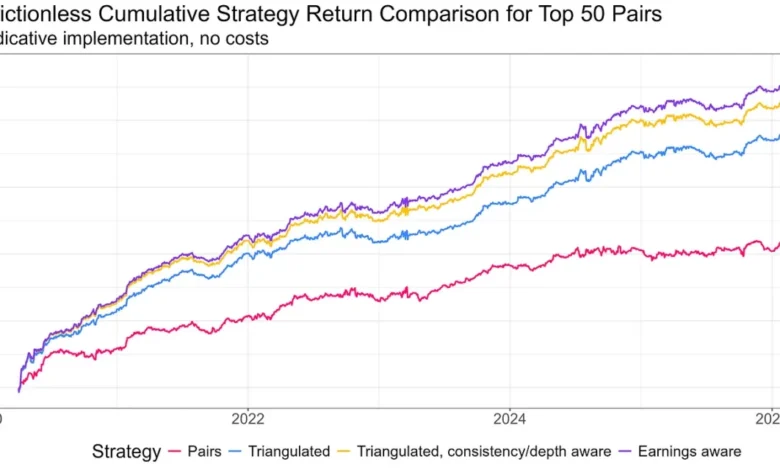
Statistical arbitrage has long held a dual reputation in the quantitative trading community: it offers mathematically sound foundations yet presents notorious operational hurdles for independent operators. Traditionally, the practice relies on pairs trading—a simple bet on convergence where two historically correlated equities drift apart and an investor wagers on their eventual return to a mean spread. While conceptually straightforward, canonical pairs trading often proves capital-inefficient and prone to signal wastage, leaving solo traders at a structural disadvantage against large-scale institutional funds equipped with vast infrastructure.
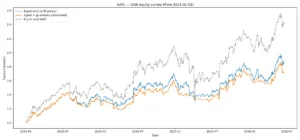
Addressing these inherent limitations, quantitative researchers have developed an advanced iteration known as Triangulated Statistical Arbitrage. Operating live for several months after a rigorous six-month collaborative development cycle within the Robot Wealth Pro (RW Pro) community, this production-grade framework re-engineers how independent desks handle multi-asset strategies. By systematically building a clean universe of high-quality pairs, flattening those pairs into individual ticker-level views, and aggregating signals across a broad network, the methodology eliminates the primary bottlenecks of traditional pairs trading.
To understand how this sophisticated architecture functions in practice, market participants must examine its core pillars: foundational pair selection, network triangulation, and dynamic event filtering.
The Foundation of Quant Alpha: Rigorous Pair Selection

At the heart of any successful statistical arbitrage program lies the universe of pairs. If the foundational asset selection is flawed, no downstream optimization or signal weighting can salvage the portfolio. Industry veterans emphasize that pair selection acts as the ultimate load-bearer of the entire pipeline.
Rather than relying on exhaustive cointegration tests—a brute-force method heavily reliant on historical artifacting—the refined framework evaluates potential pairs using unconventional metrics. The first key metric measures frictionless returns achieved by trading mean-reversion on the spread over a designated lookback window. This evaluates a fundamental question: does buying the undervalued asset and shorting the overvalued asset consistently generate profit in an idealized, cost-free setting? Spreads that diverge and remain permanently separated exhibit low or negative reversion scores and are systematically filtered out.
The second core metric assesses the consistency of spread convergence. The model tracks whether a spread drifted apart for an entire formation period only to converge by sheer coincidence at the very end, or whether it demonstrated reliable, predictable reversion behavior throughout its lifecycle. Combining these metrics yields a highly effective filter for asset pairs that exhibit structural tendency toward mean-reversion.
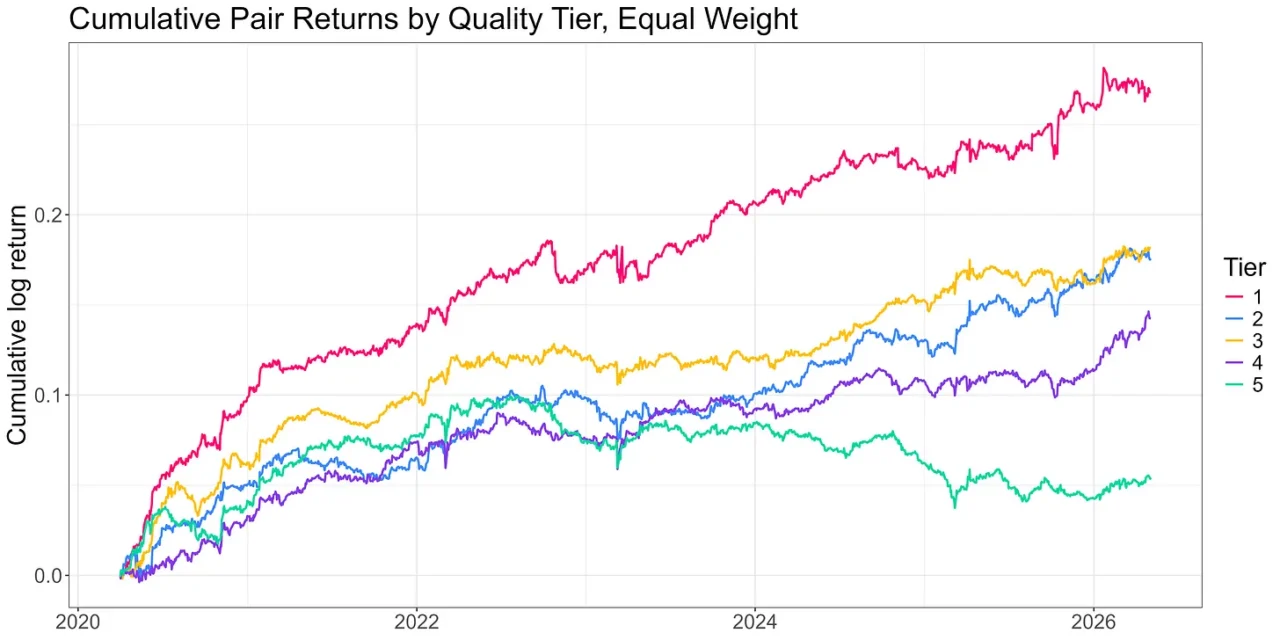
Every month, utilizing the preceding 24 months of historical price action, quantitative models ingest thousands of candidate equities to generate a ranked universe of pairs. Only the top 10% of pairs—provided they share fundamental economic exposures to similar risk factors—are exported for deployment. These top performers are further segregated into five distinct performance tiers. Quantitative backtests reveal a stark performance gradient: top-tier pairs demonstrate robust, risk-adjusted returns, while the lowest tier severely underperforms. Notably, the Sharpe ratio spread between Tier 1 and Tier 5 reaches an impressive factor of four, highlighting that upstream pair selection accounts for the vast majority of total strategy alpha.
From Pairs to Tickers: Triangulation and Capital Efficiency
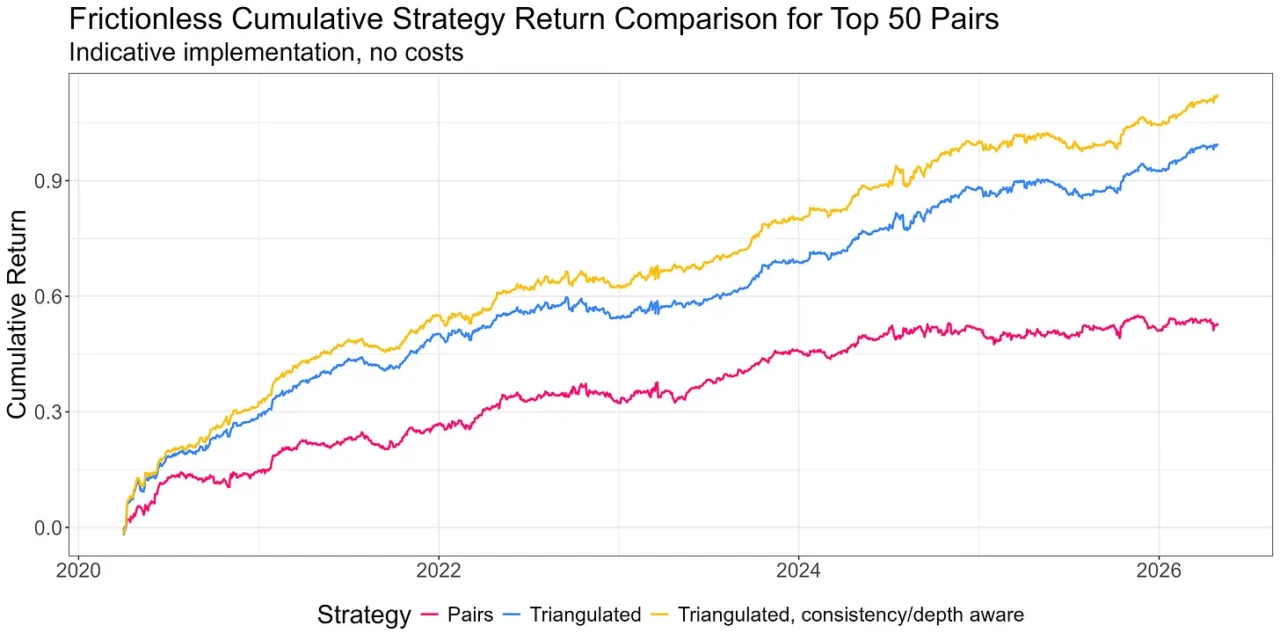
Once a pristine universe of pairs is established, the strategy transitions from a pair-centric view to a ticker-centric architecture. This structural pivot resolves the capital inefficiency that routinely frustrates independent traders.
In a triangulated framework, analysts examine every pair containing a specific ticker. Each individual pair yields a directional view—long the cheap side, short the expensive side—alongside a z-score quantifying the spread’s deviation from its rolling mean. By aggregating these per-ticker views across all associated pairs, the trading desk constructs a unified network signal. Multiple independent pairs corroborating a ticker’s mispricing provide exponentially stronger conviction than any isolated pair could achieve.
Operational data demonstrates that this network signal vastly outperforms traditional pairs trading. Furthermore, statistical significance heavily concentrates in the distribution tails. Just as a trader would never enter a pair trade at a marginal z-score of 0.5, the pipeline restricts execution to extreme mispricings, filtering out central market noise. Consequently, a triangulated long-short portfolio of mispriced legs delivers superior cost-free returns and optimal capital allocation for solo operators managing constrained balance sheets.
Filtering the Noise: Avoiding the Earnings Trap
While quantitative algorithms reliably identify when a spread has diverged, they cannot inherently discern the underlying catalyst driving the divergence. A spread signaling a short position on an expensive leg appears identical whether the price movement stems from temporary forced liquidity flows—which are prime for fading—or from fundamental corporate developments that permanently reprice the asset.
To prevent catastrophic drawdowns, the pipeline incorporates event-driven filters. Initial research explored volume-asymmetry features, hypothesizing that forced selling on a cheap leg differs observably from informed buying on an expensive leg. However, empirical testing revealed that volume features added negligible marginal value at the portfolio level, as their underlying information was largely captured by upstream pair-quality rankings.
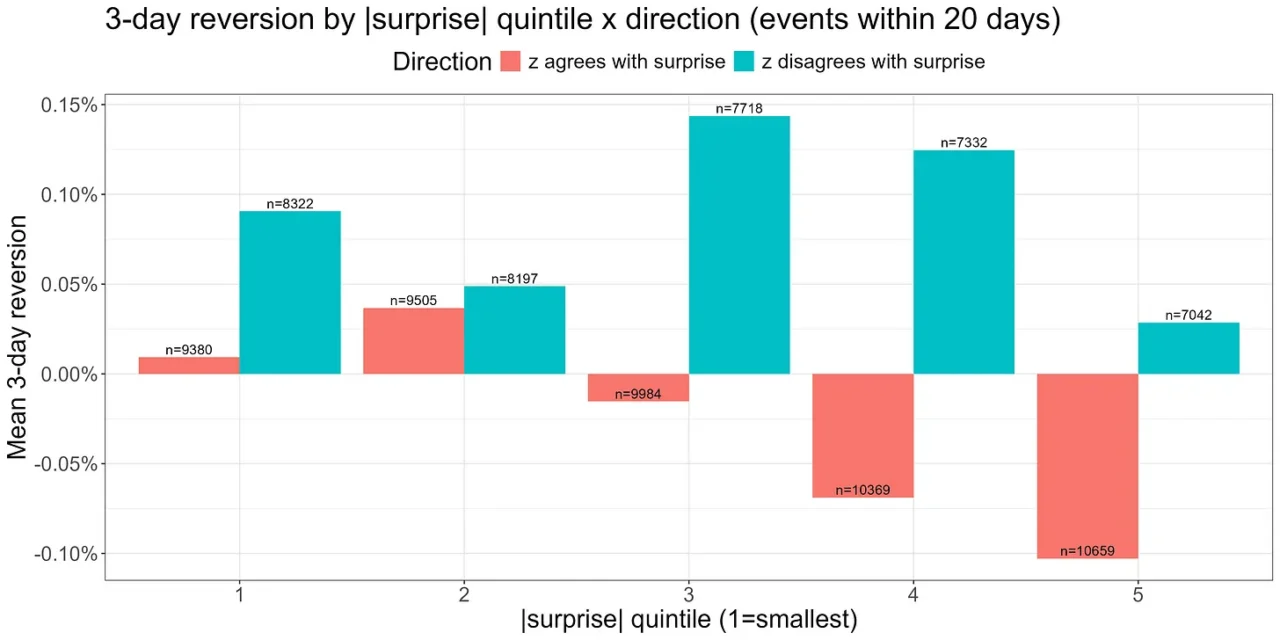
Conversely, implementing a corporate earnings filter yielded a substantial performance boost. When an earnings surprise occurs during a spread’s formation period, the resulting price divergence reflects fundamental new information rather than temporary technical noise. Consequently, fading these specific divergences leads to negative reversion—manifesting as post-earnings drift continuation. By integrating earnings data to automatically suppress trades during active reporting windows, the live strategy successfully navigates fundamental risk events.
Infrastructure, Community, and Independent Operation
Deploying a multi-asset quantitative strategy typically demands prohibitive investments in data engineering and computational infrastructure. Generating a monthly pair universe from thousands of equities requires ingesting massive tick and end-of-day databases, cleaning noisy feeds, and executing hundreds of thousands of ranking computations—an operational overhead exceeding the annual budget of many boutique trading shops.
To level the playing field, institutional-grade development frameworks now provide centralized data APIs delivering end-of-day and hourly intraday feeds alongside pre-computed historical research environments. Rather than reinventing foundational data pipelines, independent traders can focus directly on hypothesis testing, parameter tuning, and risk management.
Crucially, the methodology avoids a rigid, one-size-fits-all product model. Recognizing that an ex-startup founder managing a multi-million-dollar portfolio faces vastly different risk tolerances and capital constraints than a part-time retail operator, professional deployment environments offer modular configuration notebooks. Traders can independently adjust universe sizes, weighting schemes, no-trade buffers, signal thresholds, and leverage parameters to fit their unique operational realities.
Broader Industry Implications and Future Outlook
The maturation of triangulated statistical arbitrage marks a significant milestone for independent quantitative traders. By demonstrating that 80% to 90% of strategy alpha stems from meticulous upstream pair curation—complemented by network triangulation and targeted event filtering—researchers have debunked the necessity of hyper-complex, black-box machine learning models that obscure underlying market mechanics.
As quantitative communities continue to evolve, the integration of advanced news sentiment and natural language processing features represents the next frontier for event-based risk filtering. By systematically dismantling the operational barriers that once restricted sophisticated stat arb to Wall Street prop desks, modern frameworks empower independent traders to captain their own vessels with institutional precision, deep structural understanding, and enduring market independence.