Quantifying the Informative Value of SEC Form 4 Insider Purchase Filings A Longitudinal Event Study


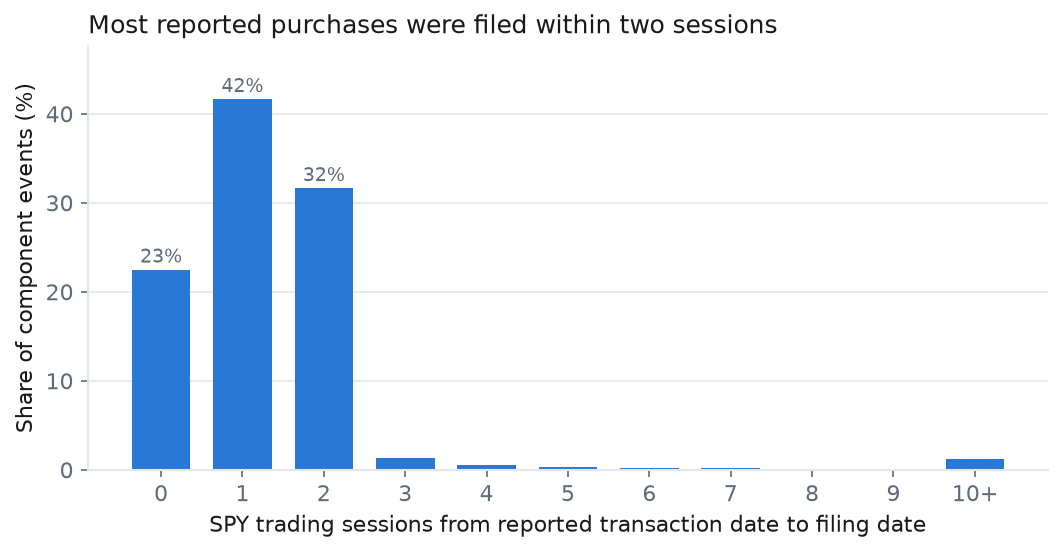
The transparency requirements of the United States Securities and Exchange Commission (SEC) provide a fertile, albeit complex, landscape for quantitative researchers and market observers. Central to this regulatory framework is Form 4, the mandatory disclosure document filed by corporate insiders—including officers, directors, and significant beneficial owners—to report changes in their equity holdings. Because these filings are public, structured, and governed by strict deadlines—typically requiring submission by the end of the second business day following a transaction—they serve as a high-frequency window into the sentiment of corporate leadership. However, extracting actionable insight from these filings requires a rigorous methodological approach that accounts for the nuances of SEC data, the variability of corporate reporting, and the distinction between mere association and causal market impact.
This study examines the statistical significance of code-P purchase filings submitted by C-suite executives between January 1, 2022, and June 30, 2026. By filtering through over 1.3 million non-derivative transaction rows, the research distills a clean sample of 11,957 component events. Through subsequent price validation and issuer-day aggregation, the final dataset yields 7,406 public signals. The primary findings indicate that while these disclosures are associated with short-term abnormal returns, the long-term predictive power remains elusive, challenging the narrative that insider purchases serve as a reliable harbinger of sustained stock price appreciation.
The Mechanics of Insider Disclosure and the Regulatory Landscape
Section 16 of the Securities Exchange Act of 1934 mandates that insiders report their transactions to ensure market integrity. Despite the common perception that a Form 4 represents a singular, clear signal from an executive, the reality of the SEC database is far more heterogeneous. A single filing can encompass multiple transaction tranches, involve joint beneficial owners, or reflect various classes of stock. Furthermore, the SEC’s transaction codes, specifically the "P" code for purchases, do not distinguish between open-market acquisitions and private, off-exchange transactions.
The complexity of the data is further compounded by the evolution of regulatory reporting. Following amendments to Rule 10b5-1, which governs insider trading plans, the SEC introduced a specific checkbox to distinguish between discretionary purchases and those executed under a pre-established contract. Since April 1, 2023, this field has provided researchers with a more precise mechanism to exclude non-discretionary, automated trades. This study purposefully excludes transactions affirmatively flagged as 10b5-1 plan trades to focus exclusively on discretionary, potentially information-driven activity.
Methodological Rigor and the Filing Funnel
To maintain scientific integrity, the research employs a conservative "filing-only" funnel. By aggregating data at the issuer-day level, the study ensures that an issuer is not over-represented simply because multiple insiders filed on the same day. This aggregation results in 7,406 unique signals, each representing a distinct event where the market was presented with new information regarding executive confidence.
The study differentiates between raw transaction data and the actual public signal. By normalizing the security class to common or ordinary stock and enforcing a minimum transaction value of $10,000, the methodology filters out the "noise" of de minimis transactions or non-common equity instruments that may not reflect a true conviction in the company’s core business. Furthermore, the exclusion of joint filings—which can obfuscate the identity of the primary decision-maker—ensures that the resulting signals are attributable to individual, identifiable members of the C-suite.
Short-Term Associations and Long-Term Uncertainty
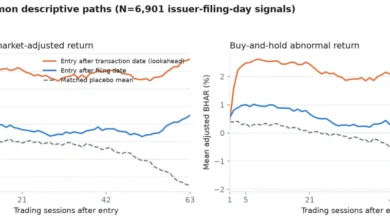
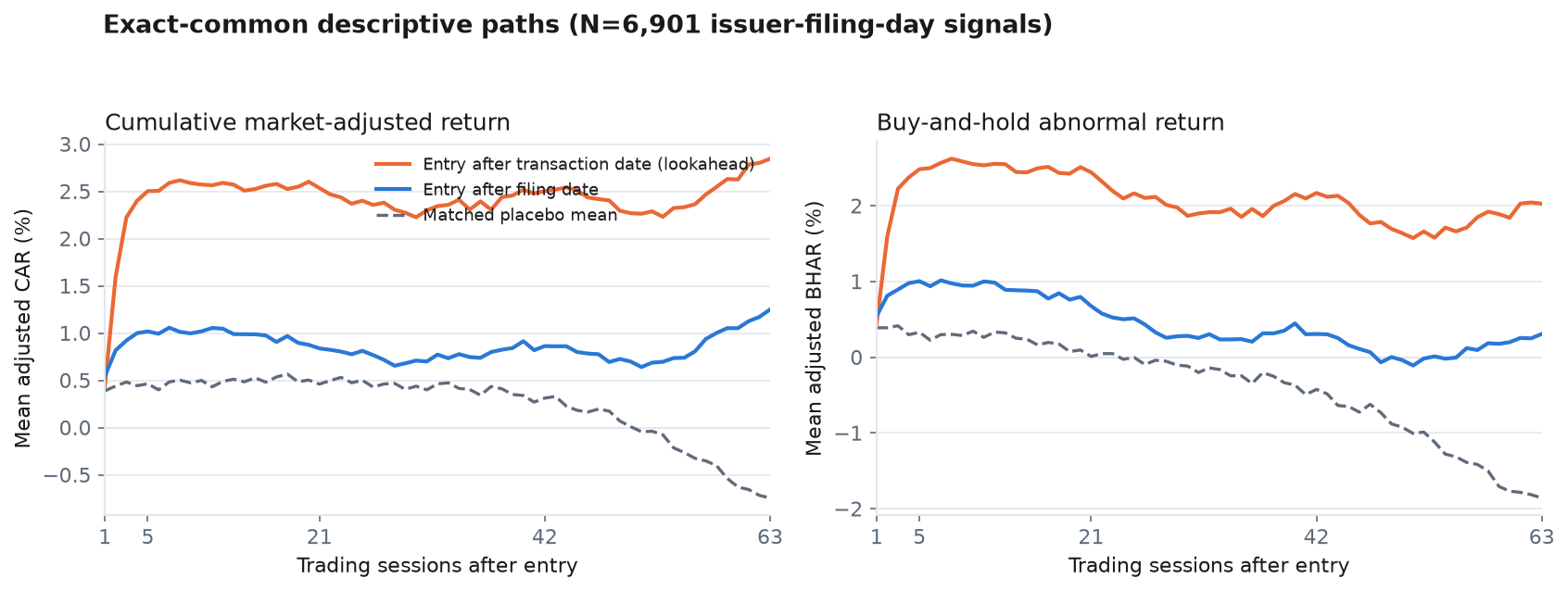
The quantitative analysis of the 7,406 signals reveals a statistically significant, albeit modest, reaction in the immediate aftermath of a filing. The primary SPY-adjusted mean cumulative abnormal return (CAR) for the next session is +0.534%, growing to +1.009% over five sessions. These results, supported by issuer-and-entry-month two-way clustered t-statistics of 6.460 and 5.053 respectively, suggest that the market does incorporate the news of an insider purchase into share prices with a high degree of confidence in the short term.
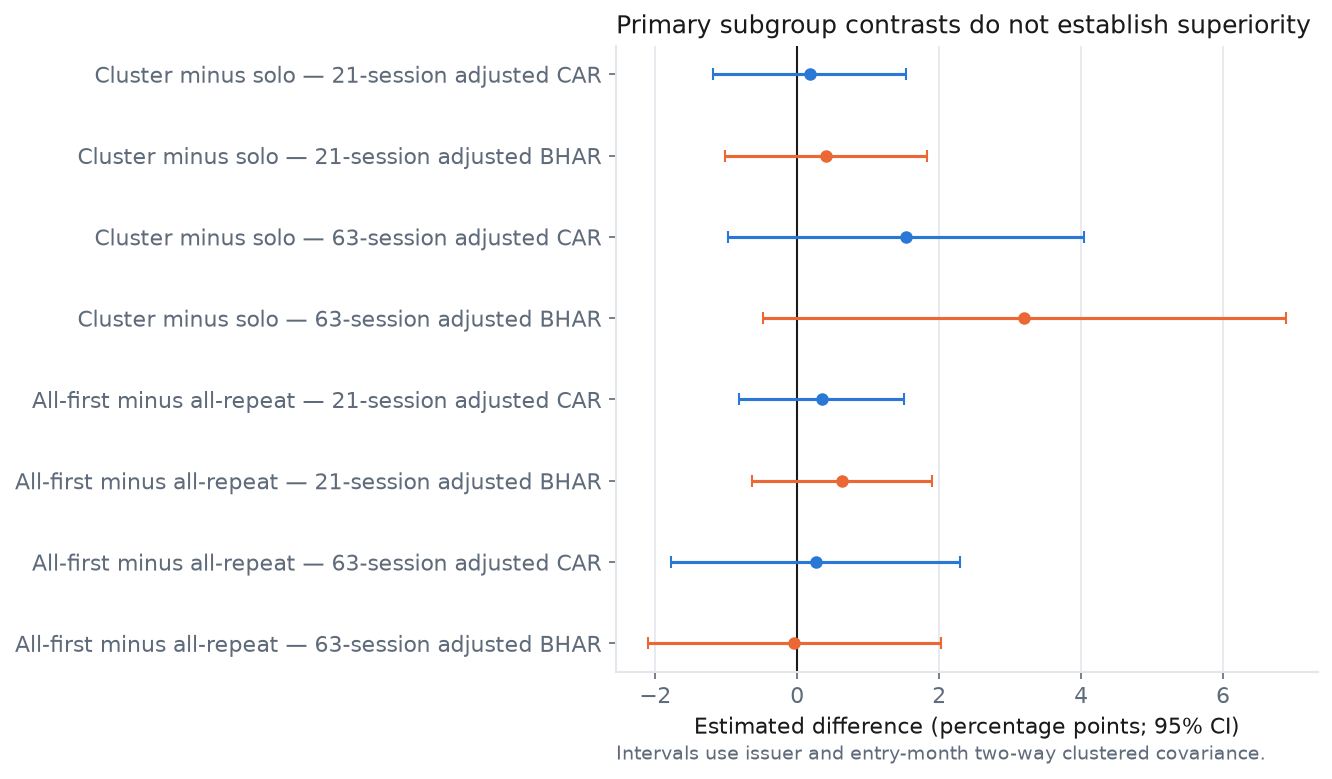
However, the picture changes significantly as the time horizon extends. At 21 and 63 sessions, the adjusted CAR confidence intervals widen to include zero, suggesting that the initial price impact dissipates or is absorbed by broader market volatility. When employing the adjusted buy-and-hold abnormal return (BHAR) metric—which is often considered a more rigorous measure for long-term performance—the results are even more tempered. At 63 sessions, the 1%-winsorized mean return is -0.967%, with a median of -3.605%. These figures suggest that while insiders may possess a "short-term edge" or a tendency to buy during temporary dips, there is little evidence to support the claim that these purchases provide a reliable signal for long-term alpha generation.
Addressing the Lookahead Bias and Market Sensitivity
A critical aspect of this study is the deliberate distinction between filing-date entry and transaction-date entry. Many studies in academic literature utilize the transaction date as the starting point for return measurement. This, however, introduces significant lookahead bias, as the public remained unaware of the transaction until the Form 4 was submitted. By anchoring this study to the filing date, the research ensures that the returns measured are truly "post-publication," reflecting only the information available to an outside investor at the time.
The study also addresses the sensitivity of market models. When applying a standard market model to estimate abnormal returns, the results appear significantly more bullish, with a 63-session CAR of +6.560%. A deeper investigation reveals that this is largely driven by the negative pre-event alpha observed in the sample. By identifying that a majority of these stocks were experiencing downward pressure prior to the purchase, the model compensates by projecting higher-than-warranted future returns. This highlights a crucial warning for practitioners: the choice of model is often more decisive than the data itself.
The Role of Liquidity and Market Impact
While the study provides a clear view of market reactions, it explicitly avoids claims of "deployable strategy" or "causal impact." One of the primary limitations is the liquidity profile of the companies in the sample. For a significant portion of the signals, the disclosed purchase value represents a substantial percentage of the median daily dollar volume. In nearly 10% of the cases, the purchase value exceeds 100% of the median daily volume.
This data point is not intended to measure the capacity of a potential trading strategy, but rather to highlight the liquidity constraints that would face any investor attempting to mirror these moves. The absence of quote data, spread models, and execution tests means that the "return" is a theoretical construct rather than a net-of-cost performance metric. For the individual investor, these liquidity hurdles often render the "insider signal" practically impossible to trade at scale without incurring significant market impact costs.
Implications for Market Observers and Regulators
The findings of this study provide a nuanced reality check for market participants who view insider purchases as a "magic bullet" for stock selection. The data confirms that while insiders, as a group, are adept at timing their purchases—often buying after a period of price weakness—the public disclosure of these purchases does not provide a reliable, long-term roadmap for market outperformance.

For regulators, the study underscores the importance of the continued evolution of SEC reporting requirements. The introduction of the 10b5-1 flag has been a meaningful improvement in data quality, allowing researchers to isolate truly discretionary actions from systematic, automated ones. Future improvements in the standardization of "private" versus "open-market" designations within the Form 4 structure would further assist in separating genuine signals of executive conviction from routine compensation-related equity adjustments.
Conclusion
The evidence presented here suggests that the "insider purchase" signal is best understood as a short-term, sentiment-based indicator rather than a foundational driver of long-term value. The positive returns observed in the five-day window post-filing indicate that the market respects the signal, but the subsequent fade to neutrality suggests that such disclosures do not reveal hidden, long-term corporate fundamental value in a way that is easily exploited by outside investors.
By adhering to a methodology that emphasizes reproducibility, controls for lookahead bias, and employs conservative statistical clustering, this research provides a template for how institutional and retail researchers should approach the vast, often messy, landscape of SEC filings. As data pipelines continue to improve and the accessibility of granular financial data grows, the ability to separate signal from noise will remain the most valuable asset for any market observer. Ultimately, the lesson of this study is one of humility: in the complex, efficient, and often volatile environment of the public markets, there is rarely a shortcut to sustainable performance, even when the signals are as public as a Form 4 filing.
Related posts: