Quantitative Analysis of SEC Form 4 Insider Purchase Filings Reveals Short Term Market Associations and Statistical Nuance

The United States Securities and Exchange Commission (SEC) maintains a vast, publicly accessible repository of financial disclosures that serves as a cornerstone for modern quantitative research. Among these, Form 4—the mandatory statement of changes in beneficial ownership—is particularly significant. Because federal law requires insiders, including executives and directors, to report transaction activity within two business days, these filings provide a structured, time-sensitive window into the confidence levels of corporate leadership. A rigorous examination of 7,406 public signals derived from over 1.3 million raw transaction rows between January 1, 2022, and June 30, 2026, reveals that insider purchases are statistically associated with positive abnormal returns in the immediate aftermath of a filing, though these effects exhibit significant decay over longer time horizons.
The study of insider transactions is not a novel endeavor; however, the methodology employed in this analysis seeks to modernize how researchers process SEC data. By isolating "Code P" transactions—which denote open-market or private purchases—and filtering out derivative trades, grants, and routine plan-based activity, researchers can create a cleaner dataset. The current findings indicate a primary SPY-adjusted mean cumulative abnormal return (CAR) of +0.534% for the next trading session, rising to +1.009% over five sessions. While these figures are statistically significant under two-way clustered t-statistics, the strength of the association wanes as the timeframe extends to 21 and 63 sessions, where confidence intervals frequently cross the zero threshold, suggesting that the "insider signal" does not reliably predict long-term alpha.

Anatomizing the Regulatory Reporting Framework
To understand the weight of these filings, one must distinguish between the regulatory requirement and the market reality. Section 16 of the Securities Exchange Act of 1934 mandates that officers, directors, and beneficial owners of more than 10% of a registered equity class report changes in their holdings. While the "P" code is frequently interpreted by retail traders as a bullish open-market purchase, the SEC definition is broader, encompassing private transactions that may not occur on a public exchange.
The data processing pipeline for this analysis was designed to account for these complexities. Specifically, the researchers implemented a strict funnel to exclude noise. For example, joint filings, where multiple beneficial owners report the same transaction, were removed to prevent double-counting. Furthermore, the study normalized the definition of "C-suite" roles to focus specifically on core leadership—CEOs, CFOs, and Chairs—while excluding deputy or divisional roles that might not reflect firm-wide strategic insight.
A critical evolution in this reporting occurred on April 1, 2023, when the SEC began requiring filers to affirmatively flag whether a transaction was executed under a Rule 10b5-1(c) contract. By excluding these flagged trades, the study isolated "discretionary" purchases, yet even this filter has limitations. The absence of a 10b5-1 flag does not necessarily equate to an opportunistic, information-driven trade, as insiders may purchase for various personal reasons, such as liquidity management or tax obligations, that remain invisible in structured fields.
Chronology and Data Integrity
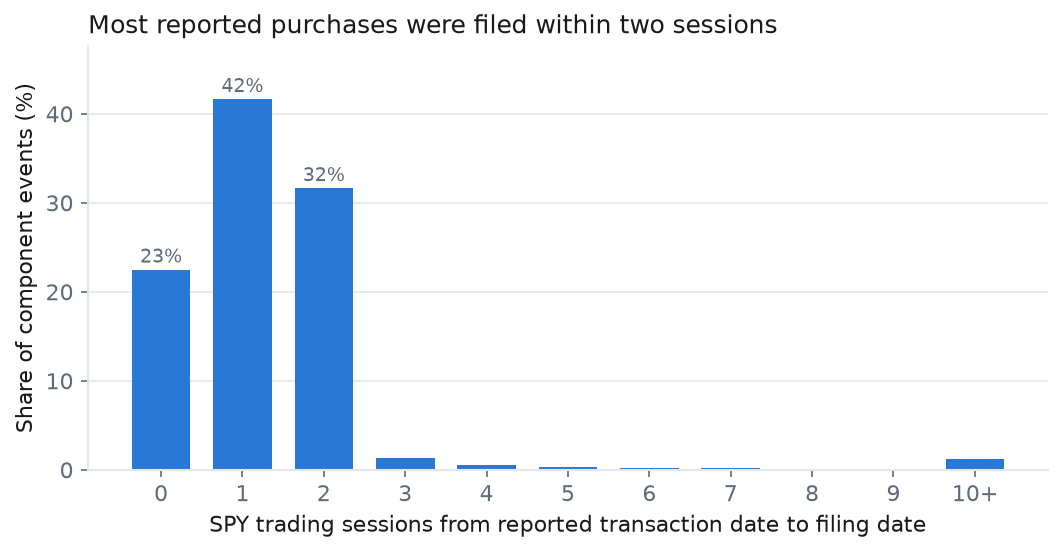
The construction of this dataset involved processing 18 quarters of filings. The filing funnel is particularly revealing: out of the initial 1.34 million non-derivative transaction rows, only 11,957 component events remained after applying filters for security class, transaction sanity, and owner attribution. The median lag between a transaction and the filing of the Form 4 was found to be just one trading session, with 95.8% of filings submitted within the two-day regulatory window.
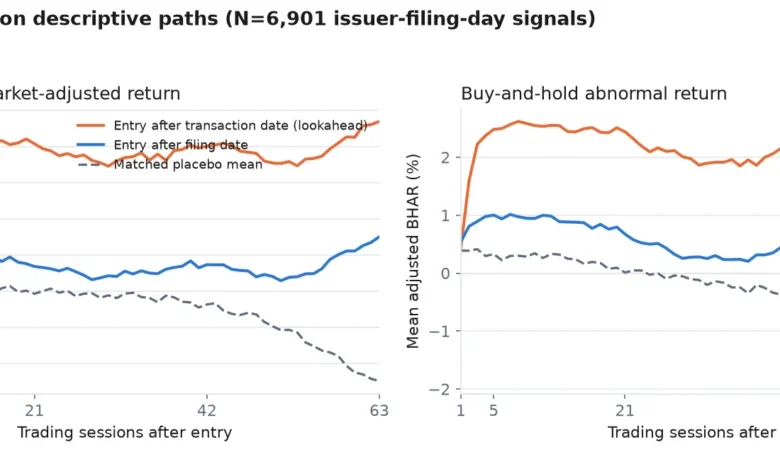
This timeliness is a double-edged sword for quantitative researchers. Because the filing date is the earliest moment a market participant can react to the disclosure, it serves as the only legitimate entry point for an event study. Researchers who use the transaction date as the entry point introduce significant lookahead bias, as that information was essentially private until the filing was submitted. When comparing the two entry points, the transaction-date approach consistently shows higher returns, confirming that pre-publication returns are being incorrectly attributed to the filing event itself.
Statistical Inference and Market Sensitivity
To ensure the results were not artifacts of statistical noise, the research utilized Cameron-Gelbach-Miller two-way clustered covariance, which accounts for both the issuer and the calendar month. This approach is essential because firms within the same sector often report transactions during similar market cycles, which could otherwise artificially inflate the perceived precision of the results.
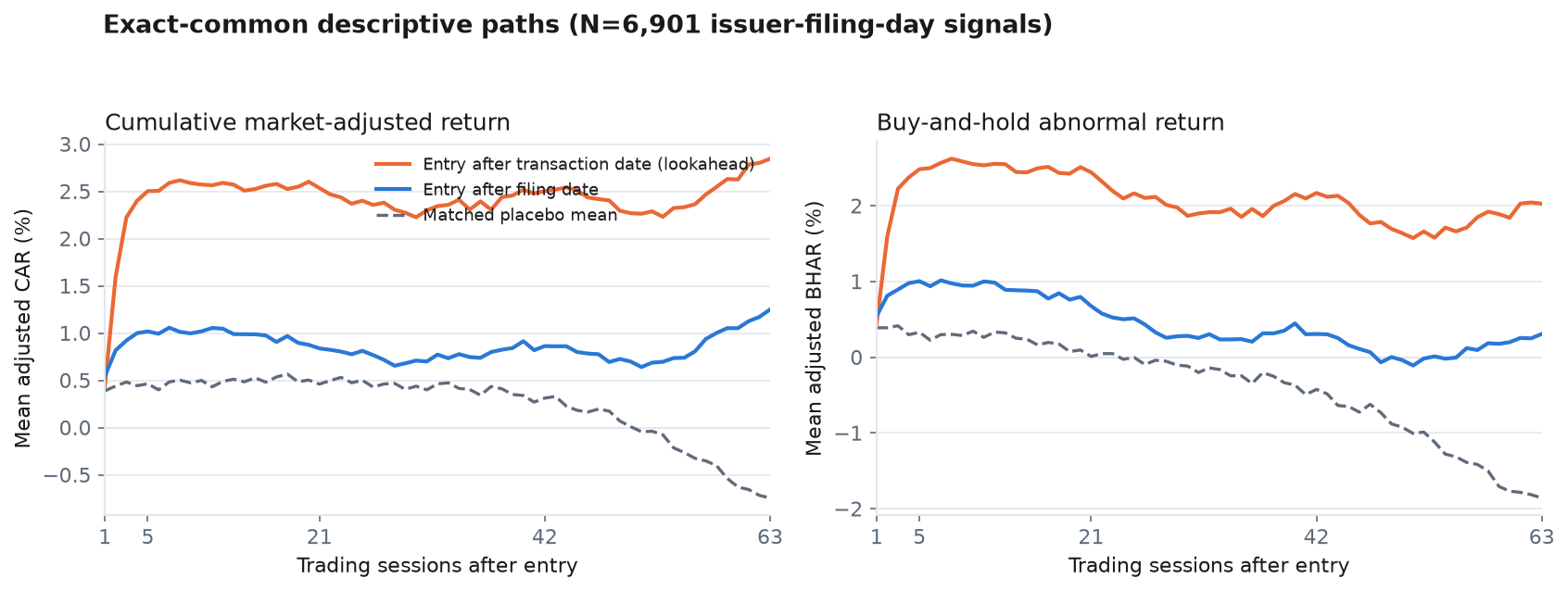
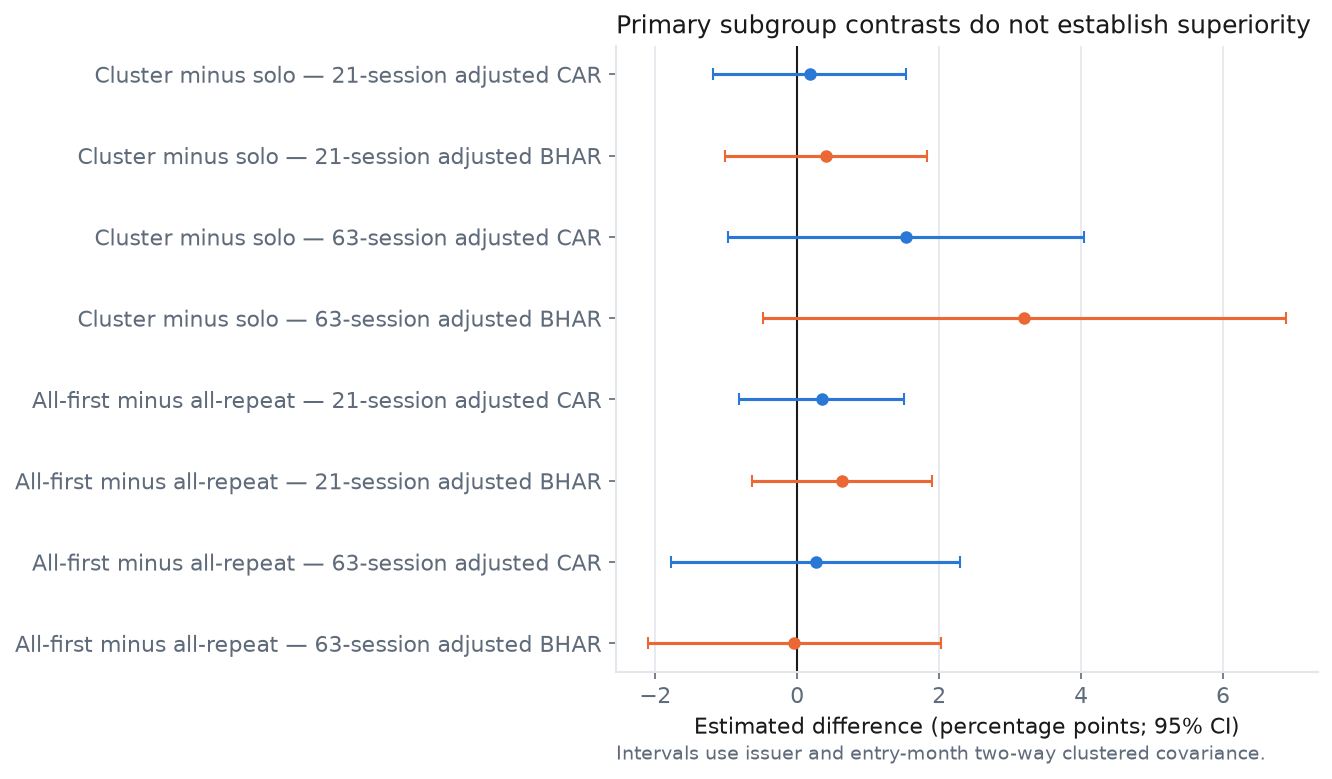
The analysis of 21-day and 63-day horizons yielded results that caution against over-optimism. While the adjusted CAR remains positive, the inclusion of zero in the confidence intervals for longer periods suggests that the "insider effect" is largely a short-term phenomenon. Furthermore, when applying a "matched-placebo" test—where candidate dates are selected for the same firms based on volatility and momentum profiles—the difference between the "honest" signals and the placebo signals was not statistically robust.
The Role of Corporate Actions and Data Quality
A persistent challenge in event studies is the handling of corporate actions, such as stock splits or dividends, which can skew return calculations. The methodology employed here involved cross-referencing daily price data with a ledger of recorded stock actions. Where historical data showed anomalies, the researchers re-constructed the nominal close prices to ensure that the abnormal return calculations were based on accurate, inflation-adjusted, and split-adjusted performance.
The exclusion of 1,888 components due to a lack of usable Yahoo price coverage underscores a potential "survivorship bias" in many such studies. Securities that are delisted, distressed, or undergoing rapid transformation are often excluded from such datasets, meaning the resulting estimand is inherently conditional on the availability of reliable price history. This limitation is not a failure of the study, but rather a necessary boundary of the research scope.
Broader Implications and Institutional Perspectives
While the results of this study offer a fascinating window into executive behavior, they should not be viewed as a blueprint for an investment strategy. Portfolio returns are heavily influenced by transaction costs, market impact, and the liquidity of the underlying security—none of which were explicitly modeled here. The "insider purchase footprint," calculated as the ratio of the purchase value to the median daily dollar volume, revealed that in roughly 10% of cases, the insider’s purchase exceeded 100% of the median daily volume. This high level of relative participation suggests that for many small-cap or mid-cap firms, insider activity has the potential to move the market significantly, independent of the information signal provided to other investors.
The academic and professional community has long debated the informativeness of insider trading. Research by Lakonishok and Lee (2001) and Cohen et al. (2012) established that insider purchases are generally more informative than sales, often concentrating in smaller, value-oriented firms. This current study supports the consensus that while insider activity is a relevant data point, it is far from a "magic bullet" for stock selection. The primary takeaway for market participants is that the "announcement effect" of an insider purchase is swift and dissipates quickly.
Conclusion
The evidence presented suggests that the market does indeed respond to SEC Form 4 insider purchases, but that response is contained within a narrow window. The statistical association between these filings and a modest positive return in the five days following disclosure is clear, yet the lack of persistent drift over the subsequent three months suggests that the information contained in these filings is rapidly incorporated into stock prices. For investors and researchers, the lesson is one of methodological rigor: by preserving the filing-date integrity, clustering standard errors, and maintaining a transparent data-processing funnel, one can extract meaningful insights from the noise of the financial markets. The study stands as a reminder that in quantitative research, the most valuable insights often come from acknowledging the limits of the data rather than chasing the promise of high-alpha strategies.