The Cruel Irony of Lifetime Frugality: Why Waiting Too Long to Spend Retirement Wealth Leads to Unintentional Deprivation

For decades, the standard financial blueprint has prioritized relentless accumulation: work hard, save aggressively, invest prudently, and defer gratification until the traditional retirement age. However, a growing body of behavioral economics and firsthand generational observation suggests that this traditional wealth-building model contains a fundamental flaw. Individuals who spend a lifetime cultivating strict financial discipline often find themselves physically and psychologically incapable of enjoying their accumulated capital once they reach traditional retirement age.
This phenomenon—where decades of intentional self-denial create a permanent psychological barrier to spending—raises critical questions about the optimal timing of wealth decumulation, the compounding nature of human behavior, and the true cost of delaying lifestyle enjoyment.
The Behavioral Mechanics of Lifelong Frugality
Financial planning models typically treat money as a fluid resource that can be deployed at any stage of life, provided the math supports the expenditure. Yet, financial advisors and behavioral psychologists note that human spending habits do not reset simply because an individual crosses an arbitrary age threshold, such as 65.
Decades of reinforcing the mental habit of saying "no" to non-essential purchases builds a psychological muscle that becomes exceptionally rigid over time. For individuals who practiced strict frugality during their thirties, forties, and fifties, thrift ceases to be a conscious strategy by the time they reach their seventies. Instead, it becomes a deeply ingrained part of their psychological identity.
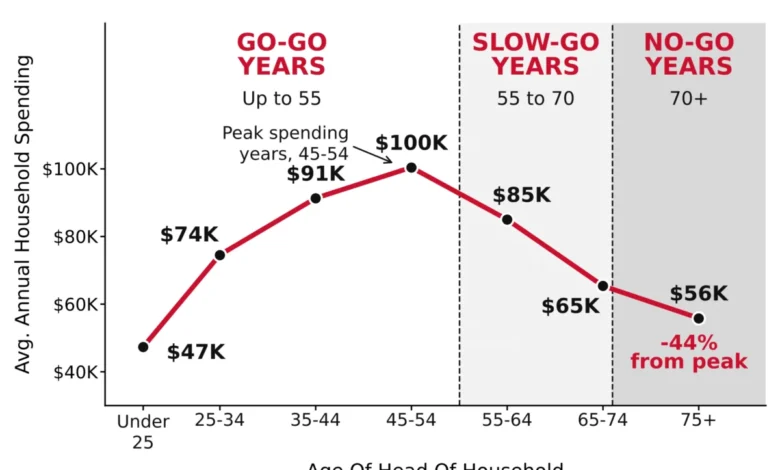
Economic analyses of retiree spending patterns consistently show that spending tends to decline sharply in real terms as people age, independent of their actual financial capacity. Even when presented with clear empirical evidence—such as financial plans and portfolio longevity analyses demonstrating that they can safely increase their annual spending without risking insolvency—lifelong savers frequently experience intense hesitation over modest discretionary outlays. This behavioral friction indicates that the primary barrier to retirement spending is often not the availability of funds, but rather the enduring cognitive wiring developed during years of capital accumulation.
The Decumulation Window: Shifting the Timeline
Traditional retirement paradigms generally assume that major wealth decumulation occurs steadily throughout the golden years, typically supported by conservative withdrawal rates such as the historical four percent rule. However, observations of modern retirees point to a compressed and shifting window of intentional spending.
Experts increasingly categorize the post-career lifespan into distinct phases: the active "go-go" years, the slowing "slow-go" years, and the inactive "no-go" years. The window for high-engagement, physically demanding consumption—such as international travel, exploratory excursions, and active recreation—tends to peak between the ages of 45 and 65, and generally begins to contract significantly after age 70.
| Retirement Phase | Typical Age Range | Characteristics & Spending Patterns |
|---|---|---|
| Go-Go Years | Ages 45 – 65 | High mobility, active travel, peak desire for experiential consumption, and higher capacity for physical excursions. |
| Slow-Go Years | Ages 66 – 75 | Gradual decline in physical mobility, shifting preferences toward localized activities, and reduced appetite for long-distance travel. |
| No-Go Years | Age 76+ | Primarily home-centric routines, reliance on essential services, minimal discretionary travel, and sharply lower overall consumption. |
For individuals who achieve financial independence early through high savings rates and favorable market returns, this dynamic is further amplified. Because these early retirees often benefit from prolonged exposure to bull markets, their portfolios frequently outpace standard conservative projections. Consequently, maintaining a rigid, highly conservative withdrawal rate can result in excessive capital retention that is ultimately never utilized by the primary earner.

The Intersection of Health, Mobility, and Desire
Beyond psychological conditioning, the physical realities of aging play a decisive role in altering consumption patterns. As individuals move past their late sixties and into their seventies, declining physical stamina and heightened health sensitivities frequently diminish the desire for complex leisure activities.
Family observations and geriatric studies indicate that once older adults establish a stable, low-stimulus domestic routine, offers for high-cost experiential gifts—such as fully funded international cruises or extended family excursions—are frequently declined not due to financial constraints, but due to a simple lack of interest and a preference for predictable domestic comfort.
This shift transforms the nature of household expenditures. Discretionary budgets shrink to cover basic living expenses, property maintenance, localized family gatherings, and low-cost entertainment. Big-ticket experiences are systematically replaced by quiet, routine-based pastimes, effectively closing the channels through which accumulated wealth might otherwise be actively enjoyed.
Implications for Modern Wealth Management
The realization that consumption capacity declines steeply in later life has prompted a reassessment among financial planners regarding how individuals should approach retirement preparation. Rather than viewing wealth accumulation as an endless pursuit, modern wealth management increasingly emphasizes the concept of intentional decumulation—encouraging retirees to front-load discretionary spending during their peak health windows.
This approach challenges the conventional fear of running out of money, a primary driver of under-spending among retirees. Tools such as comprehensive financial planning software, portfolio stress-testing, and risk-mitigation strategies like term life insurance or structured annuities are increasingly utilized to provide savers with the psychological confidence needed to authorize higher spending rates earlier in retirement.
Furthermore, economists emphasize the importance of recognizing the non-financial costs of extreme deferral. When wealth is accumulated without a corresponding plan for eventual utilization, the surplus capital typically bypasses the original earner entirely, transferring instead to heirs or investment markets via mandatory distributions or estate settlements. For many savers, the recognition that unspent capital represents forgone experiences rather than a successful safety buffer serves as a catalyst for redefining their financial strategies.
Broader Economic and Generational Perspectives
As multi-generational households navigate these economic realities, the dialogue surrounding retirement preparedness continues to evolve. Younger generations observing the spending patterns of aging parents are increasingly questioning the utility of a purely accumulation-focused lifecycle.
While older retirees often report high levels of internal contentment and peace despite modest spending habits, observers note a distinct paradox: the rigorous discipline required to achieve financial security can inadvertently preclude individuals from experiencing the very lifestyle freedoms that financial independence was designed to secure.
Ultimately, financial experts suggest that achieving a balanced financial life requires bridging the gap between mathematical planning and behavioral readiness. By recognizing that the capacity for consumption is finite and heavily tied to physical vitality, savers are encouraged to align their financial withdrawals with their physical prime, ensuring that capital serves as an active tool for enrichment rather than a static figure left behind.