SoFi Launches SOFIE: The First National Bank-Issued Tokenized Deposit Bridging Yield and Blockchain Utility

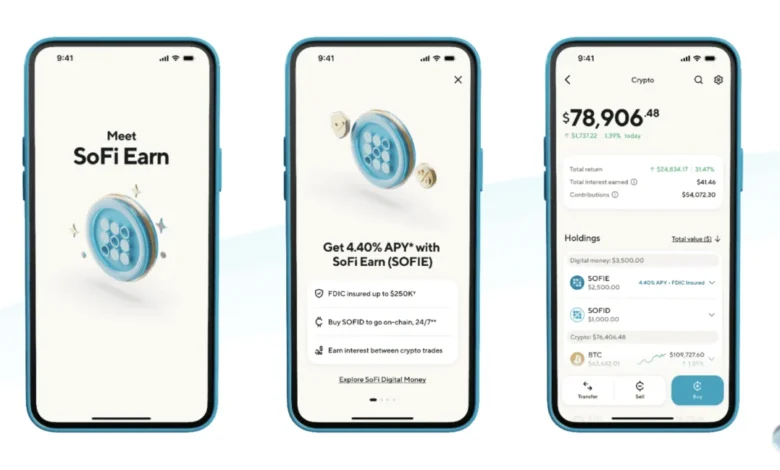
Digital finance is experiencing a profound structural shift as traditional banking infrastructure intersects more deeply with blockchain architecture. In a milestone development for consumer financial technology, digital-first financial services institution SoFi has officially launched SoFi Earn, trading under the ticker SOFIE, marking the introduction of the first-ever national bank-issued tokenized deposit designed explicitly for everyday consumers. This newly unveiled product aims to solve a persistent inefficiency in the modern digital asset ecosystem: the forfeiture of yield on capital that is actively positioned for blockchain transactions. By offering a compelling 4.40% Annual Percentage Yield (APY) paired with Federal Deposit Insurance Corporation (FDIC) protection, SoFi is attempting to redefine how consumers store, grow, and mobilize their digital dollars.
The rollout of SOFIE, which began its phased release to SoFi Crypto members and will continue through November, represents a sophisticated bridge between the safety of traditional fiat banking and the high-speed utility of distributed ledger technology. Through this innovative mechanism, consumers can hold their digital dollars in an interest-bearing, tokenized bank deposit that generates returns until the capital is required for external blockchain applications. When a member decides to purchase cryptocurrencies or initiate a cross-border or blockchain-native money transfer, their SOFIE deposits can be seamlessly converted into SoFiUSD—SoFi’s proprietary stablecoin—at a strict one-to-one ratio. This dual-layered architecture allows users to maintain full liquidity and operational readiness for digital asset markets without sacrificing the passive income traditionally associated with high-yield savings accounts.
The Regulatory Catalyst: The GENIUS Act and the Evolution of Yield
The timing of SoFi’s announcement is particularly striking, coming mere hours after the Office of the Comptroller of the Currency (OCC) finalized its rigorous rules implementing the prohibitions outlined in the GENIUS Act. Scheduled to officially take effect on January 18, 2027, the GENIUS Act introduces a stringent regulatory framework for the digital asset sector, notably barring stablecoin issuers from paying direct interest or yield to holders merely for maintaining a payment stablecoin. Lawmakers and regulators designed this statute to mitigate systemic risks and prevent stablecoins from functioning as unregulated shadow banking deposits. However, the legislation immediately ignited intense industry debate by leaving critical ambiguities regarding whether third-party reward programs, crypto exchanges, and decentralized intermediaries could legally distribute yields through alternative structures.
By anchoring the yield-generating mechanism within a federally regulated, interest-bearing bank deposit rather than a payment stablecoin, SoFi has engineered a compliant workaround. Because tokenized bank deposits fall completely outside the statutory definition of payment stablecoins under the GENIUS Act, chartered banks retain the legal authority to offer interest-bearing digital dollars under existing, time-tested banking regulations. This strategic maneuver positions SoFi’s tokenized deposits not as direct competitors to regulated stablecoins, but as complementary foundational layers that operate harmoniously within the new compliance perimeter. Industry analysts note that this approach effectively insulates SoFi from the impending regulatory squeeze facing pure-play stablecoin issuers, while offering consumers a legally secure alternative to capture yields that traditional crypto-native platforms may soon be forced to abandon.
Contextual Chronology: SoFi’s Aggressive Push into Digital Assets
The introduction of SOFIE does not occur in a vacuum; rather, it represents the crown jewel in a coordinated, rapid-fire expansion of SoFi’s digital asset ecosystem. Over the span of less than a year, the company has methodically assembled a comprehensive suite of blockchain-enabled financial products aimed at bridging the gap between traditional finance (TradFi) and decentralized finance (DeFi).
This aggressive product cadence began with the reintroduction and scaling of consumer crypto trading capabilities on the SoFi platform, giving millions of retail members direct access to digital asset markets. Shortly thereafter, the company expanded its enterprise and consumer footprints by rolling out SoFiUSD, establishing its native footprint in the stablecoin liquidity layer. This was closely followed by the launch of Big Business Banking, a specialized platform engineered to provide corporate clients with a single, highly regulated dashboard to seamlessly manage both traditional fiat currency and digital assets side by side. The unveiling of SOFIE as the fifth major digital asset offering in this compressed timeline underscores management’s determination to capture the entire lifecycle of consumer and corporate liquidity, ensuring that funds originating, residing, or terminating within the SoFi ecosystem never have to leave the institution to find utility or yield.
Executive Perspectives and Strategic Intent
Addressing the core motivations behind the product, SoFi Chief Executive Officer Anthony Noto emphasized the staggering opportunity cost currently plaguing the digital economy. “Too much money in the digital asset ecosystem is sitting idle, leaving massive potential earnings on the table for millions of people,” Noto stated during the product unveiling. He elaborated on the company’s foundational philosophy that consumer capital should remain productive at all times: “We believe your money should keep working for you until the moment you need it. SoFi Earn combines the earning power and protections of a bank deposit with the speed and utility of digital assets, giving people more value, flexibility, and control over their money.”
Financial technology experts have lauded the move as a masterclass in product positioning. For years, digital asset enthusiasts have faced a binary choice: park capital in low-yield or zero-yield stablecoins to maintain transaction readiness for decentralized applications, or lock capital in traditional, high-yield banking instruments that lack the speed and programmatic capabilities required for blockchain execution. By merging these capabilities into a single instrument governed by a national bank charter, SoFi has effectively dismantled this false dichotomy.
Broader Industry Implications and Market Dynamics
The introduction of SOFIE raises critical strategic questions regarding the long-term economic incentives governing digital currencies. From a consumer perspective, the availability of a tokenized deposit paying a competitive 4.40% APY while offering instant convertibility into stablecoins fundamentally alters the value proposition of holding unyielding assets. If market participants can earn substantial interest on their digital dollars right up until the millisecond they execute a blockchain transaction, the economic incentive to hold traditional, non-interest-bearing stablecoins diminishes significantly. Consequently, consumers are heavily incentivized to route their digital liquidity through banking institutions capable of issuing tokenized deposits, potentially reshaping the deposit acquisition strategies of retail banks nationwide.
Furthermore, traditional banking institutions that have long viewed the rise of cryptocurrencies and stablecoins as an existential threat to their deposit bases can draw profound lessons from SoFi’s blueprint. For the past decade, mainstream financial institutions have largely responded to the digital asset revolution with defensive posturing, strict compliance barriers, or outright hostility. SoFi’s strategy demonstrates a pragmatic alternative: rather than attempting to wall off traditional banking from the blockchain economy, institutions can leverage their unique regulatory charters to bridge the two worlds. By connecting federally insured, interest-bearing deposits with the lightning-fast settlement capabilities of stablecoins, banks can deliver an optimized user experience that satisfies both regulatory mandates and the modern consumer’s demand for velocity, utility, and yield. As the rollout of SOFIE continues through November and the January 2027 effective date of the GENIUS Act draws closer, the broader financial services landscape will undoubtedly monitor SoFi’s experiment closely, watching to see whether tokenized bank deposits become the new gold standard for digital liquidity management.