The ongoing debate surrounding the artificial intelligence boom has reached a critical juncture, characterized by a fundamental tension between market valuations and technological necessity. Citadel founder Ken Griffin recently told a gathering of investors that the global financial markets are "almost certainly" navigating an artificial intelligence bubble. While financial historians and seasoned market commentators note that Griffin’s assessment aligns with traditional patterns of technological adoption and speculative excess, acting prematurely on this thesis carries immense financial risk. The central challenge facing portfolio managers and individual investors is not identifying whether a bubble exists, but rather timing its eventual deflation without missing out on the substantial economic gains that typically precede a market correction.
To paraphrase legendary Fidelity Magellan fund manager Peter Lynch, the most difficult aspect of navigating any speculative cycle is determining the exact timing, as history repeatedly demonstrates that moving to cash too early often inflicts greater damage on a portfolio than the market crash itself. Howard Marks, co-founder of Oaktree Capital Management, famously captured this dilemma with the adage that being right and being early amounts to the exact same thing as being wrong. As financial analysts dissect the multi-trillion-dollar investments flowing into generative AI infrastructure, the consensus among prudent risk managers is that the bubble phase and the underlying technological progress can run parallel for several years, leaving investors to grapple with a complex matrix of capital allocation decisions.

The Dichotomy of Market Perspectives: Griffin Versus Fink
To understand the current market environment, financial analysts must reconcile two seemingly contradictory viewpoints expressed by prominent industry leaders. Speaking at Citadel’s Future of Global Markets conference on October 20, 2026, Ken Griffin addressed the financial mechanics of technological revolutions. Any radical economic transformation, he argued, is invariably intertwined with a speculative bubble, noting that corporate America’s ability to extract tangible financial value from its AI models remains highly uneven.
Conversely, just one day later during an appearance on Bloomberg Television, BlackRock CEO Larry Fink highlighted a different systemic risk. Fink pointed out that computational power remains exceptionally scarce and expensive, asserting that the speed of infrastructure buildout dictates economic vitality. According to Fink, the faster data centers are constructed and compute capacity is expanded, the faster operational costs will decline. In Fink’s view, deliberately slowing down this infrastructure expansion to avoid a valuation bubble actively jeopardizes broader economic productivity.

A rigorous examination of these two perspectives reveals that they are not mutually exclusive. Griffin’s primary concern centers on the price investors pay for equities and the potential overextension of capital markets, whereas Fink focuses on the physical necessity of foundational infrastructure. Historical parallels—ranging from the nineteenth-century expansion of railroads and the widespread rollout of electrical grids to the telecommunications fiber-optic boom of the late 1990s—illustrate that society-altering technologies frequently destroy substantial amounts of investor capital during their initial financing phases, even as they permanently revolutionize global commerce. This duality implies that technological maturation and speculative euphoria can coexist for an extended duration.
Analyzing the Fundamental Metrics: Revenues Versus Capital Commitments
The mainstream narrative advanced by perpetual market pessimists often suggests that the artificial intelligence sector is entirely devoid of genuine revenue generation. However, empirical data from corporate filings complicate this simplistic viewpoint. For instance, financial reviews of Anthropic’s draft S-1 registration statement reveal that the artificial intelligence firm booked $16.3 billion in revenue during the first half of 2026 alone, representing a dramatic increase from the $1.1 billion reported during the corresponding period a year earlier.
Despite these impressive top-line figures, critics quickly point to the staggering scale of associated financial liabilities. The same regulatory filings indicate approximately $450 billion in compute commitments scheduled over the next decade, with potential totals reaching up to $750 billion when factoring in ongoing negotiations. Much of this financial outlay involves binding contracts that require payment regardless of whether the computational capacity is fully utilized.
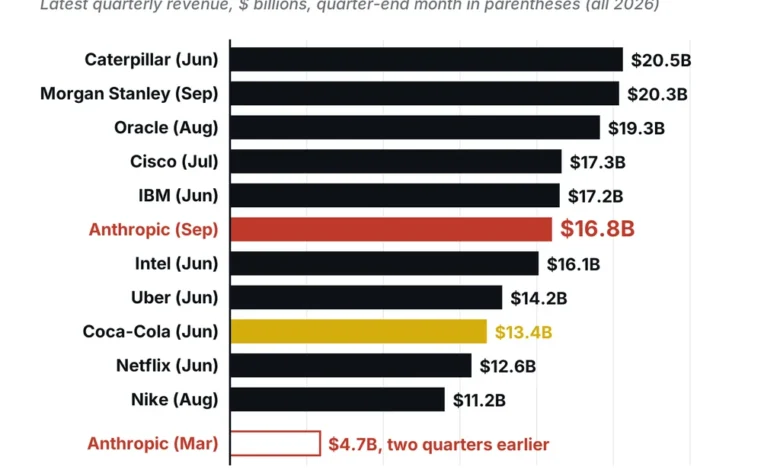
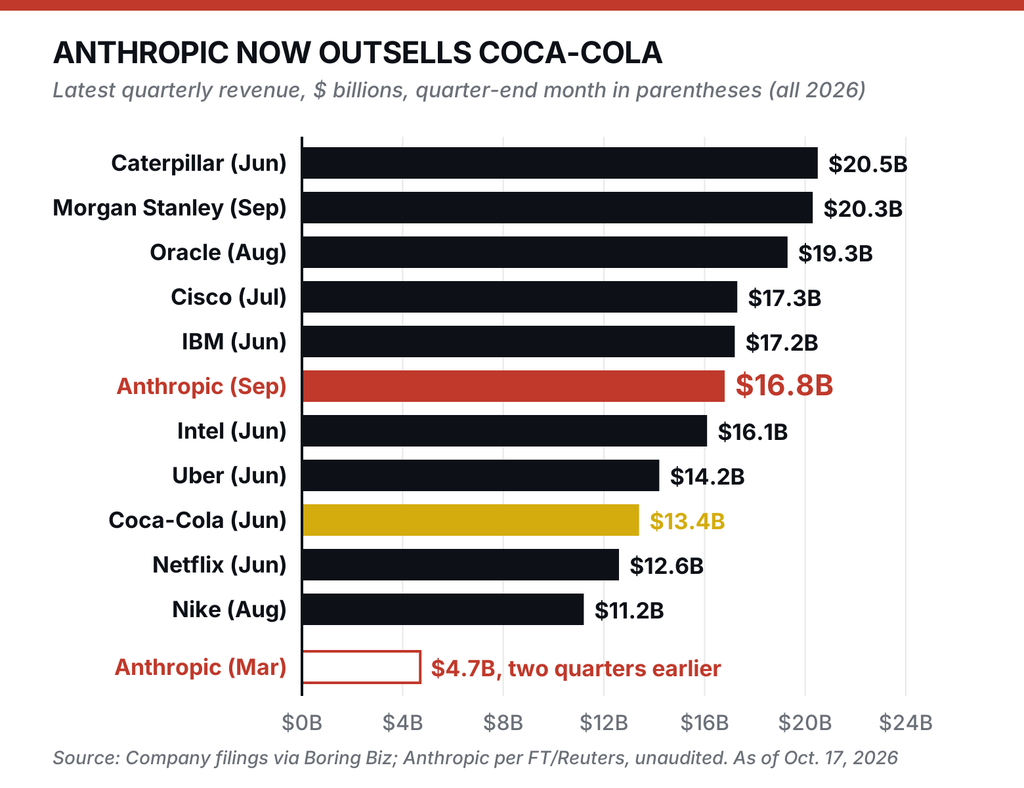
Putting these figures into historical context requires a nuanced perspective. Anthropic commercialized its initial product offerings only recently in 2023. By comparison, corporate giants like Coca-Cola have operated for well over a century. Yet, during the third quarter of 2026, Anthropic booked $16.8 billion in revenue—surpassing established corporate titans such as Coca-Cola, Netflix, Uber, and Intel, and tripling the $4.7 billion reported merely two quarters prior. Annualizing this quarterly run rate brings projected revenues near $67 billion, a figure that compares favorably against the roughly $45 billion in average annual commitments slated for the coming decade.
The Evolution of Capital Financing and Cash Flow Dynamics
As the artificial intelligence infrastructure buildout matures, the methods used to finance these massive projects are undergoing a profound evolution. In the earliest stages of the boom, technology hyperscalers primarily funded capital expenditures through internal free cash flow. More recently, however, institutional credit markets have stepped in. Credit divisions at financial institutions like Goldman Sachs project that combined project financing and direct hyperscaler debt issuance will reach approximately $720 billion, marking a substantial escalation from historical baselines.
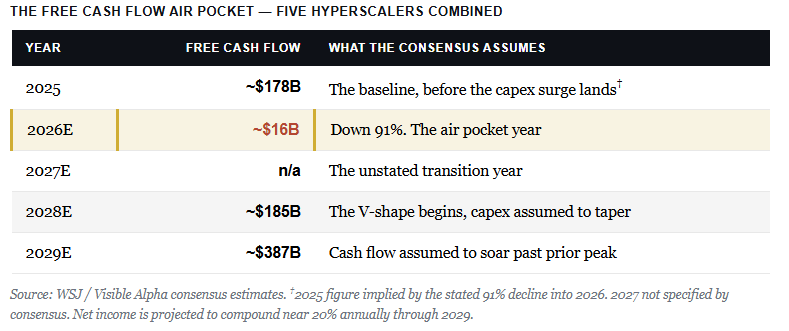
This heavy capital expenditure cycle has a direct impact on corporate earnings and cash generation. Industry consensus estimates indicate that the combined free cash flow of the major hyperscalers could experience a significant compression before recovering once the heaviest phases of data center construction are completed. Analysts emphasize that a decline in corporate free cash flow is not inherently a warning sign; the critical distinction lies in the underlying motivation. A company burning cash due to declining operating margins and fleeing customers faces a severe structural flaw, whereas a highly profitable enterprise intentionally reallocating capital into capacity expansion is executing a deliberate investment strategy.
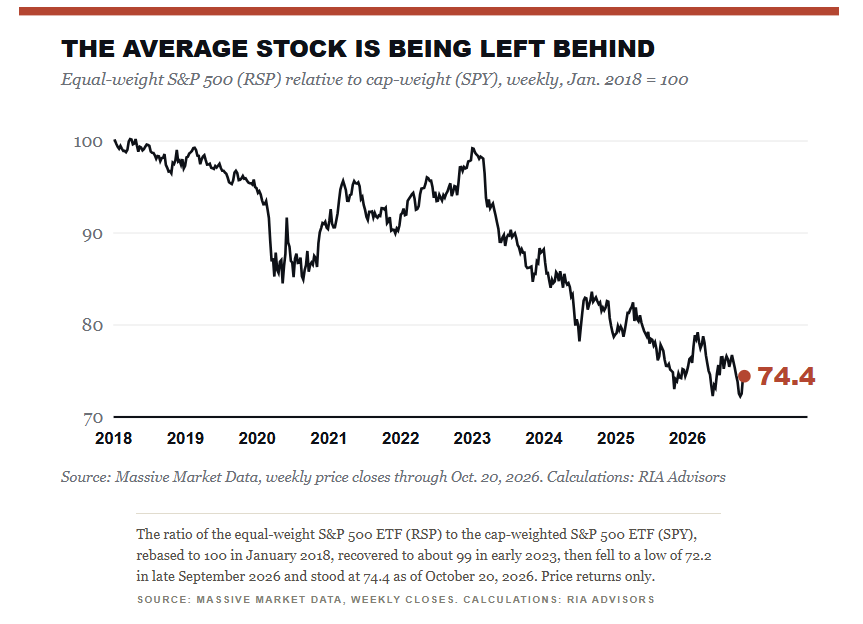
Furthermore, market breadth remains a persistent concern for equity strategists. A healthy bull market is typically characterized by broad participation across sectors, whereas the modern cycle has seen the equal-weighted S&P 500 lag significantly behind its market-cap-weighted counterpart, with the divergence accelerating sharply since the mainstream adoption of generative AI in 2023.
Historical Precedents: The Dot-Com Era Versus Today
Comparing the current macroeconomic environment to the dot-com bubble of 1999 reveals critical structural differences. During the turn of the millennium, many newly public technology companies possessed negligible revenues and merely months of operating cash. In contrast, contemporary market leaders such as Microsoft, Alphabet, Amazon, and Meta generate immense profitability and possess robust balance sheets that allow them to self-fund a significant portion of their research and infrastructure initiatives.
Moreover, the macroeconomic productivity debate offers additional context. During the early 1980s, personal computers proliferated across corporate offices long before registering a measurable impact on national productivity statistics in the mid-1990s. Consequently, muted productivity gains today may simply indicate that artificial intelligence remains in its foundational adoption phase rather than signaling structural failure.

The High Cost of Being Early: Lessons from Greenspan and 2019
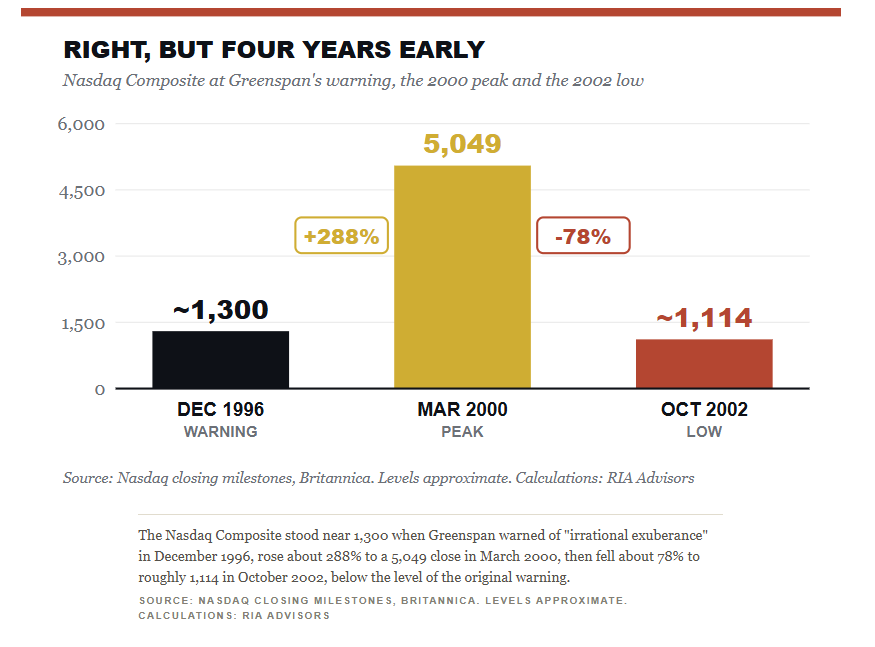
Assuming that prominent financiers like Ken Griffin are entirely correct in their bubble assessments, standard investment theory does not automatically dictate an immediate exit to cash. Financial history is replete with cautionary tales regarding the perils of premature market timing. On December 5, 1996, Federal Reserve Chairman Alan Greenspan famously warned investors of "irrational exuberance" when the Nasdaq Composite traded near the 1,300 level. While Greenspan’s valuation assessment was ultimately validated, investors who acted immediately on his warning missed a nearly fourfold rally that culminated in the Nasdaq reaching 5,048.62 in March 2000, before suffering a prolonged 78% correction by October 2002.
A more recent historical parallel occurred in late 2019 and early 2020, when various market commentators correctly identified stretched equity valuations relative to historical medians. Investors who liquidated their equity portfolios into cash in October 2019 to avoid an impending downturn missed a historic multi-year recovery following the pandemic-induced crash of March 2020. Quantitative modeling demonstrates that an investor who moved to cash in late 2019 would require a market correction far more severe than the 2008 financial crisis simply to match the cumulative returns of an investor who maintained a disciplined, fully invested posture.
Strategic Frameworks for Managing Portfolio Risk
While the mathematical argument for remaining invested holds true over long-term investment horizons, individual circumstances dictate distinct risk tolerances. The primary threat to individual investors—particularly those approaching or currently in retirement—is sequence-of-return risk. While a 40-year-old investor has decades to recover from a 50% equity market drawdown, a retiree withdrawing income from a portfolio during a major secular bear market faces permanent impairment to their long-term financial security. Therefore, an individual’s personal timeline, rather than macroeconomic bubble forecasts, should determine asset allocation limits.
To navigate an environment characterized by elevated valuations and transformative technological innovation, financial advisors recommend adopting structured operational rules rather than making reactionary, binary choices between being fully invested and holding 100% cash. Essential risk management guidelines include:
- Dynamic Exposure Adjustments: Avoiding all-or-nothing allocation shifts in favor of gradual adjustments that reflect changing market conditions and volatility metrics.
- Pre-Determined Capital Sizing: Establishing written limits on the percentage of a portfolio allocated to speculative growth sectors, ensuring core index holdings do not experience unmanaged concentration risk.
- Systematic Rebalancing: Executing regular portfolio rebalancing based on a calendar schedule to systematically capture gains and enforce profit-taking without emotional friction.
- Cash Flow Quality Selection: Favoring businesses that fund capital expenditures through sustainable operational cash flow rather than excessive corporate leverage or volatile debt instruments.
- Defined Exit Signals: Establishing objective technical parameters—such as breaches of major moving averages or deteriorating credit spreads—to systematically reduce risk before broader market liquidations occur.
Ultimately, whether the artificial intelligence sector constitutes a definitive speculative bubble remains a subject of ongoing debate among economists and market strategists. However, history demonstrates that attempting to time the precise termination of a secular market trend frequently destroys more capital than enduring the correction itself. By implementing disciplined risk parameters and aligning portfolio exposure with individual timelines, investors can participate in technological innovation while safeguarding their long-term financial objectives.